
The fundamentals of Artificial Intelligence
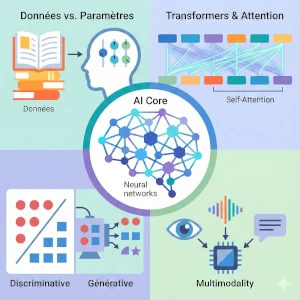
Far from marketing hype, these Web guide unveil the inner workings of the tools transforming modern business. This guide provides precise technical definitions of the core concepts of artificial intelligence.
To navigate the AI revolution with authority, marketing professionals, software architects, and decision-makers must move beyond superficial buzzwords and master the underlying theoretical foundations.
From classical Machine Learning algorithms to Deep Neural Networks and modern Transformer architectures, every breakthrough rests on rigorous mathematical and computational principles. What truly separates training data from learned parameters? Why do generative LLMs hallucinate?
 Author: Thierry P. Gaillard -
Artificial Intelligence: definitions, history, and scope
Artificial intelligence is a scientific discipline at the intersection of computer science, mathematics (statistics, linear algebra), and cognitive science. It involves designing systems capable of modeling and simulating cognitive functions traditionally associated with human intelligence, such as perception, reasoning, learning, and decision-making.
AI should not be viewed as a monolithic technology, but rather as a set of nested sub-disciplines:
- Machine Learning is a subset of AI.
- Deep Learning is a subset of Machine Learning.
- Generative AI is a specialized application of Deep Learning.
Machine Learning (automated statistical learning)
Machine Learning (ML) forms the core of modern artificial intelligence (AI). Unlike traditional programming, where rules are explicitly hard-coded ("if x then y"), a machine learning system builds its own mathematical model directly from data.
The fundamental principle is optimization: the system seeks to minimize a "loss function" (cost function) that measures the gap between its prediction and the expected ground-truth outcome.
Two primary paradigms are distinguished:
- Supervised learning, where the model learns from labeled data (input-output pairs); it seeks to generalize a decision rule in order to predict the label of unseen data.
- Unsupervised learning, where the model learns from raw, unlabeled data; it seeks to discover hidden structures, patterns, or natural groupings (clustering) within the dataset.

Deep Learning (multi-layered deep neural networks)
Deep Learning is a branch of machine learning that relies on artificial neural networks composed of many layers (hence the term "deep").
These networks are universal function approximators. They consist of interconnected nodes (or artificial neurons) that process information through non-linear matrix operations.
Fundamental distinction between data and parameters
To grasp the internal mechanics of deep learning, it is imperative to distinguish the resource from the mechanism:
- Data (the corpus) corresponds to raw information external to the model (books, images, articles). It serves as educational material. Once training is complete, raw data is no longer stored inside the model.
- Parameters (the "brain") are the internal variables of the model (weights and biases). During training, the algorithm progressively adjusts the values of these billions of parameters to minimize prediction error.
Analogy: parameters are the crystallization of statistical understanding extracted from data, much like a student who retains the core concepts of a textbook without memorizing every page word-for-word.
Generative Artificial Intelligence & Transformer architectures
Generative AI is a subset of deep learning. It uses deep neural networks and can process both labeled and unlabeled data using supervised, unsupervised, and semi-supervised methods.
Generative AI is a class of artificial intelligence that creates new content learned from existing data distributions.
The process of learning from existing content is called "training" and results in the creation of a statistical model.
When given a prompt, generative AI uses this statistical modelMathematical equations encoding patterns extracted from training data. to predict the most probable output and generate novel content that resembles the training distribution without copying it verbatim.
To understand its uniqueness, we must compare it with the traditional (discriminative) approach.
Distinction between discriminative and Generative AI
The difference lies in the nature of the probability distribution the model seeks to learn.
Discriminative AI (traditional approach)
Discriminative models (classification, regression) focus on the decision boundary. They do not attempt to understand how data is generated, only how to separate classes.
- Mathematically, they learn the conditional probability P(Y|X): what is the probability that the label is Y given input X?
- Use cases: spam detection, facial recognition, sales forecasting.
Generative AI (creative approach)
Generative models aim to model the underlying structure of the data itself.
- Mathematically: they learn the joint probability P(X, Y) or the distribution P(X).
- Mechanism: this enables them to model how features are distributed and, through statistical sampling, generate entirely new instances.
The Transformer architecture & self-attention
Introduced in 2017 by Google Brain researchers in the seminal paper "Attention Is All You Need" (Vaswani et al.), the Transformer architecture sparked the technological breakthrough behind modern LLMs (Large Language Models) such as BERT, GPT, Gemini, and Claude.
The Transformer is a deep neural network architecture designed to handle sequential data (text, code, DNA), breaking free from the bottlenecks of earlier architectures through parallel processing rather than sequential processing.
Breaking away from recurrent networks (RNNs and LSTMs)
Before 2017, the standard for natural language processing was Recurrent Neural Networks (RNNs), which read data sequentially, word by word, from left to right.
- This sequential bottleneck meant that to process word n, the RNN had to finish computing word n-1. This prevented parallel computation across GPUs, making training slow and difficult to scale.
- The memory bottleneck: over long sequences (such as a full paragraph), the network tended to "forget" the beginning of the sentence by the time it reached the end (the vanishing gradient problem).
The Transformer solves both issues by processing the entire input sequence simultaneously rather than sequentially. It can analyze a sentence, paragraph, or entire document in a single pass, enabling massive parallel training on GPU clusters.
The self-attention mechanism
At the core of the Transformer lies the self-attention mechanism—an algorithm that allows the model to weigh the importance of every word in a sequence relative to all other words in order to build an accurate contextual representation.
Unlike older static embedding methods like Word2Vec, where a word with multiple meanings had a single fixed vector representation, the Transformer dynamically recalculates a word's meaning based on its surrounding context.
Educational illustration:
Consider the sentence: "The animal did not cross the street because it was too tired." To a computer, the pronoun "it" is ambiguous. To resolve this ambiguity, the attention mechanism computes a relevance score (attention weight) between "it" and every other word in the sentence. Mathematically, the model assigns a high attention weight between "it" and "animal", and a low weight between "it" and "street". The vector representing "it" thus absorbs the contextual features of "animal". Conversely, if the sentence were "The animal did not cross the street because it was too wide," attention would focus on "street".
From unsupervised to self-supervised learning
Transformers require colossal volumes of training data. Manually labeling petabytes of text—marking every subject, verb, or entity—is humanly impossible. Instead, they rely on Self-Supervised Learning.
The model generates its own supervisory signals directly from raw text:
- Masked Language Modeling: words are randomly masked in a sentence (e.g., "The cat chases the [MASK]") and the model must predict the missing token using bidirectional context.
- Next-Token Prediction (Causal Language Modeling): the model learns to predict the next token in a sequence, as used by GPT (Generative Pre-trained Transformer) models.
It is this ability to learn autonomously across the entire web, combined with the parallel architecture of Transformers, that gave rise to the apparent "intelligence" of today's foundation models.
Core differences between training data and weights
To understand the internal mechanics of Transformers, it is essential to distinguish external training resources ("data") from the internal processing and storage mechanism ("parameters").
"Data" refers to the training corpus—raw information external to the model that the algorithm analyzes during training:
- It consists of billions of sentences, books, software repositories, and web articles.
- It serves as instructional material: during self-supervised pre-training, the model "reads" this data to extract statistical regularities.
- Once training is complete, the raw data is not stored inside the model. It was used to calibrate the network and is then discarded. The model does not "contain" texts like a relational database; it retains their statistical representation.
"Parameters" form the brain of the model—the internal variables of the artificial neural network that define how the model processes information:
- They consist of numerical values (weights W and biases b) organized into massive multidimensional matrices. These billions of parameters are adjustable variables within the network.
- Each parameter is comparable to a microscopic tuning dial or an artificial synapse.
- Initially, parameters are set to random values (the model knows nothing). During training, the optimization algorithm progressively adjusts each parameter to minimize prediction error across the training corpus.
- The frozen set of trained parameters constitutes the final "model" (such as GPT-4 or Claude). They are the mathematical crystallization of what the AI has learned.
Why do Large Language Models (LLMs) hallucinate?
In the context of language models, a hallucination refers to the generation of content that appears coherent, syntactically fluent, and confidently stated, yet is factually inaccurate, ungrounded in the training corpus, or logically contradictory to the provided prompt.
Unlike classic software bugs, hallucination is not a technical malfunction, but an intrinsic consequence of the probabilistic nature of LLMs.
Distinction between syntax and semantics
It is essential to correct a common misconception: modern hallucinations are almost never grammatical errors.
- Thanks to the Transformer architecture, models master grammatical and stylistic rules effortlessly. The generated sentence is structurally flawless.
- Semantic drift: the error occurs at the level of factual meaning. The model fills "gaps" in its probability distribution with the most statistically plausible sequence of words, even if the resulting statement is factually false.
Simply put, an LLM is optimized for plausibility (what sounds like a convincing human answer) rather than veracity (what is objectively true).
Technical causes of hallucinations
- Lossy compression: an LLM does not store facts like a database; it stores statistical associations across its weights. During training, it compresses a vast amount of web text into a finite number of parameters, causing a loss of precision on rare or specific facts.
- Next-token prediction objective: the model has no internal concept of "truth" or the "real world". Its sole mathematical objective is to predict the most probable next token. If a factually incorrect token has a high probability in context, the model will select it.
- Training data noise: if the training corpus contains contradictions, outdated claims, or falsehoods (as the open internet inevitably does), the model will reproduce those inconsistencies.
Typology of hallucinations
In technical analysis, two primary categories of hallucinations are distinguished:
- Intrinsic hallucinations, which directly contradict the source context provided in the prompt (for example, given meeting notes stating a meeting took place on Monday, the summary claims it occurred on Tuesday).
- Extrinsic hallucinations, where the model fabricates external facts unverifiable from the context (for example, inventing non-existent legal case law or attributing a quote to the wrong author).
Mitigating hallucinations
While hallucinations cannot be completely eliminated from a probabilistic engine, proven engineering techniques keep them under tight control:
- RAG (Retrieval-Augmented Generation): the generative model is connected to a trusted external knowledge base and instructed to formulate its answer strictly from retrieved documents, drastically reducing fabrication (grounding).
- RLHF (Reinforcement Learning from Human Feedback): during post-training alignment, human evaluators penalize fabricated answers, training the model to state "I don't know" rather than invent facts when uncertain.
Steering the system: Prompt Engineering
Prompt engineering is the art and science of designing and optimizing text inputs (prompts) to effectively guide a Large Language Model (LLM) toward a specific output without modifying its internal weights.
Unlike traditional deterministic programming, prompting constrains the model's probability distribution to steer generation. This is known as "in-context learning": the model learns temporarily from the information supplied inside its attention window, and that temporary state vanishes as soon as the session ends. The model's underlying weights remain frozen.
Here are the foundational techniques every business leader should know:
- Zero-shot prompting: asking the model to perform a task without providing any prior examples (e.g., "Translate this text into English").
- Few-shot prompting: providing the model with a few "input-output" examples inside the prompt to demonstrate the expected format or logic before asking the actual question. This dramatically improves output reliability.
- Chain-of-Thought (CoT): instructing the model to break down its reasoning step by step ("Think step by step") before delivering the final answer. This enables the model to solve complex mathematical or logical problems while reducing hallucinations.
Fine-tuning: domain adaptation and alignment
Fine-Tuning is a supervised learning process performed after a model's initial pre-training. It is a transfer learning technique.
Unlike Prompt Engineering, Fine-Tuning permanently updates the internal parameters (weights) of the neural network.
The process involves taking a general-purpose pre-trained foundation model (such as Gemini or Llama) that has absorbed broad web knowledge, and training it further on a smaller, highly curated, domain-specific dataset.
Why use fine-tuning?
There are three primary reasons to fine-tune a model:
- Domain specialization: adapting a model to medical, legal, or proprietary enterprise terminology and codebases.
- Style and format alignment: training the model to consistently respond in a strict tone, schema, or structure (e.g., structured JSON, brand voice, or standardized compliance reports).
- Cost and latency reduction: a smaller, well-fine-tuned model can often match or exceed the performance of a giant general-purpose model on a specific task at a fraction of the inference cost and latency.
Note on PEFT (Parameter-Efficient Fine-Tuning): today, retraining all billions of parameters in a model is rarely necessary. Techniques like LoRA (Low-Rank Adaptation) modify only a tiny fraction of parameters (often less than 1%) to achieve comparable domain adaptation at minimal compute cost.
Multimodal Artificial Intelligence
Modern AI is converging toward multimodality—the ability to simultaneously process and relate different signal types (text, images, audio, video) within a unified mathematical representation (latent space).
Unlike unimodal models built for a single task (such as a text-only translation model), a multimodal system can process, understand, and generate information across multiple signal types or modalities simultaneously: text, images, audio, video, code, and sensor data.
Core modalities
- Text-to-Text: reasoning, translation, summarization.
- Text-to-Image / Image-to-Text: visual synthesis or image understanding via diffusion networks and visual encoders.
- Natively multimodal: models (such as GPT-4o or Gemini) trained from the ground up on interleaved media, capable of "seeing" and "hearing" directly without separate transcription pipelines.
AI agents (text-to-action)
The next frontier is the AI agent: rather than merely generating a text response, it can invoke external tools (web browsing, code execution, API calls, CRM updates) to autonomously execute multi-step workflows.

About the author:
Thierry P. Gaillard - End-to-end digital project management
After working at American Express for 15 years—including six years as an IT project manager and eight years as a profit center director managing around a hundred people—Thierry P. Gaillard became a web entrepreneur, digital marketing manager, and e-commerce specialist.
His areas of expertise include web performance, branding, business negotiation, and management.