
AI & marketing: six concrete use cases to move from fear to action

Artificial intelligence is no longer a theoretical concept—it is a concrete performance driver.
Facing the relentless rise of Artificial Intelligence, business leaders often oscillate between irrational technophobia and reckless hype. Yet, real competitive advantage belongs to pragmatists who apply AI to concrete business friction.
Technology alone never drives transformation—organizational mindset, operational discipline, and clear customer orientation do. How can commercial enterprises harness AI right now to elevate client satisfaction, multiply productivity, and fortify margins?
 Author: Thierry P. Gaillard -
Why your mindset matters far more than technology to adopt AI
Feeling overwhelmed by AI? Convinced your competitors have already figured it all out? Let me reassure you—that is an illusion. A recent Google study conducted among marketing leaders across Europe reveals a very different reality: fewer than one in five professionals have reached an advanced stage of adoption.
The study analyzed 2,500 pages of internal communications, such as emails and executive presentations. The objective was to understand how AI was actually being adopted behind closed doors, far from public PR statements. The conclusion is unmistakable: access to technology is not the primary bottleneck. Mindset is what drives adoption.
I have summarized the three marketing leader profiles identified in the study.
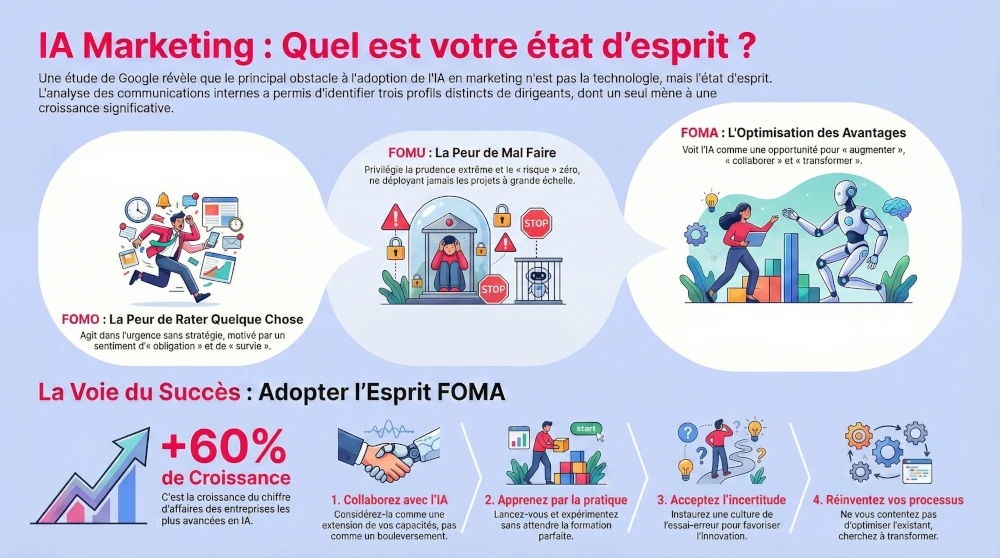
The first profile has a "fear of missing out" (FOMO)
They act out of urgency, without a clear strategy. Their vocabulary is one of obligation: "must", "survival", "imperative". They chase every new innovation without knowing where they are heading.
The second profile has a "fear of messing up" (FOMU)
Risk and loss aversion hold them back. Their vocabulary revolves around "risk", "vigilance", and "security". These professionals prioritize extreme caution: they launch isolated pilot projects but never scale them across the organization.
The third profile "focuses on maximizing advantage" (FOMA)
These leaders do not talk about fear. They view AI as an opportunity to create value and build a competitive edge. They take calculated, strategic risks. Their vocabulary centers on "augment", "collaborate", and "transform".
How do these "FOMA" leaders operate? They treat AI as a strategic partner rather than a disruption. They learn through hands-on practice and experimentation without waiting for perfect training. They embrace uncertainty and take calculated risks to innovate.
The results speak for themselves: companies most advanced in artificial intelligence (AI) report revenue growth 60% higher than their peers.
As a digital project manager, I guide SMBs and mid-market companies through this transition. My goal is to help you cultivate this "FOMA" mindset.
Here is the 5-step method drawn from the study:
- Collaborate with AI: treat it as an extension of your team's capabilities.
- Learn by doing: hands-on experimentation is essential.
- Embrace uncertainty: a test-and-learn culture is required.
- Add strategic value: integrate AI proactively into your planning.
- Reinvent your processes: do not settle for merely optimizing existing workflows.
Understanding these mindsets is the first step toward unlocking the true potential of AI.
How retail uses AI to boost customer experience, productivity, and security
As time goes on, generative AI is no longer a futuristic concept for retail—it is a practical tool delivering tangible results.
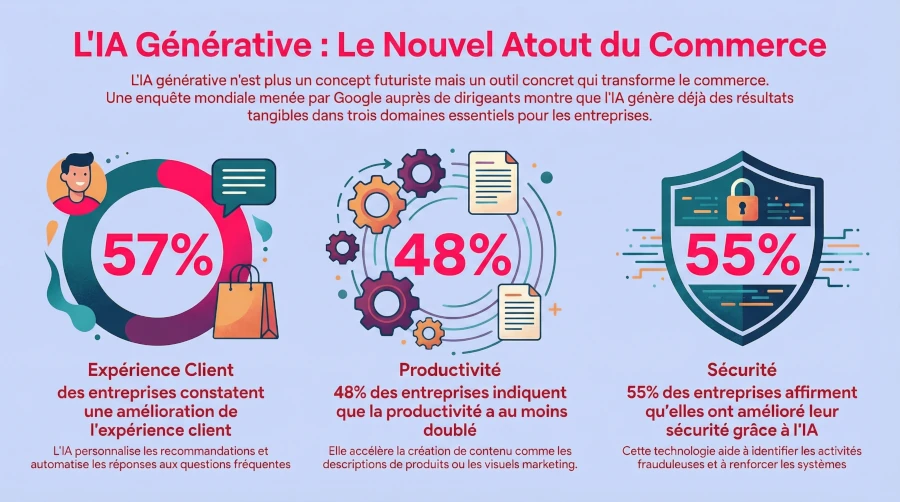
A global surveyconducted by Google among 376 retail executives confirms this: AI is already transforming three core areas of commerce—customer experience, workforce productivity, and cybersecurity.
How? First, by optimizing every customer touchpoint. Nearly three in five companies have seen measurable improvements in this area. Generative AI automates call transcription and summarization, enabling faster, more accurate responses to frequent prospect and visitor inquiries.
Some retailers go even further, such as personal stylists who use generative AI to craft hyper-personalized visual recommendations tailored to each channel.
Second: workforce productivity, a critical priority for entrepreneurs and managers. Nearly half of surveyed companies saw their productivity double. Marketing is the biggest winner: 59% of businesses use generative AI for sales and marketing because it elevates both creativity and efficiency—generating high-converting product descriptions and campaign visuals at scale.
These organizations slash content production lead times by accelerating the journey from concept to execution, making them far more agile during peak events like Black Friday or seasonal sales.
Third: security. The retail sector faces increasingly sophisticated cyber threats. More than half of surveyed executives report that AI has strengthened their defenses, helping detect fraudulent activities and harden merchant security systems.
These three pillars prove that generative AI is here to stay: it elevates customer experience, multiplies productivity, and fuels sustainable growth.
As a digital project manager who uses generative AI daily, I strongly encourage you to pinpoint a specific operational bottleneck you want to solve and apply generative AI to resolve it.
My goal is to help you capture the full potential of this technology for your SMB or mid-market enterprise. Understanding these practical applications is the first step to staying ahead of the curve.

Agentic AI: autonomous holiday shopping agents take the wheel
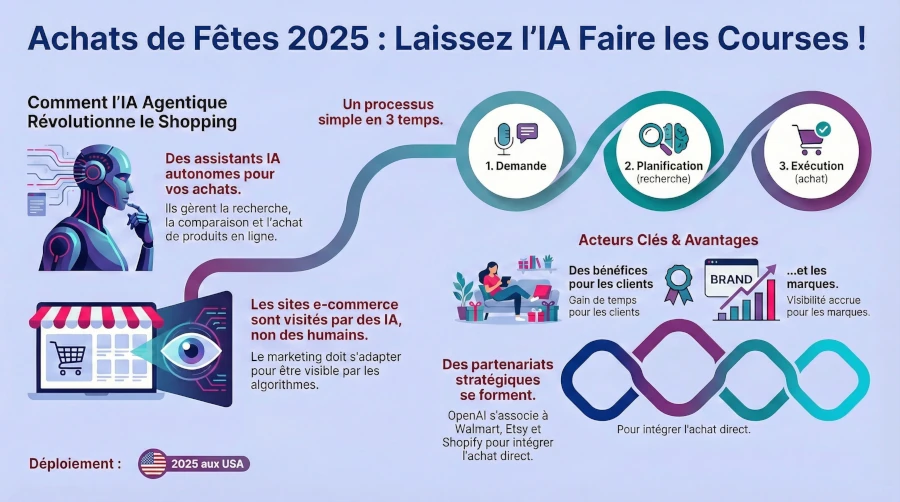
In the United States, 2025 marks the rise of autonomous AI agents managing product research, recommendations, and holiday purchases.
Embedded directly within artificial intelligence platforms such as ChatGPT and Perplexity, these agents can execute online purchases autonomously on behalf of consumers.
Walmart, Etsy, and Shopify have signed partnerships with OpenAI to integrate an instant "Buy" button inside ChatGPT, enabling seamless checkout through linked accounts. Meanwhile, Perplexity is deploying shopping agents to compare products and complete transactions across e-commerce stores, and Google is testing AI-powered shopping modes for deep product comparisons.
Agentic AI interprets the user's request (e.g., finding the best price for a PlayStation 5), plans the workflow (scanning inventory, evaluating options and pricing), and executes the purchase once the user approves. E-commerce websites are therefore increasingly visited by AI agents rather than human browsers.
Brands gain major marketing advantages: heightened visibility in conversational search, frictionless customer journeys that lift conversion rates, and direct monetization through integrations with AI providers.
For consumers, the benefits are time savings and reliable web-wide price and stock comparisons.
Marketing thus becomes proactive and deeply embedded in AI ecosystems—capturing high-intent queries like "best gifts under $50" and securing a decisive visibility advantage.
While marketers face technical and privacy challenges, the core opportunity lies in turning conversational product discovery into direct sales during seasonal peaks like Christmas.
In Europe, even if adoption lags slightly behind the US, 2026 will undoubtedly mark the moment e-commerce merchants embrace agentic AI by forging direct integrations with leading AI platforms.
Workflow automation: how Google Gemini enterprise drives real productivity
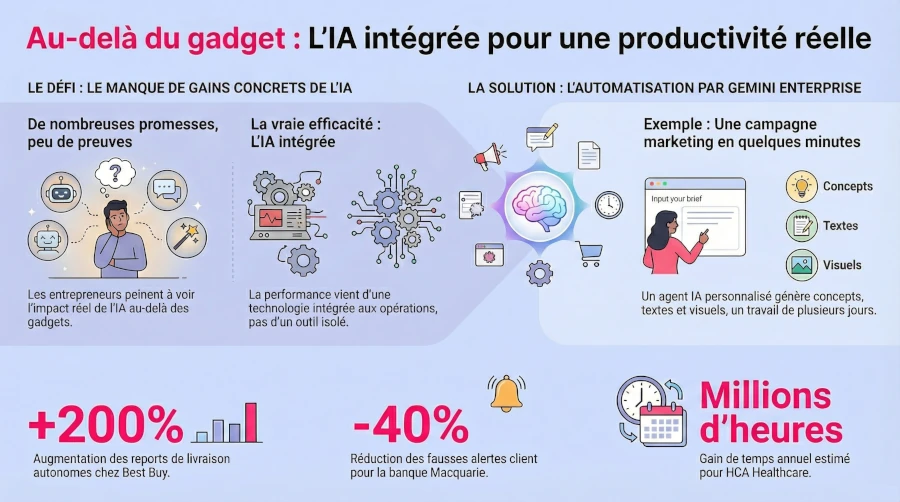
I see many entrepreneurs still searching for real-world productivity gains from AI. Promises abound, but concrete proof is often scarce. True efficiency never comes from a standalone gadget—it comes from technology deeply integrated into core operations. That gap has now been bridged.
Google positions Gemini Enterprise not as a simple chat tool, but as a performance engine. The platform plugs directly into enterprise workflows to deliver measurable business outcomes, and real-world use cases already demonstrate its impact.
The true breakthrough lies in automating end-to-end workflows. Take a concrete marketing example: a marketing manager wants to launch a new product campaign and asks a custom AI agent to generate creative concepts. Zero lines of code are required to build this agent.
The agent securely accesses internal company data, understands product specifications, and retrieves brand-approved logos and visual assets. Within moments, it produces complete campaign concepts—including social media copy and visual mockups. Work that previously took several days is completed in minutes.
Similar productivity gains are emerging across industries. Healthcare leader HCA Healthcare estimates savings of millions of hours annually. Best Buy increased self-service delivery rescheduling by 200%. Macquarie Bank reduced false customer-protection alerts by 40%.
Google applies this exact logic to its own engineering teams: nearly half of all new code is now generated by AI, allowing engineers to review, validate, and ship faster.
These examples illustrate a new paradigm: productivity does not come from an isolated chatbot, but from AI embedded in business processes. The question for you is simple: which core workflows in your company are ready to be transformed?
Social media strategy: why authentic user-generated content (UGC) beats AI content
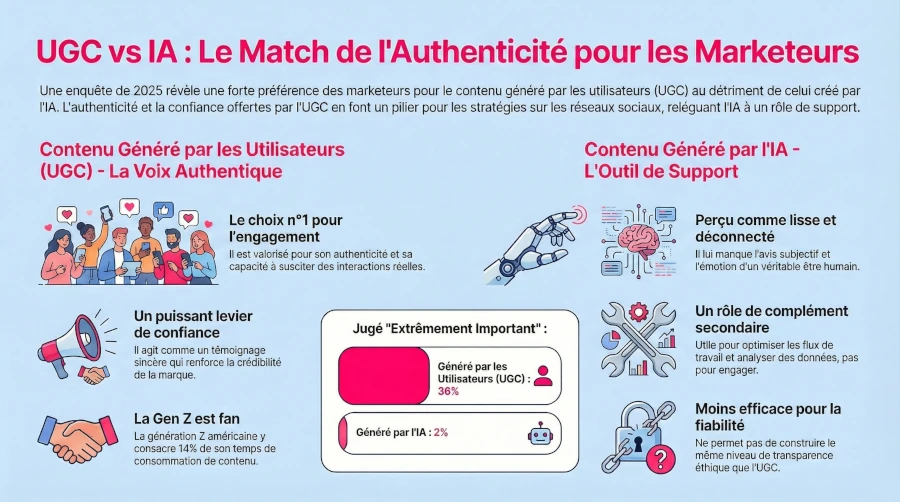
According to an August 2025 PhotoShelter survey of 397 global marketers, 36% consider User-Generated Content (UGC) to be "extremely important" for their social media strategy, compared to just 2% for AI-generated content.
Posts, videos, comments, and reviews created by real consumers are prized for their authenticity and their power to spark genuine engagement. They represent "real human voices" that resonate far more deeply with audiences than AI-generated content, which is often perceived as overly polished and emotionally disconnected.
User-created content acts as candid social proof that builds trust—even when critiques are mixed—whereas generative AI (such as automated image or copy generators) remains a secondary operational aid lacking human subjectivity and lived experience.
Today, 25.9% of US marketing leaders already leverage user-generated content in their social media and connected TV (CTV) advertising. Considering that US Gen Z consumers spend 14% of their media time engaging with user-generated content (Deloitte, October 2024), the return on investment is undeniable.
For brand marketers, the takeaway is clear: prioritize programs that encourage customers to create and share authentic content rather than flooding social feeds with synthetic AI posts.
AI is invaluable for back-office content management (workflows, analytics, editing), but it is no substitute for human connection when engaging social media communities.
Authenticity and lived human perspective drive more trustworthy, higher-converting campaigns—especially in an era where ethical transparency matters more than ever.
The Publicis method: +5.5% organic growth powered by AI
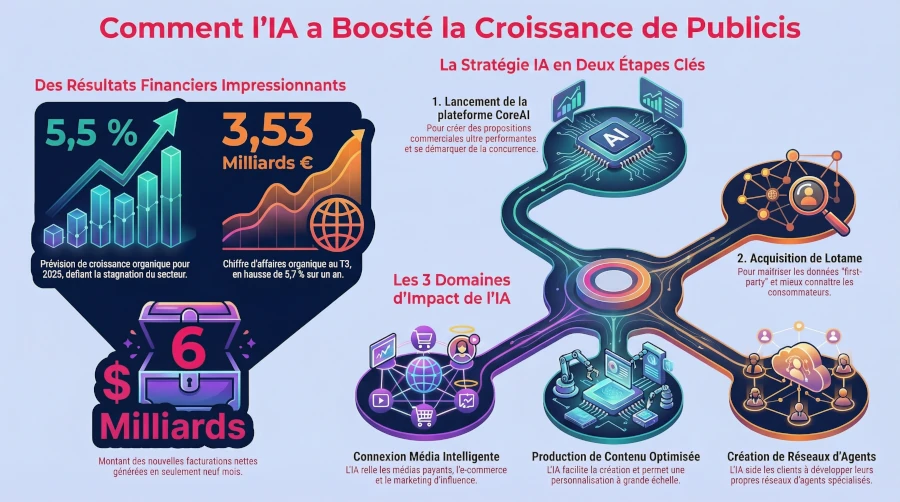
Winning major enterprise accounts without even pitching a traditional slide deck is possible—and Publicis proved it. Their secret? A marketing strategy built around artificial intelligence.
For months, the global advertising market has faced macroeconomic headwinds. Yet Publicis continues to outperform the market. Contrary to industry expectations, their clients did not cut ad spend in Q3, and the group recorded significant production growth.
Their financial results speak volumes: organic revenue grew 5.7% year-over-year to reach €3.53 billion. Better still, the group raised its full-year 2025 organic growth guidance to between 5% and 5.5%—a remarkable feat while competitors stagnate or contract.
One of the primary engines behind this momentum is the appeal of AI-powered commercial offerings. AI now powers 80% of connected media operations, which in turn account for 60% of net revenue over the period.
Publicis executed its strategy in two major steps:
- Launching its CoreAI platform in early 2024, enabling the group to differentiate itself from competitors by building high-converting commercial proposals capable of winning major enterprise contracts throughout the year.
- Acquiring Lotame in 2025, a leading independent global data solutions provider. This acquisition empowers Publicis to prioritize first-party data, delivering razor-sharp insights into target consumer behaviors.
Their AI architecture drives impact across three core pillars:
- It connects paid media directly with e-commerce and influencer marketing.
- It streamlines production and enables hyper-personalization at scale.
- It empowers clients to deploy interconnected networks of AI agents.
This integrated approach is winning over global advertisers—and for SMBs and mid-market companies, it charts a clear path forward. AI enables differentiated offers that drive measurable revenue growth. In just nine months, Publicis generated $6 billion in net new billings. Inspiring, isn't it?

About the author:
Thierry P. Gaillard - End-to-end digital project management
After working at American Express for 15 years—including six years as an IT project manager and eight years as a profit center director managing around a hundred people—Thierry P. Gaillard became a web entrepreneur, digital marketing manager, and e-commerce specialist.
His areas of expertise include web performance, branding, business negotiation, and management.