
Stop anthropomorphizing AI to truly understand it
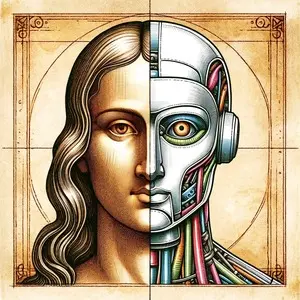
In our digital era, generative AI is everywhere, sparking equal parts wonder and concern. But do we truly understand AI? Or are we falling into the trap of anthropomorphism, attributing human feelings and conscious intent to digital algorithms?
In this article, we dive deep into the inner workings of AI, stripping away myths to analyze its true nature. We unpack the disconnect between fluent language and rational thought in models like ChatGPT, and evaluate the risks of viewing algorithms through a human lens.
This analysis is designed for marketing leaders, digital strategists, and business innovators seeking an objective, grounded understanding of cognitive automation.
Join us on this deep dive where we separate science fact from marketing fiction, giving you the strategic clarity needed to steer the future of AI integration.
 Author: Thierry P. Gaillard -
AI vs humanity: understanding the boundaries
In a rapidly evolving world, the distinction between artificial intelligence and humanity is becoming an increasingly vital topic. Raphaël Millière, assistant professor of philosophy of artificial intelligence at Macquarie University, and Charles Rathkopf, research fellow at the Institute of Neuroscience and Medicine at the Jülich Research Centre in Germany, offer a deep reflection on why we must ask ourselves why it is important to remember that AI isn't human.
The philosophical disruption of language
ChatGPT and other language models are sparking considerable fascination and concern across the scientific community. Their ability to generate language with a flexibility rivaling human speakers disrupts our traditional understanding of the bond between language and the rational mind. This raises an unsettling philosophical question: are we witnessing the severing of that bond, or the emergence of a new kind of mind?
The anthropomorphism trap in modern AI
Interacting with language models like ChatGPT often feels like conversing with another rational being. However, that impression can be deceptive. Cognitive linguistics warns us about the dangers of anthropomorphism, especially when inferring intentions behind words. In a world where every speaker has genuine intentions, our cognitive mechanism for deducing those intentions is invaluable. But in a world populated by statistical language models, it can lead us astray.

Dangers of anthropomorphism and anthropocentrism in AI
Anthropomorphism presents real enterprise hazards: unwarranted overreliance on unverified outputs, emotional vulnerability in end-users, and legal liabilities when automated recommendations breach compliance.
Simultaneously, anthropocentrism—the flawed belief that human intelligence is the only template for cognitive processing—blinds us to novel, non-biological forms of algorithmic computation that solve problems via orthogonal paradigms.
Grounded science: a hypothesis-driven approach to AI
It is crucial to adopt a science driven by hypotheses to truly understand the internal mechanisms of language models. These models operate within high-dimensional vector spaces that are notoriously difficult to interpret. Although progress has been made in extracting and understanding these internal representations, much remains to be explained.
Strategic conclusions for business leaders
To advance our understanding of language models and AI in general, it is essential to resist the temptation to anthropomorphize them or judge them solely by the yardstick of the human mind. As research in animal cognition demonstrates, an open and curious approach can lead to significant breakthroughs. By accepting that language models do not possess a mind in the human sense of the term, we can approach their study and deployment with a more objective and enlightened perspective.
Further reading & references
- Vox.com – Why it's important to remember that AI isn't human – Article by Raphaël Millière and Charles Rathkopf.
- Medium.com – Is LaMDA Sentient? – Transcripts of dialogues with Blake Lemoine – Published online.

About the author:
Thierry P. Gaillard - End-to-end digital project management
After working at American Express for 15 years—including six years as an IT project manager and eight years as a profit center director leading around a hundred people—Thierry P. Gaillard became a web entrepreneur, digital marketing manager, and e-commerce specialist.
His specialties include web performance, branding, business negotiation, and management.