
Reduce AI bias in your digital marketing
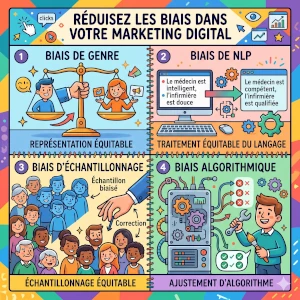
Generative AI and Large Language Models are redefining digital marketing workflows. Yet, beneath their creative fluency lies a persistent threat: algorithmic bias. When trained on skewed, unrepresentative data, AI systems replicate and amplify systemic prejudices.
For marketing decision-makers, uncontrolled bias damages brand equity, skews audience targeting, and alienates loyal customer segments. How can marketing executives identify, audit, and systematically reduce bias in their AI pipelines?
This practical guide details sampling and NLP biases, their business impacts, and actionable data governance frameworks to ensure fair, inclusive, and high-converting marketing campaigns.
Understanding these nuances is crucial for any effective and ethically responsible AI strategy.
 Author: Thierry P. Gaillard -
Overview of Generative AI and NLP biases
Sampling bias in marketing datasets
This bias is commonly found in statistical processing. Sampling bias is an error that occurs when a data sample is not representative of the population from which it was drawn. In other words, certain opinions, characteristics, or groups may be overrepresented or underrepresented in the sample compared to the reality of the population being studied.
To better understand, let's imagine a simple scenario: suppose you want to find out the favorite ice cream flavor in a given city. If you only go to an elementary school to ask the question, you will likely get different results than you would by surveying a more diverse sample that includes people of different ages, socioeconomic backgrounds, and so on. In this example, the sample is biased because it only includes elementary school students and does not represent the diversity of the city's population.
This type of bias can seriously compromise the validity and reliability of a study or survey. That is why it is crucial to choose a sample as neutrally and randomly as possible, to reduce the risk of bias and make the conclusions more generalizable to the population as a whole.
Researchers use various methods to minimize sampling bias, such as simple random sampling, stratified sampling, or cluster sampling, each having its own pros and cons depending on the study's context.
Natural language processing (NLP) bias
Bias in natural language processing (Natural Language Processing or NLP) refers to prejudices that can become embedded in machine learning models used to understand, interpret, or generate natural language text. These biases can stem from various sources, including:
- Gender Bias: Associating leadership and technical roles predominantly with male pronouns, while assigning administrative or caretaking roles to female pronouns.
- Cultural & Racial Bias: Delivering lower sentiment scores or flagging legitimate vernacular speech patterns as toxic or uneducated.
- Recommendation Engine Bias: Pushing stereotypical product categories based on demographic assumptions rather than genuine individual intent.
- Human interpretation: finally, the way model outputs are interpreted and used can also be a source of bias. For example, if a model is used to predict the "risk of recidivism" in a judicial context, but the training data is biased, decisions made on the basis of those predictions could be unfair.
Bias in NLP is a subject of active research and debate because it raises important ethical questions. Researchers and engineers work to identify and mitigate these biases, for example by using data auditing and rebalancing techniques, or by implementing explainability mechanisms to better understand the model's decisions.
It is important to note that even if a model is mathematically neutral, the data on which it was trained may contain existing social biases. Consequently, great caution is necessary when applying these technologies in sensitive fields such as recruitment, justice, or healthcare services.
Here are three examples of NLP bias:
- Gender bias: suppose an NLP model is trained on a large corpus of texts that predominantly use male pronouns for professions like "engineer" and female pronouns for professions like "nurse." The model may then associate these professions with a specific gender and perpetuate this stereotype. For example, if asked to complete the sentence "the engineer said that...", the model might use a masculine pronoun, even though the engineering profession is also practiced by women.
- Ethnic or racial bias: an NLP model used to evaluate text quality or for automated filtering applications may be biased if its training data contains ethnic or racial stereotypes. For example, a text recognition algorithm might misinterpret proper names from non-Western cultures, treating them as errors or anomalies, which could have serious consequences in fields like recruitment or security screening.
- Bias in recommendation systems: recommendation systems that use NLP to analyze user preferences can also exhibit bias. For example, if a news recommendation system is trained on articles coming mainly from sources with a particular political leaning, it may be biased for or against certain perspectives, thereby creating "filter bubbles" that limit exposure to diverse viewpoints.
These examples illustrate why it is crucial to pay close attention to the data used for training and the way NLP models are applied, particularly in contexts that have a significant social or ethical impact. Efforts are underway in the research community to detect and mitigate these types of biases.

Actionable strategies to reduce AI bias
Reducing bias in natural language processing (NLP) is a complex challenge that is the subject of ongoing research. Here are several commonly used techniques to mitigate bias:
- Data Cleansing & Rebalancing: Actively audit training corpora and fine-tuning datasets to eliminate overrepresented cultural tropes and ensure demographic diversity.
- Weighted Sampling: Apply inverse propensity scoring or weighted sampling to ensure minority user cohorts receive equal statistical significance.
- Fairness-Aware Machine Learning: Integrate algorithmic fairness constraints into loss functions (demographic parity, equalized odds).
- Continuous Red Teaming & Auditing: Stress-test prompts with adversarial counterfactuals to expose hidden model assumptions prior to customer deployment.
- Explainability & Attribution Tooling: Utilize SHAP and attention attribution maps to trace why a model generated a specific recommendation.
- Continuous Retraining Loops: Schedule regular model retraining cycles with freshly curated production data to prevent model drift.
- Diverse Human Oversight: Assemble multi-disciplinary review panels (data scientists, brand guardians, ethics experts) to validate high-stakes automation.
- User feedback: collecting and integrating user feedback can also be an effective method for identifying and correcting biases, especially those that were not anticipated during model design or evaluation.
There is no single silver bullet to eliminate bias, but by combining several of these techniques, it is possible to significantly reduce risks. The goal is to build fairer, more transparent, and more accountable NLP systems.
Strategic takeaways for marketing leaders
Algorithmic bias is not a theoretical academic debate; it is an active enterprise risk with immediate implications for brand reputation, customer loyalty, and legal compliance.
Close collaboration between marketing strategists, legal counsel, and data science teams is indispensable to build robust guardrails around autonomous systems.
Organizations that champion transparent, bias-minimized AI will establish decisive competitive advantage through authentic consumer trust and superior campaign relevance.
Sources & further reading
- Statistics Canada - Considerations on biases in bilingual natural language processing.
- Le MagIT - Five examples for understanding biases in an NLP project.
- Datascientest.com - Resampling: A method for balancing data.
- Blogue.som.ca - Data weighting.
- Kamishima.net - Fairness-Aware Machine Learning and Data Mining.
- Kereval.com - Explainability of Artificial Intelligence.
- Towardsdatascience.com - Framework for a successful Continuous Training Strategy.

About the author:
Thierry P. Gaillard - End-to-end digital project management
After working at American Express for 15 years—including six years as an IT project manager and eight years as a profit center director leading around a hundred people—Thierry P. Gaillard became a web entrepreneur, digital marketing manager, and e-commerce specialist.
His specialties include web performance, branding, business negotiation, and management.