
Artificial Intelligence through the eyes of Richard Feynman

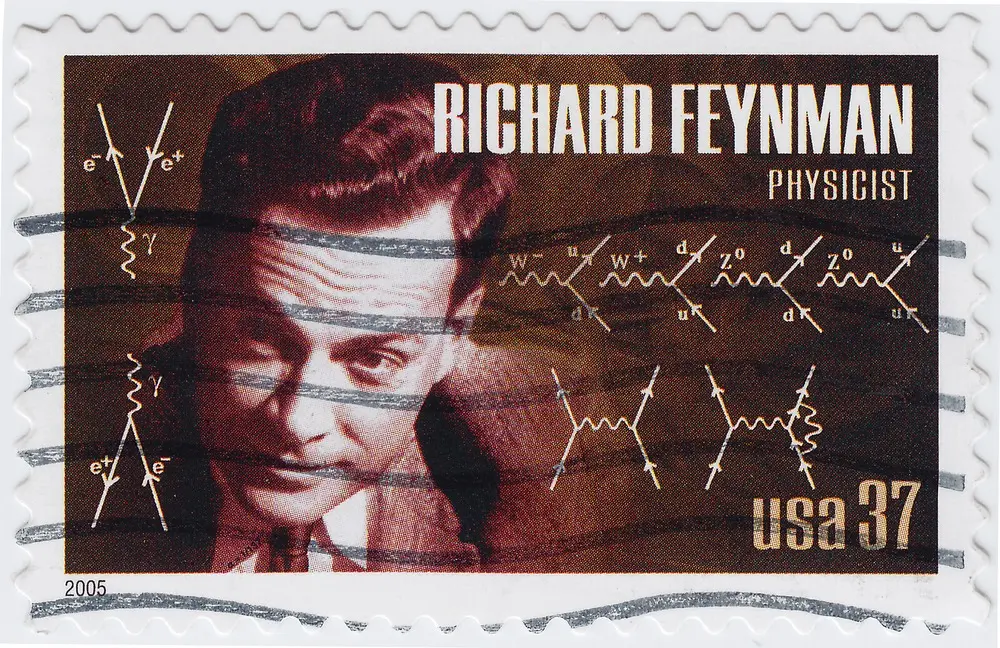
Long before deep learning and transformer models took over public discourse, theoretical physicist and Nobel laureate Richard Feynman delivered a legendary lecture in 1985 on computers, machine intelligence, and the physical limits of computation.
With his trademark intellectual honesty and playful clarity, Feynman asked the fundamental questions: Can a machine truly 'think'? Will computers become more intelligent than humans? Where do biological brains maintain insurmountable advantages over silicon?
Rediscover Feynman's timeless insights and examine how modern Large Language Models both confirm and challenge his extraordinary technological vision.
 Author: Thierry P. Gaillard -
Will a machine ever think exactly like a human being?
Richard Feynman believed that machines would never think like humans because the two are built from fundamentally divergent materials and use different computational methods. This makes any literal mimicry between machines and humans highly improbable.
The human brain is composed of neurons connected to one another by synapses. These connections allow the transmission of electrical and chemical signals, which form the basis of our thought, memory, and learning.
In contrast, computers are based on electronic circuits that use transistors to perform calculations. Although both systems can execute complex operations, the way they do so is very different.
To illustrate his point, Feynman gives the example of airplanes and birds. Both can fly by relying on aerodynamic lift, but in very different ways. Birds use their wings to flap through the air, whereas airplanes use engines and fixed wings. Yet both rely on the same physical principle—lift. Airplanes do not need to "flap" their wings like birds to fly. Similarly, machines do not need to "think" like humans to solve problems or perform tasks.
Another example is how humans and machines perform mathematical calculations. Humans frequently use heuristic methods or mental shortcuts to perform quick estimates, whereas machines use precise algorithms to reach the same result—often much faster and with far greater accuracy.
In short, although machines can be designed to accomplish tasks similar to those of humans, the way they achieve them is generally very different.
Will machines inevitably become more intelligent than humans?
According to Feynman, it is possible that machines will one day surpass humans in specific domains, but this does not mean they will be more intelligent in every respect. In other words, machine intelligence is typically highly specialized and limited to the specific tasks for which it was designed.
Take chess as an example. Computers can calculate millions of possible moves in seconds and choose the best one, giving them a considerable advantage in that game. However, this ability to excel at chess does not mean the computer can understand a joke or show empathy—which are other forms of human intelligence.
Richard Feynman also points out that humans tend to measure machine intelligence by comparing machines to the very best among us in specialized fields. For instance, if a machine beats the world chess champion, we are impressed, but that does not mean the machine is better than all humans across all domains. Humans possess general intelligence that enables them to adapt and solve problems across a wide variety of situations, which is very different from the specialized intelligence of machines.
In which cognitive domains do humans remain far superior?
For Feynman, humans possess an exceptional ability to recognize patterns—whether faces, voices, shapes, or even behaviors. This skill is the result of millions of years of evolution and is deeply rooted in our brain, allowing us to navigate a complex and constantly changing world.
For example, you can recognize a friend in a crowd simply by seeing the way they walk or hearing their voice among many others. You can also identify objects or animals with very little information, such as a silhouette or a shadow. This pattern-recognition capability is crucial for our survival and social interaction.
By contrast, machines struggle to master this skill. Although major progress has been made in image recognition and computer vision, these systems are often restricted to specific tasks and lack the flexibility and adaptability that humans possess. For example, a facial recognition algorithm may be very good at identifying faces under specific lighting and angle conditions, yet fail if those conditions change slightly.
Feynman also mentions that machines have difficulty handling the variations and exceptions that are commonplace in the real world. He gives the following example: if you try to program a machine to recognize fingerprints, it may struggle to cope with variations such as dirt, the angle at which the print was taken, or even physiological changes like the appearance of a scar or wart.
Understanding the raw calculating power and physical limits of silicon
Richard Feynman compares the computing and memory capacities of machines with those of humans. He notes that machines are extremely fast and accurate when performing mathematical calculations and storing information—domains where they far surpass human capabilities.
A computer can perform millions of calculations per second, a speed unattainable for a human being. This speed allows machines to solve complex problems in record time, such as simulating weather systems, analyzing massive databases, or decrypting codes.
When it comes to memory, computers also hold a significant advantage. They can store terabytes of data accurately and retrieve them instantaneously whenever needed. Humans, on the other hand, have limited memory and are prone to forgetting, recall errors, and even memory distortion.
In his lecture, Feynman gives the example of a sequence of numbers that humans would struggle to memorize and recite in reverse order, whereas a machine can easily store and manipulate much longer sequences of numbers without making a single error. This capacity to store and manipulate vast amounts of information is particularly useful in fields like scientific research, finance, and logistics, where large volumes of data must be analyzed quickly and accurately.
However, it is important to note that this speed and precision do not mean machines are "intelligent" in the human sense. They are simply designed to be efficient at specific tasks that leverage their advantages in computing speed and storage capacity.
Timeless lessons from Richard Feynman for modern AI thinkers: heuristics and Machine Learning
Richard Feynman describes a naval battle simulation game played in California shortly before his lecture. It was not an actual naval battle, but rather a strategy game governed by highly detailed rules. Each player received a budget to design different types of ships, each with specific costs for acquiring defensive elements such as armor, additional cannons, and so on.
The game was designed so that each ship type and weapon system had specific advantages and disadvantages. For example, a heavily armored ship might be very resilient, but also very expensive. Players therefore had to make strategic trade-offs on how to spend their budget to build the most effective fleet possible.
Once players had designed their personal fleets, they competed in a simulation to see which fleet was most effective. The game used mathematical calculations to determine which player had the superior fleet and won the match.
One participant used a computer program to build its fleet. The program relied on what Feynman calls "heuristics." In this context, a heuristic is a strategy or rule of thumb that helps solve problems more effectively than exhaustive methods, especially in complex situations where an exact solution would be too costly in time or resources.
These heuristics guided the machine in choosing which strategies to use when designing its ships and deploying them in battle. What is particularly interesting is that the machine was programmed to adjust the weight of these heuristics based on their success. If a given heuristic led to a victory, its value increased, meaning the machine would be more likely to use it again in the future.
In this naval wargame, the machine won the California championship two years in a row using radically different strategies. The first year, the program designed a massive battleship with all possible armor. The second year, the organizers banned the construction of a single giant battleship. The program then spent its entire budget acquiring a fleet of one hundred thousand tiny boats, each carrying a single cannon. Once again, its strategy proved superior and the program won the tournament.
These victories demonstrate that a machine can show flexibility and adaptability by learning from experience. The program was not merely a set of rigid rules; it had the ability to adjust in response to new information or constraints, which is one reason it won each time with very different strategies. This is unquestionably a key element of what we consider intelligence.
However, Feynman also notes that this form of machine learning remained quite rudimentary compared to the human capacity to learn and adapt. Humans use a wide variety of learning methods—including observation, experience, and even intuition—that are far more complex and nuanced than machine learning algorithms. Since then, of course, tremendous progress has been achieved.

What can we conclude?
Feynman concludes his lecture by stating that we are getting closer to creating intelligent machines. Yet according to him, they will inevitably display the inherent weaknesses of intelligence. In other words, intelligence—whether human or artificial—is never without flaws.
This can be viewed as a kind of "bias" or "weakness" in the system, similar to how humans develop cognitive biases or habits that are not always optimal. Feynman suggests that such behaviors are, in a sense, unavoidable in any intelligent system, whether human or machine.
He also emphasizes that humans tend to add extra criteria when measuring intelligence—such as self-awareness, emotions, and consciousness—which are domains where machines remain fundamentally limited.
To conclude this article, one can only admire Richard Feynman's deep insight and foresight, as he explained all of this in 1985, three years before his passing. Even though artificial intelligence has made extraordinary strides since then, his explanations remain remarkably relevant nearly forty years later.
Sources and references
Richard Feynman Computer Science Lecture - Hardware, Software and Heuristics - September 26, 1985

About the author:
Thierry P. Gaillard - End-to-end digital project management
After working at American Express for 15 years—including six as an IT Project Manager and eight as a Profit Center Director managing around a hundred people—Thierry P. Gaillard became a web entrepreneur, digital marketing manager, and e-commerce specialist.
His specialties are web performance, branding, business negotiation, and management.