
How do internet users actually search on Google?

Every day, billions of queries flow through Google's search algorithms. But what are users truly seeking when they hit enter? Understanding the exact breakdown of search intent—informational, navigational, commercial, and transactional—is the foundation of any sustainable SEO strategy.
Drawing on extensive empirical clickstream and query dataset analysis, this study reveals how search patterns have evolved in the era of generative AI, zero-click searches, and multisearch.
 Author: Thierry P. Gaillard -
Data collection methodology and query classification
The study draws on search clickstream data from Datos, a Semrush company, collected from a panel of 130,000 US devices (mobile and desktop) actively used on Google over a 21-month period (January 2023 to September 2024). The analysis focused on queries that generated more than 100 searches during this timeframe.
Duplicate queries performed by the same device within a 24-hour window were excluded. To classify them, Rand Fishkin of SparkToro used Large Language Models (LLMs) such as GPT-4o-mini, achieving 96% classification accuracy.
This study was one of the longest, most intensive, and most educational experiences I have had with Big Data in my career.
Rand Fishkin, CEO and Co-Founder of SparkToro
How search intent is distributed across Google queries
In my view, the primary value of this study is that it provides an empirical, data-backed breakdown of internet users' search intent. This is invaluable when building a digital marketing plan.
Weight of informational searches
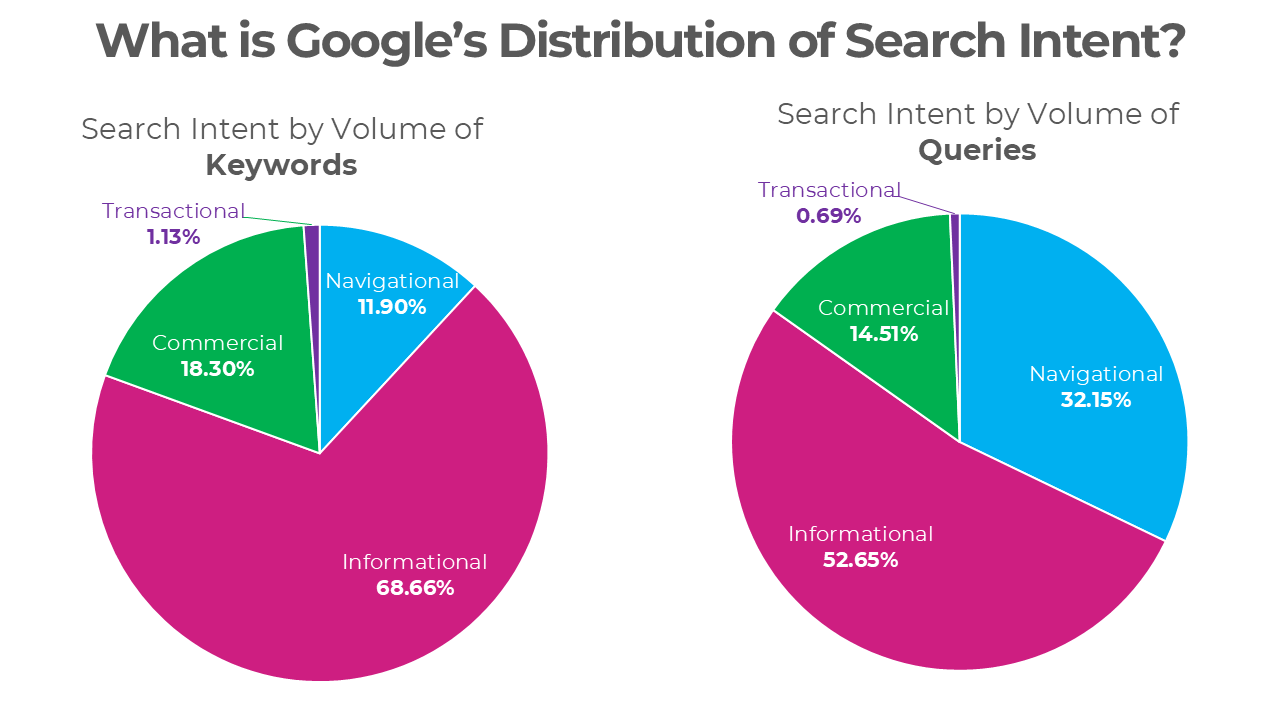
Informational searches encompass a vast spectrum of topics—weather, news, history, painting techniques, science, and billions of other knowledge-seeking queries. 52.65% of total search volume on Google is purely informational, representing 68.66% of unique keywords. To be completely honest with you, I expected an even higher share of informational queries, closer to 80%. We can deduce that internet users primarily turn to Google to research information spanning a very wide array of topics.
Here are ten examples of action verbs reflecting typical user behavior during informational searches on Google:
- Search: to obtain information on a specific topic.
- Understand: to deepen knowledge about a subject.
- Discover: to explore new ideas or concepts.
- Learn: to acquire skills or knowledge.
- Stay informed: to keep up with current events or recent developments.
- Identify: to pinpoint specific elements or understand the characteristics of a topic.
- Check: to verify facts or confirm information.
- Explore: to browse areas of interest.
- Define: to find meanings or explanations of terms.
- Analyze: to examine subjects in detail.
These verbs reflect diverse intentions that drive users' informational queries.
Google is a major engine for learning and content discovery. This is the first stage where you can effectively leverage organic search optimization (SEO) to appear at the very beginning of the buyer's journey when prospects are seeking answers.
52.65% of total search volume on Google is purely informational, accounting for 68.66% of unique keywords.
Weight of commercial searches
Commercial searches occur when users compare products or gather information before purchasing goods or services, whether in a B2B (business-to-business) or B2C (business-to-consumer) context. These queries signal purchase intent, though not yet at the stage of an immediate transaction. They indicate a desire to evaluate options for a potential upcoming purchase.
Search volume stands at 14.51%, representing 18.30% of unique keywords. Sitting between informational and transactional queries, commercial searches are a goldmine for digital marketers.
Here are ten verbs corresponding to commercial searches on Google:
- Compare: to evaluate products or services before buying.
- Explore: to discover available options or solutions.
- Evaluate: to judge the quality or suitability of a product/service.
- Research: to find specific product or service specifications.
- Analyze: to examine the features or benefits of an offer.
- Review: to read customer feedback, recommendations, or critiques.
- Verify: to check pricing, promotions, or availability.
- Choose: to select the product or service best suited to one's needs.
- Plan: to prepare a purchase or organize a project requiring specific products.
- Discover: to find new brands or alternatives to known products.
These verbs illustrate the mindset of users investigating options before potentially making a purchase.
Commercial searches are extraordinarily valuable for businesses because they signal active interest in a potential purchase. Organic SEO is highly effective for this search intent, provided you craft high-converting landing pages, thoroughly answer user questions, and maintain competitive market pricing.
Commercial search volume stands at 14.51%, representing 18.30% of unique keywords.
Weight of navigational searches
Navigational searches occur when users already know where they want to go. They use Google as a shortcut to reach a specific website or page rather than typing the URL manually. For instance, instead of typing "www.youtube.com" into the address bar, a user simply searches "YouTube" on Google.
They account for 32.15% of all searches performed on Google while representing 11.90% of unique keywords. These figures highlight Google's immense influence in routing web traffic, and explain why a small minority of established sites capture a disproportionate share of online traffic.
To compete in the big leagues for this type of traffic, traditional SEO will be of limited help until you have built a recognized brand that people actively type into the search bar to reach you directly. Budget and time are two decisive factors in your success. You will need to invest across other channels—social media, Google Ads, YouTube, TikTok, podcasts, and PR—to build brand awareness. To check whether your brand is being searched online and benchmark your growth against competitors, simply use Google Trends.
Navigational searches represent 32.15% of all searches performed on Google, accounting for 11.90% of unique keywords.
Weight of transactional searches
Transactional searches occur when users have a clear intent to complete a specific action, such as buying a product, subscribing to a service, or hiring a company.
Transactional searches represent just 0.69% of total volume and 1.13% of unique keywords. Very few people come to buy directly online without knowing the brands or conducting prior research.
Transactional searches account for 0.69% of total search volume and only 1.13% of unique keywords.
Here are ten verbs corresponding to non-branded transactional searches on Google:
- Buy: to find a product or service to purchase immediately.
- Order: to place an online order (for example, a meal or retail item).
- Book: to reserve an experience, trip, or service appointment.
- Subscribe: to sign up for a recurring service or product (such as insurance or software).
- Add: to place an item into an online shopping cart.
- Checkout: to complete an ongoing transaction or purchase.
- Download: to immediately obtain a paid file or software application.
- Rent: to find goods or services available for immediate rental.
- Pay: to complete an online payment for a product or service.
- Register: to join a service or platform requiring immediate commitment.
These verbs reflect a direct intent to complete a concrete action, usually tied to an immediate transaction or commitment.
SEO targeting this search intent is expensive, fiercely competitive, and highly lucrative. That does not mean you should avoid it, but rather that it requires substantial marketing budgets. You can also leverage Google Ads for these queries, as they convert directly into hard revenue. However, doing so requires high-quality campaigns and a long-term commitment given the fierce competition.
My perspective
Google has become a tool people use after discovering a need, rather than a demand-generation or demand-stimulation engine.
Buyer journeys have evolved: discovery now happens primarily on social media, YouTube, TikTok, podcasts, industry news sites, Google Discover, Apple News, newsletters, print flyers (especially for local retail), trade shows, and conferences.
This demonstrates that while Google remains a powerhouse, it is no longer the sole channel for discovering brands and services.

Critical strategic insights into modern searcher behavior
Businesses must build brands that are recognized, trustworthy, and transparent, while addressing user needs with precision.
A business card for brands
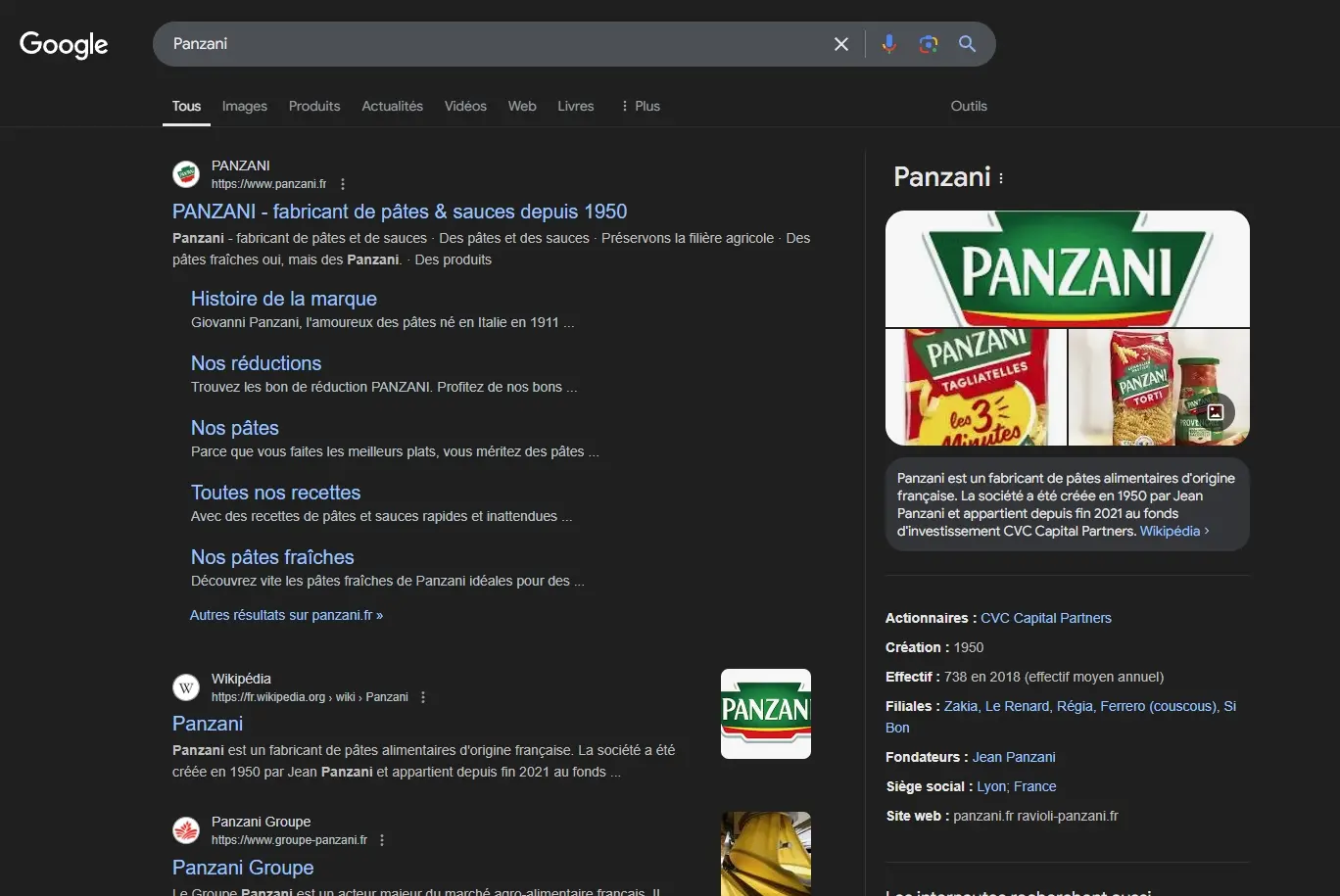
Google has become the homepage of every brand. One-third of all Google usage is purely navigational, meaning the search results page for your brand on Google is likely the first lasting impression people get of who you are and what you do. Reputation management within the search engine results pages (SERPs) is therefore essential, as they serve as your digital business card.
Branded searches
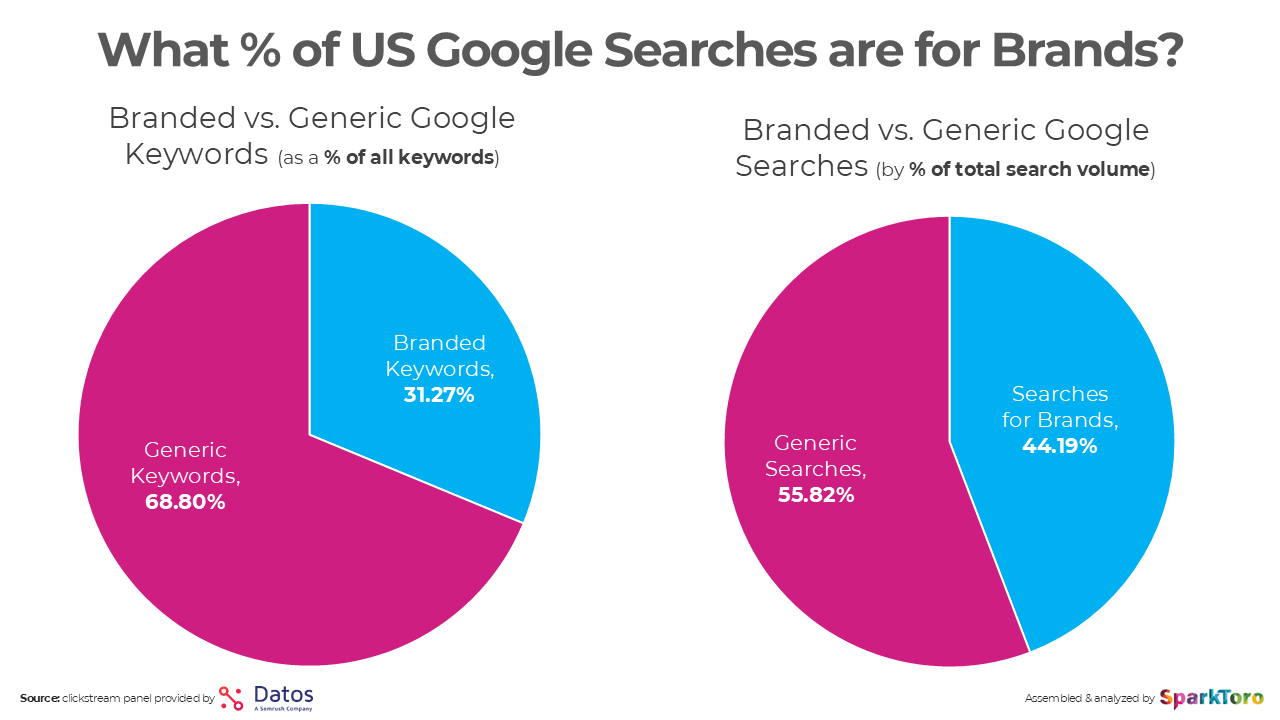
Nearly 44% of Google searches are branded queries, and because branded terms carry higher average search volume per query, total search volume is split almost evenly between branded searches and generic terms. This means consumers heavily rely on Google to find companies, products, and services they already know. Do not miss out—make your brand remarkable!
Traffic monopolization
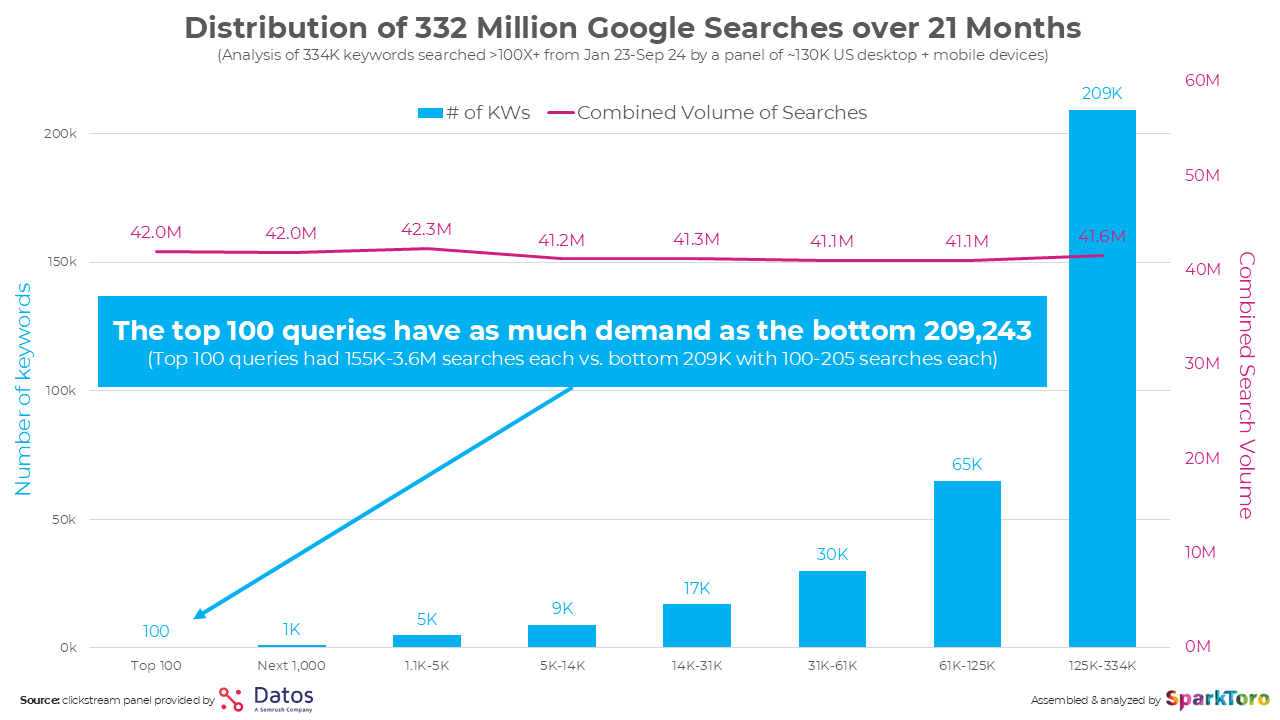
A tiny fraction of search terms generates a disproportionate share of search volume. A small number of head keywords account for a massive portion of Google traffic, giving Google significant leverage to concentrate or redirect traffic. Conversely, there is a vast long tail of rare queries that individually represent a tiny fraction of total volume. Major brands capture a disproportionate share of traffic and attention, and this concentration trend continues to grow.
My perspective
As a destination for brands, an information retrieval engine, a navigational utility, a lookup platform for known brands, and a waypoint after a need is discovered, Google shapes consumer behavior. The study also highlights a structural shift in how consumers discover brands and services, underscoring the importance of diversified, multichannel marketing strategies beyond Google Search alone.
Strategic conclusions: future-proofing your search visibility
Google is increasingly used to fulfill an already identified need rather than as an initial discovery tool. Brand and service discovery now takes place largely on social networks, YouTube, podcasts, and niche media. Hence the vital importance today of investing heavily in multichannel brand building. Working to make your brand known is working to be recognized by search engines—especially Google and AI-powered answer engines.
Search intent glossary
- Branded query: a search query that includes the name of a specific brand, product, or company.
- Non-branded (generic) query: a search query that does not mention a specific brand and uses general terms to describe a need or topic.
- Search intent: the underlying goal behind a search query, which may be navigational, informational, commercial, or transactional.
- Informational search: a query performed to obtain knowledge or answers about a particular topic.
- Navigational search: a query performed to reach a specific website or webpage the user already knows exists.
- Commercial search: a query performed to compare products or services prior to making a purchasing decision.
- Transactional search: a query performed with the immediate intent to buy, subscribe to a service, or transact with a business.
- Zero-click answer: an answer provided directly on the Google search results page without requiring the user to click through to an external website.
- Large Language Model (LLM): an artificial intelligence system capable of understanding, classifying, and generating human language.
- Long tail: the portion of the search demand curve representing less frequent, highly specific multi-word queries.
- SERP: Search Engine Results Page.
- Search volume (Searches): the total number of times a given keyword was searched across all users.
- Keyword volume: the number of distinct keywords falling within each intent category.
Further reading & research sources
- SparkToro - New Research: We analyzed 332 million queries over 21 months to uncover never-before-published data on how people use Google - December 2024.

About the author:
Thierry P. Gaillard - End-to-end digital project management
After working at American Express for 15 years—including six years as an IT project manager and eight years as a profit center director managing around a hundred people—Thierry P. Gaillard became a web entrepreneur, digital marketing manager, and e-commerce specialist.
His areas of expertise include web performance, branding, business negotiation, and management.