
Use AI to optimize your SEO title and meta tags

The `<title>` tag and meta description remain your website's primary display window in Google search results. Crafting concise, persuasive, and keyword-rich tags for hundreds or thousands of pages is an exhausting editorial bottleneck.
Generative AI models excel at analyzing text and generating punchy variations tailored to precise character limits and search intents. But can an algorithm outperform human copywriters in driving click-through rates (CTR)?
This practical guide details a 4-step workflow: structured data preparation, automated prompt generation, comparative A/B evaluation, and human-in-the-loop editorial validation.
Here is a tried-and-tested method for crafting title tags and meta descriptions according to SEO best practices—a workflow that combines AI speed with human editorial judgment.
 Author: Thierry P. Gaillard -
Step 1: preparing and structuring input data for the AI model
I start by feeding the entire content of the target web page to my AI algorithm (for example, ChatGPT). This gives the AI a complete understanding of the topic and context.
I often take this opportunity to ask what weak points or omissions exist in my draft. Depending on its feedback, I either add new content (written by myself) or ignore its suggestions—which is exactly what I did for this article.
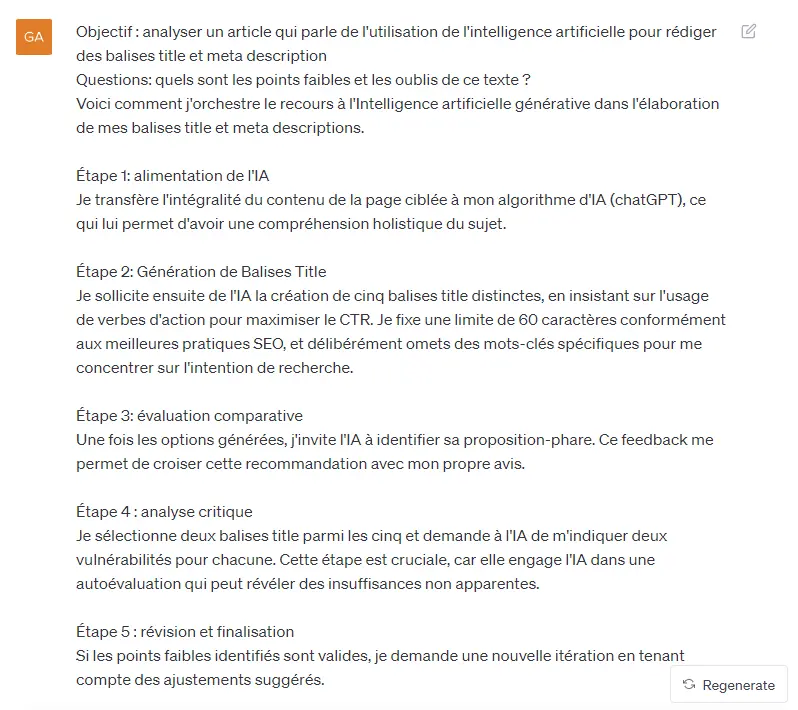
Step 2: automated multi-variant generation of title tags
Next, I ask the AI to generate five distinct title tags, emphasizing the use of action verbs to maximize click-through rate (CTR). I set a strict 60-character limit in accordance with SEO best practices and deliberately omit predefined keywords so the model focuses purely on search intent.
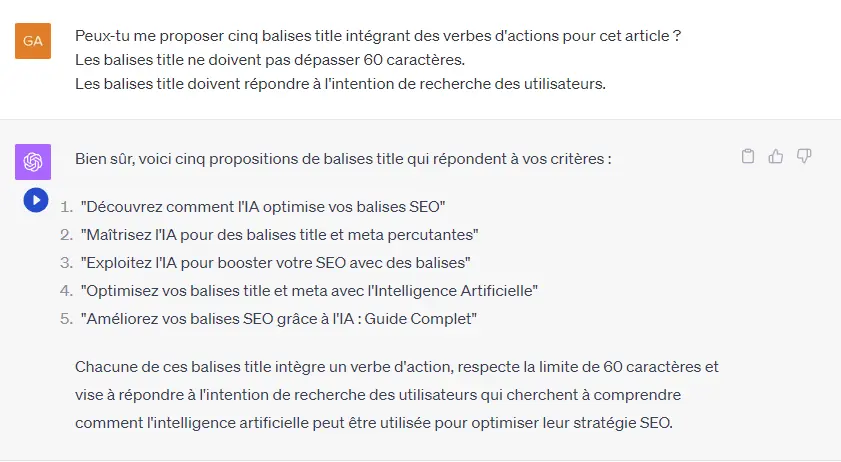
Step 3: comparative evaluation against human copywriting
Once the options are generated, I ask the AI to identify its top recommendation. This feedback allows me to cross-reference its selection against my own editorial judgment.
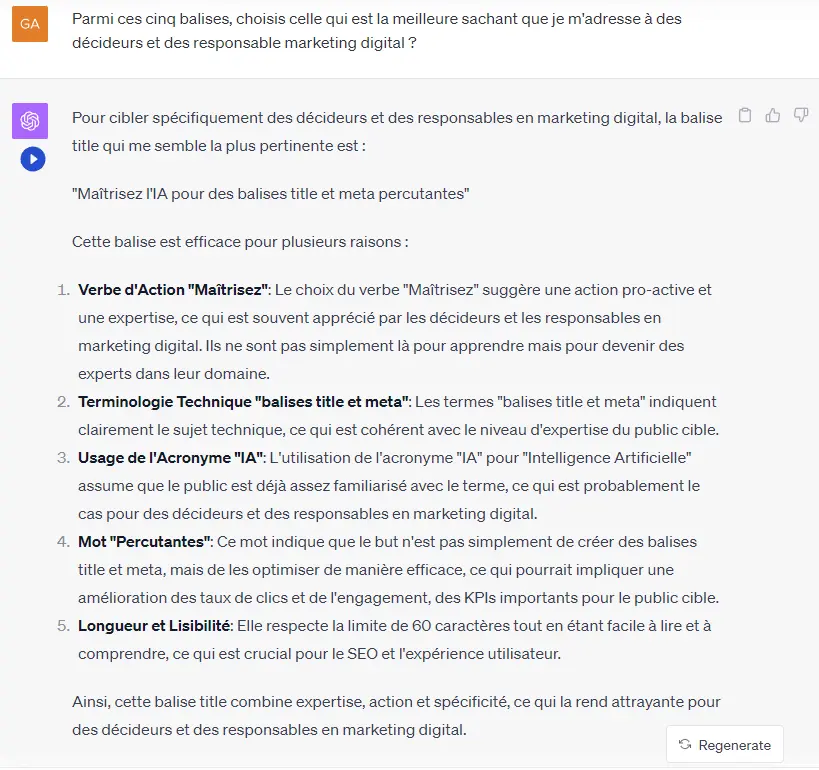

Step 4: critical analysis of strengths, pitfalls, and nuances
I select two title tags out of the five and ask the AI to provide one or two criticisms for each of them. This step is crucial because it engages the AI in self-evaluation that can uncover subtle weaknesses.

Step 5: revision and iterative refinement
If the identified weaknesses are valid, I request a new iteration incorporating the suggested adjustments.
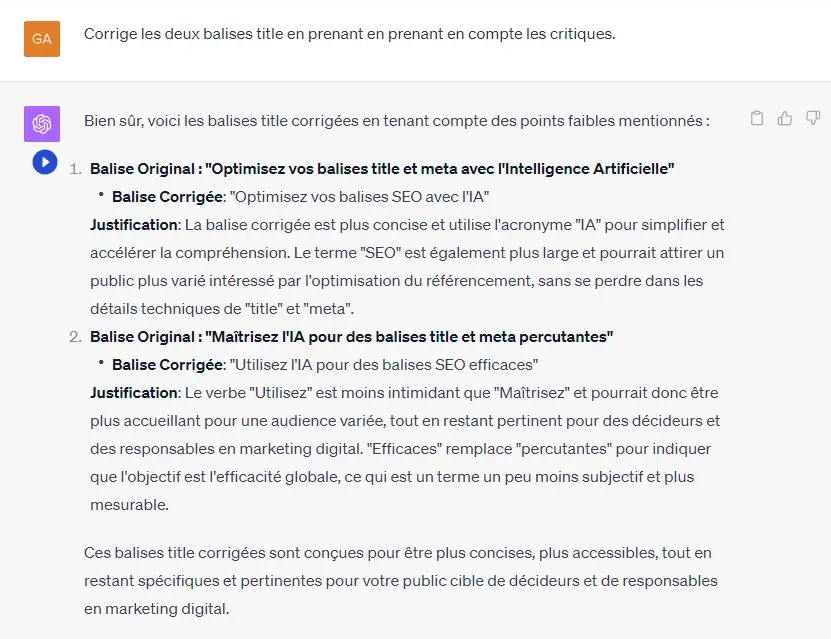
Step 6: final selection and implementation
At this stage, I have two options:
- Adopt one of the generated or revised title tags as-is.
- Build a hybrid title tag by merging the strongest elements from multiple suggestions.
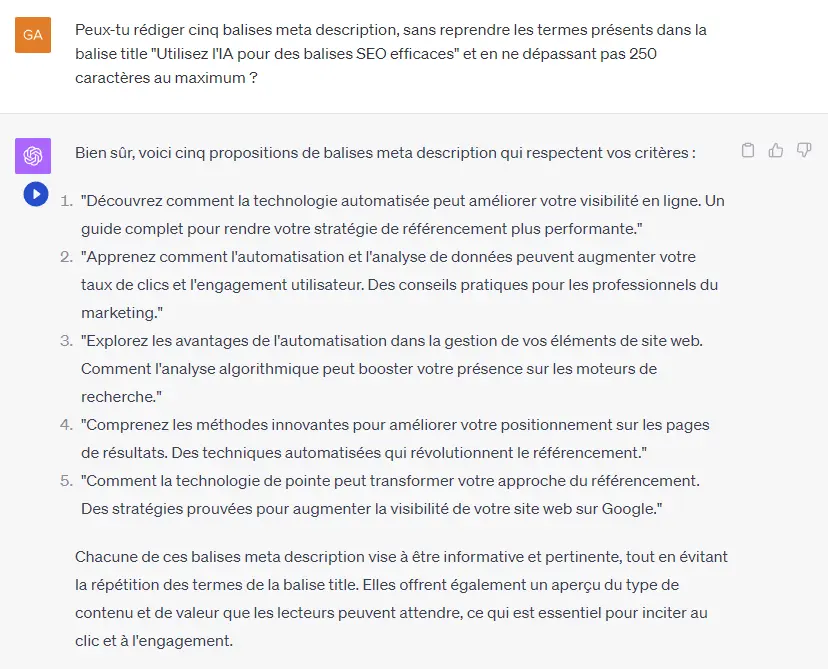
The screenshots shown in this article are the actual prompts and responses I used to craft the title and meta description tags for this very page.
Ultimately, I chose: "Use AI to Optimize Your SEO Title and Meta Tags".
As an SEO professional, I always have the final word. Through this example, you can clearly see how generative AI serves as a high-leverage personal assistant rather than an autonomous replacement.
Conclusions
Using artificial intelligence to craft SEO tags offers an optimal blend of rich semantics and search-intent alignment. This workflow fits seamlessly into an enterprise SEO strategy focused on maximizing organic visibility and user engagement.
I repeat this exact method for meta description tags, instructing the AI to respect character limits and avoid redundant phrasing already present in the final title tag.

About the author:
Thierry P. Gaillard - End-to-end digital project management
After working at American Express for 15 years—including six as an IT Project Manager and eight as a Profit Center Director managing around a hundred people—Thierry P. Gaillard became a web entrepreneur, digital marketing manager, and e-commerce specialist.
His specialties are web performance, branding, business negotiation, and management.