Digital marketing lexicon from A to Z


Home
End-to-end digital project management.
Acronym for Augmented Backus-Naur Form.
Standard metalanguage applied by the IETF to describe an RFC language. Its format is similar to EBNF despite a few differences.
An Ad request is counted every time your website requests that an advertisement be displayed on the screen.
Acronym for Asymmetric Digital Subscriber Line.
Telephones use signals along a pair of copper wires with frequencies from 25 to 3,400 hertz. ADSL uses these copper wires in parallel, utilizing 255 frequency bands reaching up to 1.1 megahertz, well above classic voice frequencies.
Joseph Lechleider, who invented ADSL in 1988, noticed that when upload and download speeds were identical (SDSL), interference was high and data rates were very low. By making the connection asymmetric, he enabled up to 16 Mbps of data transfer, fueling the rise of the Internet, digital television, and VoIP.
The ability of a system or product to suggest its own use. For a website, you use visual elements (logos, icons, etc.) that make it immediately obvious what will happen when you interact with them (skeuomorphism). Example: a "Play" button to start an audio file.
Persian mathematician and writer who lived in the 9th century (783–850). A pioneer of the concept of zero, he popularized Indian decimal numerals (algebra) and equation solving all the way to Europe. His name is the origin of the word "algorithm," which he helped formalize even though he did not invent it.
A word derived directly from the treatise "Kitab al-jabr wa'l-muqabala" written by Al-Khwarizmi. "Al-jabr" means "restoration" or "completion." This work explains that to solve simple equations, one takes a term and moves it to the other side of the = sign while inverting its sign (+ to – and – to +).
A word coined from the name of the Persian mathematician Al-Khwarizmi, father of algebra. Algorithms are at the heart of computer science, even though they are not limited to this discipline.
An algorithm is a sequence of simple interconnected instructions that makes it possible to execute one or more complex tasks to solve a problem. An algorithm can be executed by a human or a machine. When executed by a machine, it can be automated and requires no intelligence. There are two main types:
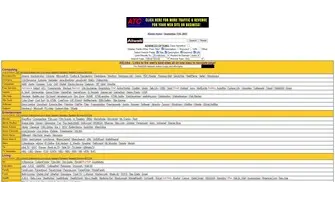
Considered by many to be the first true web search engine, Aliweb was launched by its creator, Martijn Koster, in May 1994. Its particularity was that it did not have a crawler, meaning webmasters had to manually submit their pages and websites to the engine so it could index them and create a meta description. Unfortunately, few did so, which led to the search engine's demise even though this technique had the advantage of using very little bandwidth.
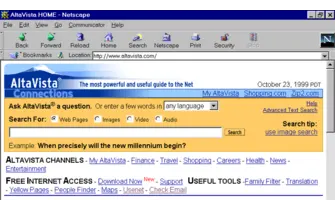
Search engine launched on December 15, 1995 by researchers at Digital Equipment Corporation. The company's goal in launching its search engine was not commercial, but rather to showcase the power of one of its supercomputers, the AlphaServer 8400 TurboLaser. It was characterized by blazing execution speed and highly reliable results. Its name comes from "a view of Palo Alto." Its web crawler, Scooter, was developed by Frenchman Louis Monier. AltaVista enjoyed meteoric success, attracting 80 million visitors per day in 1997. In February 2003, having been largely overtaken by Google since 2001, it was sold to Yahoo for $140 million before Yahoo integrated it into its own search engine in 2011 and retired the brand in 2013. A sad end for a pioneer...
Ask Me Anything.
Software and methodology used to see how a website is crawled and viewed by search engine bots such as Googlebot.
A way of transporting signals (radio, voice, etc.) in the form of continuous electrical waves.
The visible, clickable text portion of a hyperlink.
In affiliate marketing, this term refers to the company that pays a website publisher to place links or banners on their site pointing to the advertiser's website.
API stands for Application Programming Interface. It is a set of code definitions and protocols—known as software interfaces—that allow applications of completely different designs to communicate with each other and facilitate interoperability.
A web page that allows the user to perform interactive tasks rather than simply displaying static content. Hosted in the cloud, it has the advantage of performing the same tasks as traditional software without requiring installation on a computer.
An advanced neural-network-based approach to machine learning.
Combines the DOM and the CSSOM to compute the visual layout of a web page.
Originally a project developed by student Alan Emtage as part of his computer science studies at McGill University in Montreal. J. Peter Deutsch and Bill Heelan joined the project, which in 1987 was designed to allow university students and faculty to find software and documents on FTP servers.

Then in 1990, it enabled live searches via the Telnet protocol. Archie became what many consider today to be the first Internet search engine before disappearing in the face of competition.
ARPANET, which stands for Advanced Research Projects Agency Network, was the first packet-switching data network. It prefigured what would later become the Internet. Its first public demonstration took place in 1972.
The original military-driven idea was to maintain data exchanges between computers in the event of a nuclear strike by the USSR. To be able to retaliate after a first strike, computers needed to retain their ability to communicate with one another.
To achieve this, a decentralized network had to be built that would continue operating even if the enemy destroyed a centralized switching station. Traditional telephone communications relied on a centralized protocol, whereas ARPANET operated on a distributed model: if data packets could not travel along one path, they would take another route to reach their destination.
Initially, ARPANET was intended for scientists to exchange data between their computers. Very quickly, however, it became an ultra-fast post office for exchanging electronic messages.
In 1983, ARPANET was split into two separate networks: one for military purposes and one for civilian use.
A table-like data container capable of holding multiple elements or data types.
Acronym for AnyTime, AnyWhere, Any Device.
ATAWAD, a registered trademark, is a term coined by Xavier Dalloz to illustrate the fact that thanks to digital technology, people can connect at any time of day, from anywhere, and using any type of screen. This gives users a form of ubiquity that requires brands to be able to respond effectively at any moment.
Google defines it as follows in a 2017 patent:
In general, an authoritative site is a site that the search system has determined provides particularly reliable, accurate, and trustworthy content. The search system can distinguish authoritative sites from low-quality sites that feature shallow content resources, or that frequently display intrusive or abusive advertisements that can be characterized as spam. Whether the search system considers a site authoritative will generally depend on the query. For example, the search system may consider the Centers for Disease Control website, "cdc.gov," as an authoritative site for the query "cdc mosquito bites," but may not consider the same site authoritative for the query "restaurant recommendations." A search result that identifies a resource on an authoritative site for the query may be referred to as an authoritative search result.
Source: Google - Obtaining authoritative search results.
Average revenue generated by each user. It is calculated by dividing total revenue earned from advertisements by the total number of users.
Intelligent Virtual Agent on the Internet.
Inventor in 1834 of the Analytical Engine, considered by many computer scientists to be the first mechanical computer. It was a calculating machine into which he incorporated punch cards from the Jacquard loom to give it instructions sequentially.

Never completed during his lifetime, it was his youngest son who built the central processing unit and printer in 1888 before demonstrating its operation to the Royal Astronomical Society in 1908 in tribute to his father.
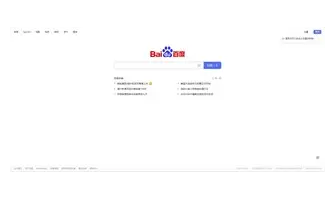
Chinese search engine meaning "hundred degrees," created in 2000 by Li Yanhong (Robin Li).
BackRub was the original name of the Google search engine project.
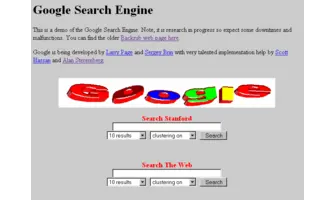
Created in 1996 by Sergey Brin and Larry Page, it was defined as a "web crawler" designed to traverse the Web. BackRub was a digital library research project in Stanford University's Computer Science Department.
BackRub was written in Java and Python and ran on Sun Ultra and Intel Pentium computers running Linux. The primary database was stored on a Sun Ultra II with 28 GB of hard disk space.
Co-inventor, independently alongside British scientist Donald Davies, of packet-switched data network communication. He also founded numerous companies commercializing his research, several of which are publicly traded.
He co-founded the Institute for the Future, a think tank dedicated to long-term forecasting and foresight.
Pioneered by Apple (iBeacon), a beacon is a small wireless transmitter equipped with a sensor and a battery that exchanges information with nearby smartphones and tablets. Based on BLE (Bluetooth Low Energy) technology, it allows brick-and-mortar retailers to send targeted messages to customers browsing store aisles: promotions, product information, customer journey tracking, and more. According to a study by Reports Monitor, the beacon market was projected to reach $33.7 billion by 2025, tripling the number of deployed devices each year.
It is a forward-looking technology increasingly used in Industry 4.0—for example, to locate equipment in airports or identify shipping containers on vessels.
Electronic voting software designed by teams at INRIA and CNRS, intended to replace mail-in voting and organize secure polls or consultations (as a verifiable alternative to Google Forms), though not to replace paper ballots in voting booths for political elections.
Acronym for Bidirectional Encoder Representations from Transformers.
BERT is an open-source TensorFlow language representation model used by Google that enables deeper natural language understanding by search algorithms. Instead of processing search keywords one by one in isolation, its neural network architecture processes each word in a query or sentence in relation to all the other words around it.
This fundamentally transforms state-of-the-art technologies for text classification, translation, summarization, and question answering—making it especially useful for voice assistants.
Bing is the fourth iteration of Microsoft's search engine, following MSN Search, Windows Live Search, and Live Search.
Microsoft Bing was launched in 2009 by the Redmond-based company. Through its Webmaster Guidelines, it helps developers and site owners implement best practices to gain visibility on its search engine results pages (SERPs).
Acronym for BInary digiT.
The fundamental unit of measurement for the minimum amount of information transmitted by a message. This unit can only take one of two values: for example, 0 or 1, or true or false. 8 bits (b) = 1 byte (B). This is called binary language because it operates in base 2. Be careful not to confuse a bit (lowercase b) with a Byte (uppercase B).
A "black hat SEO" practitioner is someone who violates Google's guidelines and best practices in order to artificially manipulate and boost a website's search rankings.
A blockchain is a decentralized database accessible to everyone, whose contents are stored across multiple nodes rather than in a single location. Each participant has read and write access according to protocol rules. No central authority controls the ledger; transactions are validated collectively by consensus, making the system tamper-resistant and difficult to hack.
A browser bookmark containing a small JavaScript snippet that executes specific tasks directly on the web page being viewed.
A technique consisting of starting up a program or system by executing a minimal initial sequence of instructions that then loads the rest of the software. For example, an operating system like Windows boots via bootstrapping.
British mathematician who was the first to transform logical reasoning into algebraic calculation using purely logical truth values such as "true," "false," "yes," and "no." He is the pioneer of binary logic, which later became Boolean algebra—the foundation of all modern computer programming and digital circuits.
His most important publication dates from 1854 and is titled An Investigation of the Laws of Thought, on Which are Founded the Mathematical Theories of Logic and Probabilities. In this work, he builds upon Aristotelian logic to demonstrate algebraic logic.
An iterative programming structure that repeats a block of instructions to perform complex operations efficiently.
Example: While (condition) → Do → End While.
A Brand Book (or brand style guide) is a comprehensive reference document outlining a brand's identity.
A B2B and internal communication document containing all the rules governing a brand and its visual identity. Inside, the company tells its story and describes its mission, values, ambitions, and priorities to explain what it stands for.
These guidelines enable all brand stakeholders (employees, clients, shareholders, suppliers, partners, etc.) to embrace and consistently apply the company's identity. Both the logo and the graphic charter are built from the brand book.
Brand content refers to editorial or multimedia content produced directly by brands. Rather than traditional hard-sell advertising, it uses storytelling and informative media to engage audiences and promote a brand's universe and products.
Brand marketing encompasses the marketing techniques used by companies or individuals to build brand awareness, shape brand equity, and strengthen recognition among their target audience.
A methodology and set of thresholds established to safeguard and optimize web performance throughout a project's lifecycle.
A bug is defined as a discrepancy between the intended behavior of software and its actual behavior. It very often results from human error during coding or design. To prevent bugs in critical systems, computer scientists use formal methods.
Bring Your Own Device refers to the practice of employees bringing their own personal digital devices (laptops, smartphones, tablets) to the workplace and using them for work.
This can pose security challenges for IT departments (CIOs) because corporate networks become more vulnerable to cyberattacks. However, tech giants such as Microsoft with Intune shift the security layer from the physical devices (antivirus) to the applications and data themselves, meeting the demand for both flexibility and security.
A unit of computer memory capacity equivalent to 8 bits (called an octet in French).

Precision mechanical calculator invented by Curt Herzstark (1902–1988) during World War II. It operated by engaging hundreds of tiny gears using a small crank that the user turned to obtain the calculation result.
An HTML link attribute (rel="canonical") used to prevent duplicate content issues by specifying the "original" or preferred URL that search engines should index and display.
Computer-Aided Design is a digital simulation and modeling technique.
Using computers, engineers and designers can digitally design objects—modeling them in 2D or 3D to test and stress-test them virtually before physical manufacturing. This technology has dramatically reduced R&D and prototyping costs.
Coined by B.J. Fogg, a professor at Stanford University, this term is an acronym based on the phrase "Computers As Persuasive Technologies."
This discipline focuses on the design, research, and analysis of interactive computing products created for the purpose of changing people's attitudes or behaviors.
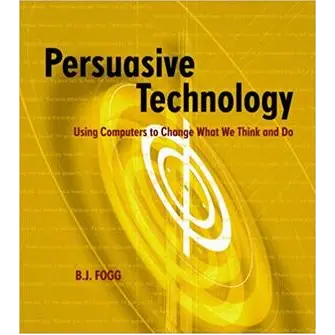
It describes the exact domain where technology and persuasion overlap (B.J. Fogg, 2003 – Persuasive Technology – Page 5).
Content Delivery Network. A system of distributed servers networked together to improve the loading speed of a website. Servers are deployed across multiple geographic locations so that the server physically closest to the user delivers the requested assets.
The advantage is reduced bandwidth consumption, lower latency, and a better user experience. It is particularly valuable when operating an international website, as it ensures global availability while delivering a fast, local experience to every visitor.
The website responds with local speed—even for search engine crawlers (which benefits SEO)—by acting as if the website has a dedicated server in every region.
A researcher at Stanford University, he is considered one of the fathers of the Internet, having co-designed the TCP/IP protocol in 1974 in collaboration with Robert Kahn. He was awarded the Turing Award in 2004.
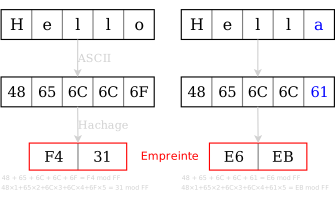
A checksum is a small-sized block of digital data derived from a larger document (also called a digital fingerprint) used to verify data integrity and detect any discrepancy or corruption between two copies.
See "CRP (Critical Rendering Path)" below.
A trademarked metric created by the backlink analysis platform Majestic. A score between 0 and 100 that measures the link equity or "power" of a website based on the quantity of links pointing to it. Citation Flow is paired with Trust Flow; together, they form Majestic's Flow Metrics algorithm. Because a strong link has a stronger influence on URLs, Citation Flow relies on a more powerful iterative mathematical logic than the older ACRank metric.
In e-commerce and retail marketing, the practice of purchasing an item online and picking it up in person at the retailer's physical store or a local pickup point.
An illicit technique that tricks an internet user into clicking on something disguised as a safe link or button when they are actually clicking on an invisible or disguised element. Websites can protect against clickjacking by implementing the X-Frame-Options HTTP header or Content Security Policy (CSP).
The practice of presenting different content or URLs to human users than to search engine crawlers (by hiding or swapping content). Cloaking is strictly prohibited by search engines.
A solution that stores data and runs software on remote servers accessed over the Internet rather than on a local computer or on-premise server.
The advantage is being able to access data from anywhere on any device while drastically reducing the risk of data loss thanks to redundant storage across multiple remote servers.
The drawback is that unless end-to-end encryption is used, the cloud hosting provider may technically have access to the hosted data.
Cumulative Layout Shift measures the visual stability of a web page—that is, how often users experience unexpected layout shifts while the page is loading. To provide a good user experience, pages should maintain a CLS score below 0.1.
Layout shift score = impact fraction × distance fraction. Common causes of a poor CLS score include:
Customer Lifetime Value. This metric represents the total economic value of a customer to a business. It highlights all net profits generated across every interaction with a customer over the entire duration of their relationship, regardless of channel (calculate your CLV).
In this context, customer retention is critical because retaining an existing customer costs significantly less than acquiring a new one, particularly given marketing acquisition costs.
This indicator relies on customer segmentation to determine which cohorts are most profitable for the company so it can focus its efforts accordingly.
Content Management System. Software platforms—often open-source or free—that allow users to create, manage, and update websites intuitively and efficiently without needing computer programming skills.
Examples of popular CMS platforms: WordPress / Shopify / Joomla / Drupal / Wix / Squarespace / Bitrix / Blogger / Magento / OpenCart / PrestaShop.
An SEO content architecture concept created by French SEO consultant Laurent Bourrelly.
A structured network of pages covering a specific topic where navigation from page to page occurs through contextual internal links embedded within the body copy rather than solely through global menu links. This creates a logical, engaging journey for users who click links to explore a subject in greater depth.
The goal of the semantic cocoon is to answer the question: "Why does my website deserve to rank #1 on Google?" It is a form of content marketing combined with a rigorous SEO siloing layer characterized by a specific hierarchy of parent, child, and sibling internal links.
A website built around a semantic cocoon leverages rich multimedia content (text, images, video, audio, etc.).
Human-readable text written in a programming language that instructs a computer program, application, or software how to operate according to the programmer's specifications.
An algorithmic program that translates source code written by humans in a high-level programming language into machine language (binary code) so that it can be executed directly by a computer.
In programming, concatenation consists of joining one character string end-to-end with another character string.
According to the Content Marketing Institute (CMI), content marketing is a strategic marketing approach focused on creating and distributing valuable, relevant, and consistent content to attract and retain a clearly defined audience—and, ultimately, to drive profitable customer action.
A black hat SEO technique that consists of automatically generating numerous variations of an article from a single master text. Software tools randomly swap words and synonyms to mass-produce pages, resulting in low-quality content.
"The completion of a desired action defined in advance by the company as a business goal." Source: Ryte.
Corporate Open Online Course. Online training courses created by a company based on the MOOC model. The objective is twofold: share corporate culture across employees and stakeholders, and enable staff to acquire new professional skills.
A small alphanumeric text file that a web server stores on a user's browser (client system) to remember state or user preferences. The next time the client connects to the server, the browser sends the cookie back.
A technique for collecting opt-in email addresses shared among multiple partner brands during a single registration flow.
Broad, large-scale Google updates that significantly adjust multiple aspects of web search rankings. Google maintains an official dashboard tracking its core updates released since January 2020.
A statistical linguistics tool that represents the content of a document mathematically, pioneered by Gerard Salton (1927–1995). A document is represented as a vector whose magnitude depends on the weighted significance of the terms it contains. Each term weight plots a line in multi-dimensional space at a specific angle. The cosine of the angle between two vectors measures the semantic distance separating two documents: the larger the angle, the greater the semantic distance; the smaller the angle, the closer the documents are semantically.
In video games and UX design, the learning curve is a graphical representation describing the relationship between the time spent playing or using a product and the mastery gained over time.
This curve is often decisive in determining whether players will quit early or become recurring users. The more mistakes a player can make early in the game while still progressing, the smoother the learning curve, encouraging the player to continue without getting discouraged.
Cost Per Click. The amount paid by an advertiser each time a user clicks on an ad leading to their website or app.
Cost Per Install. A fixed bid or price paid when a mobile or web application is installed by a user. It represents the acquisition cost of a new app user.
Cost Per Mille (cost per thousand impressions). The price paid by an advertiser for every 1,000 times an advertisement is displayed on a website or application.
An automated bot (also called a spider) that systematically browses and analyzes websites in order to index their pages in search engines.
Acronym for Conversion Rate Optimization. Attracting visitors to a website is good, but not enough on its own. Conversion Rate Optimization is a methodology aimed at increasing the percentage of visitors who complete a desired action on a website or digital application.
The goal is to encourage users to interact with the website—by filling out a form, subscribing with an email address, purchasing a product, etc. CRO relies heavily on A/B testing to test different versions of a page and verify which layout or copy drives the highest conversion rate.
A generalization of Log Loss to multi-class classification problems. Cross-entropy quantifies the difference between two probability distributions.
(Google Machine Learning Glossary).
Artificial intelligence frequently uses cross-entropy to measure the divergence between the predicted probability distribution and the actual target distribution.
A practice consisting of engaging the general public or a large community of consumers to contribute to the creation of a product, content, or service. Wikipedia is a prime example of crowdsourcing.
Critical Rendering Path. Because the DOM is constructed incrementally (step by step), the Critical Rendering Path is the sequence of steps the browser takes to convert HTML, CSS, and JavaScript into actual pixels on the screen, displaying initial page elements before the entire page has finished loading (learn more on web.dev).
The CSSOM, which contains all styling rules for the page, is render-blocking because it is not incremental: the browser must process all CSS before rendering the page. This slows down the CRP, even if only slightly.
Developers can optimize the CRP to allow users to view and interact with above-the-fold content before all background assets have finished loading. This is essential for improving web performance.
Acronym for Cascading Style Sheets.
A stylesheet language used to describe how HTML elements on a web page should be formatted, positioned, and displayed on screen (CSS performance guide).
Click-Through Rate. The number of clicks on an ad, banner, or search result link divided by the total number of impressions, multiplied by 100.
A key performance indicator (KPI) that estimates the total revenue a business can reasonably expect from a single customer throughout their entire relationship. In other words, it is the total value of purchases a customer will make from your company over the course of their loyalty.
A "dead-end" page on a website that contains no outgoing HTML links to any other page—creating a link-equity black hole to be avoided in SEO.
See Computer Data below.
The set of predefined, finite values organized in a database or standardized schema (e.g., age, socio-professional category, number of pages visited, shopping cart amount).
Any data that can take an infinite variety of forms and cannot be neatly fitted into a fixed relational database column. Examples: customer reviews, emails, audio recordings, etc. Most often, it consists of free-form text or media.
The ability to transform raw, complex data into a clear, compelling, and easy-to-understand narrative. Imagine that your data points are the ingredients of a recipe, and data storytelling is how you combine and plate them to create a memorable dish!
A mathematical technique to minimize loss by computing the gradients of loss with respect to the model's parameters, conditioned on training data. Informally, gradient descent iteratively adjusts parameters, gradually finding the best combination of weights and bias to minimize loss.
(Google Machine Learning Crash Course).
An essential optimization algorithm in machine learning and deep learning used to find the local minimum of a loss function.
Created by Jake Knapp at Google, the Design Sprint is a five-day process for solving complex problems and launching a new product or service through ideation, rapid prototyping, and testing ideas directly with real users.
In web and application development, this means the developer starts from a blank slate when coding, without relying on heavy pre-built templates or a Content Management System, writing the entire codebase from the ground up.
A UI (User Interface) designer is a design professional responsible for creating the visual interface of a digital product or service. This includes designing the visual look and feel, layout, and interactive usability of the interface.
UI designers work on a wide variety of projects, including websites, mobile apps, software, and electronic devices. Their goal is to create interfaces that are both aesthetically pleasing and functional, taking into account user needs, technical constraints, and business objectives.
UI designers use a variety of tools and techniques to craft interfaces—including illustration, photography, typography, color systems, and micro-animations—collaborating closely with UX designers, developers, product managers, and users.
A UX (User Experience) designer conducts user research, information architecture, and wireframing/prototyping before handing off to the UI designer.
They are professionals specialized in creating and improving the overall user experience for digital products or services such as websites, mobile applications, or software. Their goal is to make the interaction between the user and the product as simple, efficient, and enjoyable as possible.
The UX designer plays a crucial role in a product's success by ensuring the user journey is intuitive and friction-free.
When software is developed, coding standards and architectural principles must be defined beforehand and respected during programming. If the source code takes shortcuts or fails to follow established standards, future maintenance and updates become much more complicated, requiring significantly more time and effort. This accumulated cost is called technical debt.
A portmanteau of "development" and "operations" (DevOps). It consists of bringing software developers and IT/business operations teams together so they collaborate continuously to build software and applications that reliably meet operational and customer needs.
Software no longer dictates rigid workflows; instead, it adapts continuously to serve those who use it. The goal is to deliver new features continuously while maintaining a high level of stability and quality.
Automated testing and frequent, incremental deployments aligned with operational feedback guarantee greater efficiency. It is a key pillar of agile methodology.
The name comes from "Index." An experimental research programming language developed by engineers at Google Research.
Dex builds on LLVM (Low Level Virtual Machine) and is designed for array processing with typed indices. It features a compact, functional syntax well suited to machine learning and complex mathematical computations.
In web analytics, an attribute or characteristic of a user or session. For example, browser, geographic location, and landing page are dimensions.
Acronym for "Double Income, No Kids." Working couples without children where both partners earn an income. They represent a prime demographic for high-end products and travel.
DINKs are typically characterized by limited free time outside work, high disposable income, and higher education levels.
Marketing that targets people actively looking to buy products and services like yours, designed to elicit an immediate, measurable action (such as clicking an ad, calling, or ordering) and persuade them to choose your solution over competitors.
A traditional mechanical hard disk drive consists of three essential components:
It was named "hard disk" in contrast to flexible "floppy disks."
A marketing concept coined by Jean-Marie Dru of the TBWA agency group and trademarked since 1992 in 36 countries, including the European Union, the United States, Russia, India, and Japan.
The disruptive approach originally consisted of implementing a three-stage advertising strategy: identifying the established conventions of an industry, challenging them, and articulating a new vision. This enabled the agency's client to stand out sharply by breaking industry norms.
Today, we speak of disruption whenever a company enters an industry and completely upends its established business models and conventions. In all cases, disruption is a creative intellectual methodology.
Digital Millennium Copyright Act. A U.S. copyright law and takedown procedure that allows copyright holders to request that search engines and hosting providers remove infringing documents from their SERPs or servers.
Domain Name System. Designed by Jon Postel and Paul Mockapetris in 1983, it is a globally distributed directory system that translates human-readable domain names into their corresponding numerical IP addresses.
Because a browser cannot locate a server using only a domain name, without DNS every internet user would have to type the raw IP address (e.g., 93.184.216.34) of the website they want to visit. Looking up the IP address by the browser is called DNS resolution.
The DOM, or "Document Object Model," is the programming interface representing the tree structure of a web page. This tree contains all the content and properties of the HTML document—elements (also called nodes), properties, attributes, text, and the relationships between nodes.
The W3C standardizes this interface so developers can build scripts and programs that work consistently across all browsers, regardless of the programming language used.
Under the HTTP/1.1 protocol, the assets of a web page (images, CSS, JavaScript, etc.) triggered dozens of client-server requests (108 on average), which web browsers throttled by limiting the number of simultaneous connections allowed to a single domain.
Domain sharding worked around this limitation by splitting static files (images, scripts, etc.) across multiple subdomains, allowing browsers to open more parallel connections. The drawback of this method was that it increased lookup overhead because each subdomain required an additional DNS resolution and TCP handshake.
Today, multiplexing in HTTP/2 and HTTP/3 makes domain sharding counterproductive, and it should no longer be used.
Digitized raw quantities (e.g., text, measurements, sensor readings) and/or aggregations of raw data (e.g., airline ticket numbers). How algorithms process data into actionable information is a central challenge in computer science, particularly regarding accurate interpretation.
See Doorway Pages (Pages satellites) under letter P.
In this e-commerce business model, the online store only manages marketing and customer relations. A third-party supplier packages and ships the parcel directly to the customer on behalf of the e-commerce site. The supplier acts as a fulfillment subcontractor, allowing the online store to operate without holding any physical inventory.
Duplicate URL, Same Text. A situation where a single web page—serving the exact same HTML code and content—is accessible via multiple different URLs on the same website. Strongly discouraged in SEO.
Estimated ad revenue generated per 1,000 impressions. Calculated from historical performance data, this metric is very useful for website publishers to compare ad campaign monetization across different advertising networks and formats.
The expression "Eating your own dog food" (or "dogfooding") is widely used in the software industry. It means being the first to use your own product or service internally in daily operations so you can spot bugs and identify improvements before customers do. Heavily practiced at Microsoft and Google.
An individual or legal entity that publishes editorial content (text, video, audio, etc.) via electronic media (apps, websites, etc.). The publisher is legally responsible for the editorial content published.
The Dunning-Kruger effect is a cognitive bias whereby individuals with low ability in a domain overestimate their own competence. This stems from their lack of metacognitive skill to objectively recognize their own limitations.
Conversely, highly qualified individuals tend to underestimate their relative competence because they assume that tasks that come easily to them are equally easy for others.
Email nurturing is a marketing technique aimed at building and maintaining relationships with prospects and customers at every stage of their journey by providing them with relevant information at the right time. This strategy is highly effective for strengthening engagement, optimizing conversion rates, and building customer loyalty.
Picture a gardener meticulously tending young seedlings: watering them regularly, ensuring optimal sunlight, and protecting them until they reach full bloom.
Email nurturing is a strategy designed to cultivate a lasting relationship with your contacts.
In marketing demographics, couples whose children have grown up and moved out of the family home.
Often considered the first general-purpose electronic computer in history, ENIAC (Electronic Numerical Integrator and Computer), built in 1946, occupied 72 m² (775 sq ft) and cost half a million dollars. Six female operators manually reconfigured its 1,500 patch cables and switches to program it.
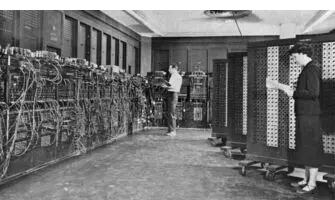
18,000 fragile vacuum tubes—which had to be constantly replaced—enabled it to perform calculations. With no screen, mouse, or keyboard, it was originally built to calculate ballistic firing tables for the U.S. Army and later assisted in early thermonuclear calculations.
User engagement refers to the quality of the user experience associated with the desire to interact with a technology.
User engagement is a dimension of user experience that emphasizes the positive aspects of interaction—in particular, being captivated by a technology and wanting to use it longer and more frequently.
According to Google, an entity is a thing or concept that is singular, unique, well-defined, and distinguishable. An entity may be a person, place, item, idea, abstract concept, concrete element, other suitable thing, or any combination thereof. For example, the color "Blue," the city "San Francisco," and the imaginary animal "Unicorn" may each be entities.
An HTTP response header that allows a browser to check whether the cached version of a resource matches the current version on the origin server.
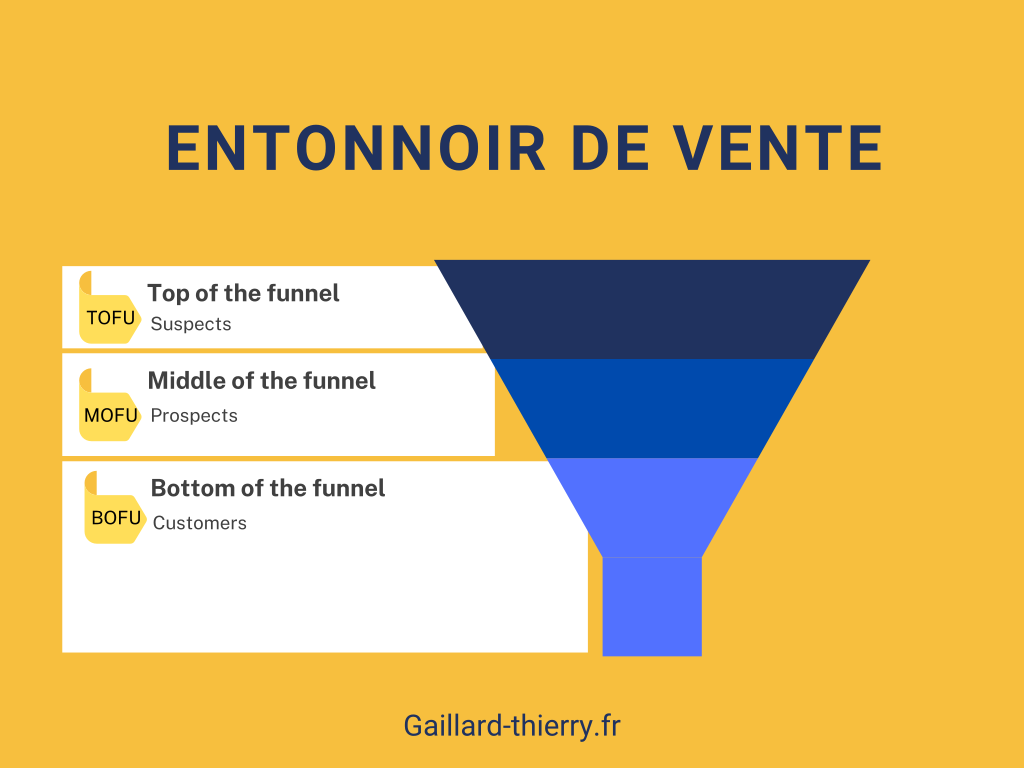
The sales funnel, also known as the conversion funnel, is a foundational concept in marketing that has existed for over a century.
The sales funnel helps entrepreneurs understand their customers' journey, from initial discovery of a product or service to the final purchase, allowing them to tailor their messaging and offers accordingly. It is divided into three main stages:
The goal of the sales funnel is to attract, engage, and convert prospects into satisfied customers while fostering long-term retention and loyalty.
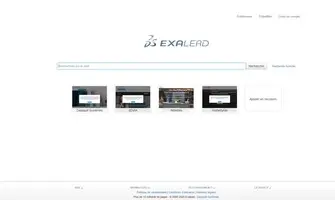
French search engine created in 2000 by former AltaVista developers led by François Bourdoncle. Exalead received the AFDEL award in 2008 for the fastest-growing French software publisher before being acquired by Dassault Systèmes in 2010. The Exalead company was merged in 2014, though its enterprise search technology continues within Dassault Systèmes.
A marketing concept consisting of making every interaction with customers a unique and memorable moment—before, during, and after the delivery of a product or service—with the goal of creating a "wow" effect.
The objective is to leave a lasting impression in the customer's mind so they continue interacting with the brand. This concept gained prominence in the late 1990s with Joseph B. Pine and James H. Gilmore's work, "The Experience Economy."
E-A-T stands for Expertise, Authoritativeness, & Trustworthiness (expanded to E-E-A-T with Experience).
Evaluation criteria used by Google's Search Quality Raters to assess the expertise, authoritativeness, and trustworthiness of the main content creator, the content itself, and the website as a whole.
A single sign-on tool that allows users on a third-party website to log in to their personal account using their Facebook credentials.
Position Zero on search engines. It is THE answer highlighted by Google to respond directly to a user's query. It appears at the very top of the organic search results inside a dedicated box and takes the form of:
The goal of the Featured Snippet is to provide a concise, immediate answer to the user without requiring them to click through to a link.
This broadband architecture means the telecom operator runs optical fiber to the base of the building, and then uses the existing copper telephone wiring to reach individual apartments.
This broadband architecture means the telecom operator runs optical fiber all the way into individual homes or apartments.
This broadband architecture means the telecom operator runs optical fiber to the last amplifier at the base of the building, and then uses a coaxial cable to reach individual apartments.
A glass or plastic fiber cable designed to guide light by total internal reflection. Light pulses bounce along the core of the cable all the way to the final destination. Depending on the angle and wavelength, multiple bits can be transmitted simultaneously at the speed of light in glass (nearly 200,000 km/s in fiber, vs. 299,792,458 m/s in a vacuum).
The major advantage of optical fiber is that the signal experiences virtually no degradation over long distances.
A standard network protocol and software tool enabling the direct transfer of files between two remote computers over TCP/IP. Widely used by web developers to publish and update websites on hosting servers. FileZilla is one of the best-known open-source FTP clients.
A programmatic advertising metric calculated by dividing the number of ad impressions served by the total number of Ad Requests. A high Fill Rate means your website or application successfully displays ads on most available inventory requests.
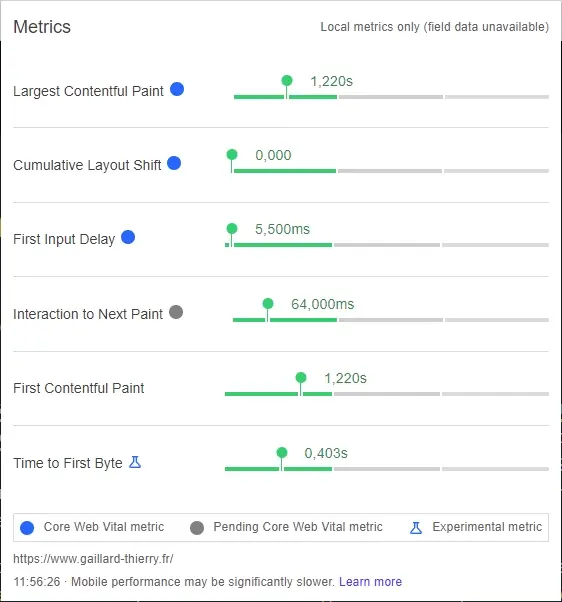
A performance metric measuring the time elapsed from when the page starts loading to when the browser renders the first bit of DOM content (text, image, SVG, etc.). First Contentful Paint is important for website users because it provides visual feedback that the page is actually loading.
Previously known as First Interactive. A legacy Lighthouse metric measuring the minimum time required before a page's main thread is quiet enough to handle most user input.
A Core Web Vitals time measurement capturing the delay between a user's first interaction with a page and the moment the browser is able to begin processing event handlers in response. Google recommended keeping FID under 100 milliseconds for a good user experience (superseded by INP in March 2024).
A legacy performance metric measuring the time required for the primary above-the-fold content of a page to become visible (now superseded by Largest Contentful Paint).
All data collected directly by a company from its own audience, customers, and digital properties (website, app, CRM, surveys) with their consent.
A minimalist UI design style using clean, two-dimensional visual elements stripped of non-essential ornamentation—no drop shadows, bevels, gradients, or 3D textures. It is the opposite of skeuomorphism.
In computer programming, a self-contained block of code that instructs the computer to perform a specific action or calculation.
A function can take parameters (arguments) that pass input data to the computer and return a result.
In computing and SEO, the set of digital traces or recurring patterns left by a person, software, application, or CMS. Example: the footer text "Powered by WordPress."
Acronym for "FORmula TRANslator," Fortran is a high-level compiled programming language invented by John Backus and his team at IBM in 1954. It remains widely used today in high-performance scientific and numerical computing.
A large collaborative knowledge base of named entities about world knowledge. Free and licensed under Creative Commons, it was created by the company Metaweb. Acquired by Google in 2010 and shut down in June 2015, its data was migrated to Wikidata. Freebase played a foundational role in helping Google build and launch its Knowledge Graph.
Randy Schmidt popularized this term in 2008 to describe a versatile all-around web developer. A full-stack developer possesses a broad range of software engineering skills across the entire technology stack—front-end, back-end, database, server architecture, and deployment—acting as a Swiss Army knife for digital projects.
For example, a "full-stack web developer" is capable of designing, coding, deploying, and maintaining a complete web application end to end.
A concise pitch document presenting a video game project. It typically includes key sections such as:
In a video game, gameplay defines the rules, mechanics, challenges, and overall interactive experience through which players interact with the game world.
The set of engineering methods, principles, and procedures used to reliably design, develop, test, and verify software applications at scale (Gérard Berry, 2017, page 354).
A shareable, reusable code snippet hosted on GitHub. Developers use GitHub Gists to quickly share single files, scripts, or configuration examples with others.
In SEO internal linking, how multiple pages on a website cover related facets of a topic while being interlinked contextually within their body copy.
The closer the topical relevance between two linked pages, the stronger the semantic signal passed through the hyperlink between them—and the more carefully transitions must be managed when bridging between adjacent topics.
Web search engine founded on September 4, 1998 by Sergey Brin and Larry Page. The adventure began earlier, in 1995, at Stanford University, where the two met when Sergey was assigned to show Larry around campus.
Initially, the search engine was a graduate research project by the two computer scientists, who named it BackRub. The name Google came later as a play on the mathematical term "googol," which designates the number 1 followed by 100 zeros.
The search engine's rapid success led the company to go public (IPO) on August 19, 2004. Its product philosophy is guided by ten core principles ("Ten things we know to be true").
Google launched its French edition (Google.fr) in January 2000 and opened its Paris headquarters in January 2004.
A manipulative link-building practice consisting of coordinating thousands of websites or blogs to link to a target web page using the exact same anchor text. Within days, the target page would rank at the top of search results for that anchor phrase—even if the phrase never appeared on the page itself.
Google's official portal for software developers to find APIs, SDKs, tools, and technical documentation needed to build modern websites and applications.
"Focus on the user and all else will follow."
Google platform where developers can access open-source codebases, projects, and tools released by Google (Chromium, Android, TensorFlow, Kubernetes, etc.).
A Google search ranking algorithm (first launched in 2011) designed to penalize thin, low-value websites (content farms, scraped directories, etc.) and reward websites that publish original, high-quality content.
A Google search ranking algorithm (first launched in 2012) designed to penalize websites using manipulative link schemes (over-optimized exact-match anchor text, automated link networks, paid backlinks) practiced by black hat SEOs.
Google's search query autocomplete feature that suggests popular keyword queries in real time based on actual user searches.
Google Tag Manager (GTM) is a tag management system that eliminates the need to manually hardcode tracking tags or scripts into a website or mobile app. By adding a single container snippet once, you can deploy and manage Google Analytics, Google Ads, or third-party tags and configure their firing triggers. The tool offers numerous advantages by:
Google Tag Manager has several competing alternatives:
A free tool provided by Google that analyzes the relative popularity and seasonality of a search query compared to total search volume across specific regions and time periods.
American mathematician Edward Kasner (1878–1955) popularized this term (coined by his nine-year-old nephew Milton Sirotta) in his 1940 book Mathematics and the Imagination.

A googol is the number 1 followed by one hundred zeros, or 10 to the 100th power (10100). A googolplex is 10 to the power of a googol—that is, 10(10100).
Large Language Models, or LLMs, are generative AI models that predict the most likely next tokens (words or subwords) based on the user's prompt and the text generated so far.
In many cases, LLMs can respond to the exact same prompt with different answers. This is due to the probabilistic sampling flexibility granted to LLMs to choose among plausible next words based on patterns learned from their training data. This flexibility enables them to generate more natural, varied, and creative responses.
For example, if asked to complete the phrase "cat and [blank]," an LLM might predict that the next word is "mouse," or it might predict "dog."
Source: Google Generative AI FAQ
In computer science and mathematics, a graph is a structure modeling a set of connections that link nodes (or vertices) together via edges (or links). When the edges have arrows indicating direction, it is called a directed graph.
An SEO practitioner who operates in the gray area between white hat and black hat SEO, occasionally using borderline or unconventional tactics to accelerate a website's rankings.
A portmanteau of "hacking" and "marathon." An event where software developers, designers, and product builders gather over a few days to collaboratively build working software prototypes or applications in small competing teams.
A highly skilled computer programmer capable of exploring, repurposing, or extending any technical system to invent new uses. The hacker ethic is at the very root of modern computing innovation.
Hackers built the foundations of the Internet, the Web, and GNU/Linux. In its original sense, "hacking" refers to clever tinkering, resourcefulness, and creative problem-solving rather than malicious intrusion.
A hacker who uses technical skills to advance a political, social, or ideological cause. Hacktivists may, for example, deface a website's home page or leak documents to denounce the actions of an organization.
A social-engineering technique used by cybercriminals to trick users into revealing sensitive personal information online. Attackers forge an email, text message, or website so that it appears to come from a trusted organization you already know.
For example, you receive an email appearing to come from your bank asking you to confirm your credit card number or login credentials—when in reality a scammer is harvesting your data.
A URI/URL containing a hash symbol (#) to identify a specific fragment or section within a document.
Example: https://domain.com/my/article#fragment.
An advanced programmatic advertising technique that consists of inserting a JavaScript wrapper in the <head> of a web page so publishers can offer ad inventory to multiple ad exchanges simultaneously in real-time auctions before calling their ad server.
While it significantly increases yield and CPMs for publishers, poorly optimized header bidding scripts can noticeably slow down page rendering, particularly on mobile devices.
An individual or company that provides website publishers with storage space and connectivity on web servers. Under safe-harbor laws, a hosting provider is generally not editorially liable for the content of the websites it hosts unless notified of unlawful content.
American computer scientist at IBM who ran the very first Fortran computer program in 1954.
American computer scientist and U.S. Navy Rear Admiral who designed the first compiler (A-0 System) in 1951 and played a leading role in developing the COBOL programming language in 1959. She popularized the term "debugging" after her team taped a real moth found inside the Harvard Mark II computer into their logbook.
Launched in May 1996 by Wired magazine and Inktomi, HotBot was a pioneering early web search engine. Fast and competitive, it indexed the web more frequently than many of its rivals, including AltaVista.
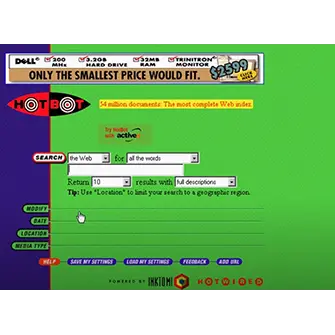
On its home page, it claimed to offer "the most complete Web index online" with 54 million documents. Acquired by Lycos in 1998, it underwent several redesigns before fading away in the 2010s.
Introduced in 2013 by Google's head of search Amit Singhal, this term refers to hands-free conversational search triggered by a wake word ("OK Google"), where humans converse directly with computers without typing.
Acronym for Hypertext Access.
The .htaccess file is a directory-level configuration file used on web servers. Placed most often in the root directory of a website, it controls server behavior (redirects, URL rewriting, caching headers, access control) for that directory and all its subdirectories.
A .htaccess file can also be placed inside a specific subfolder (such as an /images directory) to apply localized rules. It is used primarily on Apache servers and compatible servers like LiteSpeed. Like all server configuration files, it is case-sensitive.
Acronym for HyperText Markup Language.
The standard markup language used to structure web pages and weave hyperlinks between documents across the World Wide Web.
Acronym for HyperText Transfer Protocol.
A client-servercommunication protocol created in 1990 for the World Wide Web. It enables a web browser (Chrome, Opera, Firefox, Safari, etc.) to request and retrieve web pages and resources from a web server.
Excessive pride or self-confidence resulting in overbearing behavior and detachment from reality. A leader affected by hubris experiences a sense of omnipotence and arrogance that often leads to strategic blind spots.
A major overhaul of Google's core search algorithm announced in 2013, underpinned by patents such as "Synonym identification based on co-occurring terms" (filed in 2012, granted in 2013). Hummingbird was designed to better understand full conversational queries and semantic intent rather than isolated keywords, combining speed and precision to transform Google from a search engine into an answer engine.
An extension of hypertext referring to interconnected multimedia links built not just from text, but from infographics, video, images, audio, or interactive graphics.
A term coined by Ted Nelson in 1965. Hypertext is non-linear text that contains clickable links (hyperlinks) to other texts and documents.
Interactive Advertising Bureau. An international trade association founded in 1996 in the United States, bringing together ad networks, publishers, agencies, and ad-tech providers to establish industry standards, conduct research, and promote the effectiveness of digital advertising.
Identity and Access Management. A security framework and authentication process (such as multi-factor SMS codes, SSO, and role-based permissions) used to verify that a user or service attempting to access digital resources is genuinely authorized to do so.
Internet Engineering Task Force. An open international community of network designers, operators, vendors, and researchers whose mission is to make the Internet work better by producing high-quality, relevant technical documents (RFCs) that shape how people design, use, and manage the Internet.
An HTML element (<iframe>, Inline Frame) that allows a web page to embed another HTML document or external resource inside a frame—for example, embedding a YouTube video or interactive map on a web page.
A metric that counts each time an advertisement, search result, or piece of content is fetched and displayed on a user's screen.
Closely aligned with content marketing, inbound marketing consists of attracting prospects and customers naturally to a business rather than interrupting them with outbound ads, by publishing high-value content (white papers, infographics, blog articles, tutorials, podcasts, etc.). The goal is to provide useful, relevant information tailored to the audience's explicit and implicit needs, building a trusted brand that prospects turn to when ready to buy.
The essential raw material of computer science and mathematical modeling: by processing vast quantities of information and data using computers, humanity advances scientific knowledge alongside the traditional pillars of matter, energy, and waves.
The French word "informatique" (coined by Philippe Dreyfus in 1962 from information + automatique) specifically designates the science and engineering of automated information processing, and by extension the industry dedicated to these fields (French Academy of Sciences, 2013).
Modern computer science rests on five core pillars according to Gérard Berry (L'Hyperpuissance de l'informatique, p. 67): data, algorithms, programming languages, machines, and interfaces.
National Institute for Research in Digital Science and Technology (Institut National de Recherche en Informatique et en Automatique). Founded in 1967 by Jacques-Louis Lions (originally as IRIA), this French public research institute conducts world-class research across all areas of computer science, artificial intelligence, and digital technology for both industry and government. It was one of the founding host institutions of the W3C.
Institute for Information Sciences and Their Interactions (Institut des Sciences de l'Information et de leurs Interactions). A division of the French National Centre for Scientific Research (CNRS) created in 2009 to organize and advance academic research in computer science and digital technologies.
A scientific discipline aimed at enabling machines to solve complex problems. As defined by Turing Award laureate Yann LeCun, it is the ability of machines to perform tasks normally attributed to animals and humans that require perception, learning, reasoning, or planning.
Generative artificial intelligence is a class of machine learning models capable of creating new content—such as text, images, music, audio, video, and code—based on patterns learned from existing training data.
The process of learning from existing content is called training and results in the creation of a statistical foundation model.
When given a prompt, generative AI uses this statistical model to predict the most fitting continuation or output, thereby generating original content.
For example, a model can learn what a cat looks like by observing millions of different cat photos and recognizing recurring visual features associated with cats. The same principle applies to writing sonnets, resumes, or camping gear checklists.
Source: Google Generative AI FAQ
The INP metric evaluates the overall responsiveness of a web page to user interactions throughout its entire lifecycle in a web browser.
According to Chrome usage telemetry, 90% of a user's time on a page is spent after initial loading finishes. Hence the importance of measuring and optimizing INP, which officially replaced FID as a Core Web Vital in March 2024.
A global distributed packet-switched computer network co-invented by Vinton Cerf and Robert Kahn. It connects billions of computing devices (servers, computers, smartphones, IoT devices) worldwide via standardized protocols (TCP/IP). The Internet carries email, instant messaging, peer-to-peer file sharing, streaming, and the World Wide Web.
Internet of Things. The network of physical everyday objects—smartphones, smartwatches, connected cars, home appliances, industrial sensors—embedded with electronics, software, and network connectivity so they can exchange data over the Internet and act as autonomous smart assistants.
Internet Protocol. The core communications protocol used for routing data across the Internet. It breaks documents into data packets, routes them across networks, and reassembles them at the destination computer. Every connected device is identified by a numerical IP address. Two versions of the IP protocol are currently in use:
Derived from the Latin phrase ipse dixit, meaning "he himself said it." The fallacy of accepting an unsupported dogmatic assertion as true simply because an authority figure said it.
Internationalized Resource Identifier. An Internet standard that extends the URI syntax by allowing characters from the Universal Character Set (Unicode/ISO 10646)—supporting all the world's writing systems rather than being restricted to US-ASCII characters.
An object-oriented scripting language created in 1995 in just ten days for Netscape by Brendan Eich. It makes websites and web applications dynamic and interactive, powers complex UI animations, and even runs browser-based games. Originally, its defining feature was executing directly inside the user's browser (client-side) rather than on the server.
A major advantage of JavaScript is its ability to update page content asynchronously without reloading the entire web page. Popular JavaScript libraries and frameworks include jQuery, Angular (maintained by Google), React (maintained by Meta), and Vue.js, while Node.js enables JavaScript to run on the server side.
An online game created in 1988 by Robin Burgener that uses artificial intelligence (an artificial neural network) to ask twenty yes/no questions in order to guess the object the player is thinking of. At the end of twenty questions—and often by the fourteenth—it guesses the answer. If wrong, it asks five more questions and tries again, learning from every game played.
An innovation framework popularized by Clayton Christensen and Michael Raynor. Jobs to Be Done posits that customers are less interested in the products they buy than in the progress or "job" those products help them accomplish in a given circumstance. This echoes Theodore Levitt's famous observation: "People don't want to buy a quarter-inch drill. They want a quarter-inch hole!"
Acronym for JavaScript Object Notation. A lightweight data-interchange format derived from JavaScript object syntax and supported across virtually all modern programming languages. Easy for humans to read and write and easy for machines to parse and generate, it is the standard format for APIs and structured data on the Web (including JSON-LD).
Co-inventor of the TCP/IP protocol alongside Vinton Cerf. Awarded the ACM Turing Award in 2004.
Acronym for Keyword Efficiency Index. An SEO metric used to evaluate the attractiveness of a keyword by weighing its search demand against the level of competition in search engine results.
It is traditionally calculated by dividing the square of a keyword's monthly search volume by the number of competing web pages returned in Google search results. Example for the keyword "web agency":
The higher the score, the higher the potential return on effort for targeting that keyword.
A cyber-surveillance technique that consists of covertly installing spyware or hardware to record every keystroke typed on a keyboard in order to steal sensitive data (usernames, passwords, credit card numbers, etc.).
A spam technique prohibited by Google that consists of overloading a web page's text or meta tags with keywords in an attempt to manipulate a site's ranking in search engine results.
A free Google Ads tool that allows advertisers and SEOs to discover keyword ideas, check monthly search volumes, and estimate advertising costs.
A portmanteau of "knowledge" and "mol" (unit of measurement). Knol literally meant "a unit of knowledge." It was the name of Google's collaborative encyclopedia project launched in 2007 and permanently shut down in 2012.
Launched by Google in May 2012, this semantic knowledge base interconnects structured facts drawn from multiple databases to understand real-world entities—people, places, organizations, events, works—and the relationships between them. Automated processing allows Google to use the Knowledge Graph to display instant factual answers (Knowledge Panels) directly on the search results page.

An American computer scientist and professor emeritus at Stanford University, Donald Knuth is the author of the multi-volume magnum opus The Art of Computer Programming. Widely regarded as the bible of computer programming and algorithmic analysis, it has been meticulously written over decades by this legendary perfectionist—who famously offered a monetary reward check ($2.56, one "hexadecimal dollar") to anyone who spotted an error in his books. After earning his PhD in mathematics from Caltech in 1963, he dedicated his life to computer science and received the Turing Award in 1974.
Creator of Aliweb and inventor of the Robots Exclusion Standard (the robots.txt file) in 1994.
Key Performance Indicator. Quantifiable metrics that help you measure progress toward your strategic business objectives and verify regularly whether your actions are delivering the expected results.
Logics of Algorithms and Resolution of Problems.
Educational software designed for rapid prototyping of algorithms using pseudocode and flowcharts whose syntax is easy for both humans and computers to understand—ideal for teaching algorithmic logic to beginners.
The time required for a data packet to travel across a network from its source to the requesting destination device (measured in milliseconds).
Acronym for Largest Contentful Paint. A Core Web Vitals metric that measures when the largest content element (image, video poster, or block-level text) in the viewport finishes rendering and becomes visible to the user. According to Google, LCP should occur within 2.5 seconds of when the page first starts loading to provide a good user experience.
Common causes of a poor LCP score include:
HTML elements considered when calculating LCP include:
<img> elements;<image> elements inside an <svg> element;<video> elements (using the poster image or first rendered frame);url() function (as opposed to a CSS gradient);A core digital marketing practice consisting of attracting and qualifying potential customers (prospects) by capturing their contact information and guiding them toward a desired business action (requesting a quote, booking a demo, subscribing to a newsletter, or making a purchase).
The pen name of William Fitzgerald Jenkins, Murray Leinster was a prolific American science fiction writer who authored more than 1,500 short stories and articles, fourteen movie scripts, and hundreds of radio and television plays.
Leinster pioneered the "parallel universe / alternate history" subgenre—for instance, in his 1934 story "Sidewise in Time," which imagines a world where the Roman Empire never fell.
Even more remarkably, Murray Leinster envisioned the personal computer and the Internet with uncanny accuracy in his 1946 short story "A Logic Named Joe," describing interconnected home terminals ("logics") that could answer any question, stream video, and even create unintended chaos when content filters failed!
Outgoing or internal hyperlinks embedded directly within the editorial body text of a web page pointing to authoritative references and sources.
These qualified links substantiate claims made in the article: by clicking them, readers can verify primary sources and explore related subtopics in greater depth.
A link that appears on every single page of a website (for example, in the footer or sidebar). External sitewide backlinks with commercial anchor text should be avoided in SEO!
An organic SEO and content marketing strategy endorsed by search engines that consists of publishing exceptionally valuable, original, or interactive content on your website so that other publishers and users naturally want to share it and link to it.
Learning Management System. A web-based platform used to author, host, deliver, and track online training courses and educational programs.
A network and cloud infrastructure technique that distributes incoming traffic and workloads across multiple servers, preventing any single server from becoming overloaded during traffic spikes and ensuring high availability.
A file automatically maintained by a web server that records every request made to the website. Each line typically begins with the visitor's IP address, timestamp, HTTP status code, and user-agent—capturing visits from both human users and search engine crawlers.
Named after American engineer Robert Metcalfe (co-inventor of Ethernet), who stated that "the value of a telecommunications network is proportional to the square of the number of connected users of the system (N²)."
Formulated by Intel co-founder Gordon Moore (in its revised 1975 version), this empirical observation stated that the number of transistors on a microchip doubles approximately every two years. Rather than a physical law of nature, it served as an industry roadmap for semiconductor miniaturization and computing power.
The Long Tail concept was popularized by Chris Anderson in a landmark October 2004 article in Wired magazine, where he served as editor-in-chief until 2012.
It describes a niche-aggregation business model: selling small volumes of a vast number of hard-to-find items which, taken individually, generate modest sales, but when aggregated together can rival or exceed the market share of a few bestselling blockbusters. In SEO, it consists of capturing organic search traffic from thousands of specific, multi-word queries ("long-tail keywords") that each generate low search volume individually but represent the majority of qualified traffic when combined.
The daughter of poet Lord Byron, Augusta Ada King, Countess of Lovelace, is celebrated as the world's first computer programmer. Regarding Charles Babbage's Analytical Engine, she famously wrote:
"The Analytical Engine has no pretensions whatever to originate anything. It can do whatever we know how to order it to perform. Its province is to assist us in making available what we are already acquainted with."
In 1843, she published what is recognized as the first computer program intended to be carried out by a machine: a detailed step-by-step algorithm for Babbage's Analytical Engine to compute Bernoulli numbers.
In the late 1970s and 1980s, in her honor, the U.S. Department of Defense named its new high-integrity object-oriented programming language "Ada."
In SEO and information retrieval, terms and phrases closely associated with a specific topic that help disambiguate its meaning. LSI stands for "Latent Semantic Indexing."
In the late 1980s, Susan Dumais—a pioneering researcher who later made major contributions at Microsoft Research—co-developed Latent Semantic Indexing, a mathematical and statistical method (using singular value decomposition) applied to linguistics to move beyond simple exact-keyword matching and uncover underlying conceptual relationships in texts.
Her research showed that two people writing about and searching for the exact same concept often use different vocabulary (synonymy and polysemy), making semantic indexing crucial for information retrieval.
Like many early search engines, Lycos began in July 1994 as an experimental research project—originally just three pages of code—developed at Carnegie Mellon University by Dr. Michael Mauldin.
Initially built on John Leavitt's LongLegs program and the Pursuit search engine derived from DARPA's Tipster Text project for searching large document databases, Lycos launched publicly on July 20, 1994 with an index of 54,000 documents. By November 1996, it indexed 60 million documents, becoming the most popular search engine of its era following a record-setting IPO.
As a fun fact, the famous Lycos mascot dog is not a Labrador, but a black Labrador Retriever bred for retrieving game—etymologically, "Lycos" comes from Lycosidae, the wolf spider that actively hunts its prey rather than waiting in a web.
A branch of artificial intelligence trained on millions of data examples.
Software and applications powered by machine learning act as personalized assistants by making intelligent predictions based on patterns identified in user data. Without high-quality training data, machine learning cannot function.
Known in French project management as Maître d’Œuvre (MOE).
In an IT project, the Project Manager / Prime Contractor is the person or team responsible for executing the project and defining the technical resources required for implementation, in strict compliance with the specifications set by the Product Owner.
Known in French project management as Maître d’Ouvrage (MOA).
In an IT project, the Project Owner is the person or organization that defines what needs to be built, expressing business requirements (goals, deadlines, budget, etc.), most often through a formal project specification document.
Software platforms that automate repetitive marketing workflows tied to online customer acquisition and retention: traffic generation, lead nurturing, converting anonymous visitors into qualified prospects, and triggered email sequences.
An online multi-vendor e-commerce platform.
In the marketplace model, third-party sellers use a pure player's platform as a digital storefront for their products while retaining control over their own pricing and commercial levers—similar to a shopping mall in the physical world.
A distribution partnership where the producer (e.g., Booking.com) supplies its product catalog, which the distributor integrates directly into its own website and remits monthly commissions back to the producer (e.g., Promovacances).
A full-integration partnership where the distributor website (e.g., Go Voyages) manages the entire customer journey—publishing the product on its website via XML, handling booking and payment—and remits commissions to the producer.
Massive Open Online Courses.
Online educational courses made available—most often free of charge—to as wide an audience as possible. Leading universities and business schools pioneered the creation of MOOCs.
A comprehensive system of tools, components, and design guidelines created by Google to make mobile applications and web interfaces more intuitive, consistent, and user-friendly.
British physicist (born 1959) and science writer famous for his paper "Storks Deliver Babies," which demonstrated a statistically significant correlation between stork populations and human birth rates across Europe.
His paper brilliantly illustrates the danger of confusing correlation with causation when interpreting statistical data.
Google's first female engineer and 20th employee, who shaped Google's iconic search interface before serving as CEO of Yahoo! until 2017 following the company's acquisition by Verizon.
The rules, systems, and feedback loops that drive gameplay progression in response to player actions.
A contraction of MEMory EXtension, coined in 1945 by Vannevar Bush, a visionary scientist and researcher at the Massachusetts Institute of Technology (MIT).
He envisioned an electromechanical memory extension—a direct precursor to hypertext links—that would allow users to create associative trails between documents, read and annotate them, and automatically retrieve linked records.
He described this system in his landmark essay "As We May Think," published in The Atlantic Monthly.
Rigorous computer science techniques based on mathematical logic used to mathematically prove software correctness and drastically eliminate bugs in mission-critical systems such as aviation or automated train control.
The complex online consumer purchase decision-making process identified by Google's marketing research teams. The Messy Middle supersedes the linear purchase funnel formulated in 1924 by William Townsend (the classic AIDA model).
According to Google, it represents "a complex space between triggers and purchase, where customers are won and lost."
Every online purchase journey alternates between two distinct mental modes:
Shoppers loop back and forth between exploration and evaluation as many times as needed to reach a final decision. Six cognitive biases heavily influence their purchasing decisions:
Acronym for Made For AdSense. A website built solely to induce visitors to click on densely packed advertisements. The site's niche is usually tightly targeted to attract high-CPC traffic.
Mobile interactions lasting less than fifteen seconds, enabling users to complete a quick, focused, and useful task on their smartphone.
Pioneering American cognitive scientist and co-founder of MIT's AI laboratory. In 1969, he received the Turing Award for his foundational research into artificial intelligence and the mechanisms of human thought and emotion.
Centralized administration and security management of an enterprise's fleet of digital endpoints (laptops, smartphones, tablets) by IT departments.
Term popularized by Google (X Development) to describe ambitious, radical innovation projects aimed at solving global problems with long-term breakthroughs.
An automated software system that crawls the web to discover online content, indexes it, and ranks relevant results in response to user search queries.
Max Potential First Input Delay.
A web performance metric measuring the worst-case input delay a user might experience when attempting to interact with a web page while the browser's main thread is still busy loading resources.
Never confuse a Minimum Viable Product with a prototype!
A Minimum Viable Product is a product or service launched in its simplest functional form to test a business hypothesis with real customers at minimal cost.
However, it must be genuinely viable and well-executed so customers can form a clear opinion—avoiding the trap of discarding a brilliant idea simply because of poor execution. Gathering quantitative metrics, usage insights, and customer feedback is essential to validate whether to scale and iterate on the product.
Brilliant American mathematician and economist who made landmark contributions to game theory, differential geometry, and partial differential equations.
He is the only person to have been awarded both the Nobel Memorial Prize in Economic Sciences (1994) and the Abel Prize in Mathematics (2015). Recognized early on as a mathematical genius, he battled paranoid schizophrenia for nearly thirty years before making a remarkable recovery.
Leading South Korean search engine founded in 1999. Like Yahoo!, it operates as both a comprehensive web portal and a search engine.
Software application used to access and navigate the World Wide Web.
Examples: Brave, Chrome, Edge, Firefox, Opera, and Safari are the leading web browsers.
Acronym for Nanotechnology, Biotechnology, Information technology, and Cognitive science.
Refers to the multidisciplinary convergence of these four scientific and technological domains.
A Black Hat SEO practice aimed at sabotaging a competitor's organic search rankings by sending manipulative, toxic signals to search engines.
Common attacks include mass content duplication, malicious URL redirects, and pointing thousands of spammy backlinks at the target website.
An SEO strategy focused on acquiring high-quality backlinks from external websites pointing to your own site, using methods such as digital PR, linkbaiting, or guest outreach.
An open networking protocol designed to synchronize computer clocks worldwide over packet-switched networks with sub-second precision.
An AI-powered system that Google began deploying in 2018 to better connect words to underlying concepts across queries and web pages, acting as a super-synonym system.
The founding principle that internet service providers must transmit all network traffic equally without inspection, throttling, or prioritization—regardless of source, destination, content, or protocol.
The term was coined by Columbia Law professor Tim Wu in 2003.
A contiguous sequence of n items (characters, syllables, or words) from a given sample of text or speech.
In character-level analysis, an n-gram slices words into overlapping sequences of one, two, three, four, or five characters to calculate frequency distributions and statistical probabilities.
Algorithms use n-gram models to classify texts, detect languages, correct spelling, and compare semantic similarity.
Groundbreaking German mathematician specializing in abstract algebra and theoretical physics.
"In the judgment of the most competent living mathematicians, Fräulein Noether was the most significant creative mathematical genius thus far produced since the higher education of women began. In the realm of algebra, in which the most gifted mathematicians have been busy for centuries, she discovered methods which have proved of enormous importance in the development of the present-day younger generation of mathematicians."Albert Einstein
Portmanteau of "Noob" (newbie) and "Googler." Refers to a newly hired Google employee, traditionally recognizable by the multicolor propeller beanie worn during orientation.
Pioneering mathematician and engineer who began at NASA as a "human computer" before becoming the first female engineer to work in NASA's Mission Control during Apollo 8, calculating return-to-Earth trajectories for the Apollo lunar program.
Acronym for Net Promoter Score.
Customer loyalty metric introduced in 2002 by Fred Reichheld. NPS measures the likelihood that an organization's customers will recommend its products or services to others.
Based on the question "On a scale of 0 to 10, how likely are you to recommend company X or destination Y to a friend or colleague?", respondents are grouped into three categories:
Formula:
Net Promoter Score = % Promoters − % Detractors.
The score can range from −100 to +100. A strongly positive NPS reflects deep customer attachment; top-performing companies typically achieve an NPS more than double their industry average.
Acronym for New Information and Communication Technologies (NTIC in French).
Statistical definition:
"ICTs are statistically classified into three groups: computing (hardware production and related IT services), electronics (component and device manufacturing), and telecommunications (services and equipment), giving rise to four new families of activity: internet access provision, development support (consulting and assistance), dot-coms (virtual transposition of traditional commerce, banking, media, and education), and online intermediation (portals and search engines connecting web actors)."Christian Bialès
General economic definition:
"The new economy encompasses all current technological developments which, through their emergence and diffusion, generate new economic behaviors and drive profound structural changes."François Cazals
The opposite of analog.
The Encyclopédie of Diderot, d'Alembert, and Jaucourt (published between 1751 and 1772) defines it as "that which relates to numbers."
In its 2013 report, the French Academy of Sciences explains that "the adjective digital applies to any activity based on the digitization and processing of information: digital photography, digital audio, digital publishing, digital sciences, digital art, etc."
A unit of digital information storage equivalent to 8 bits (called an octet in French).
A term borrowed from philosophy. In computer science, an ontology is a formal, interconnected model of knowledge (concepts, entities, attributes, and semantic relationships) that enables machines to reason about a specific domain.
Built using graph structures and subsumption hierarchies, ontologies are foundational to the Semantic Web, knowledge graphs, and artificial intelligence.
Term coined in 2003 by Henry Chesbrough, professor at UC Berkeley's Center for Open Innovation. Open innovation is a paradigm assuming that firms can and should use external ideas as well as internal ideas—and internal and external paths to market—as they look to advance their technology.
It promotes cross-industry collaboration and knowledge sharing beyond corporate silos.
A programmable electronic machine capable of storing and processing digital information. The French word ordinateur was coined in 1955 by philologist Jacques Perret (1906–1992), a professor at the University of Paris, at the request of IBM France.
A computer that harnesses the properties of quantum mechanics to solve complex computational problems intractable for classical computers. Unlike a classical computer that processes binary bits (0s and 1s), a quantum computer operates on quantum bits, or qubits.
Qubits can exist in a simultaneous superposition of states. By leveraging "quantum superposition" and entanglement, a quantum computer evaluates vast multidimensional possibilities in parallel rather than purely sequentially.
An SEO content architecture term. A pillar page is a comprehensive hub page that covers a broad core topic in depth and links out to cluster pages addressing specific related subtopics.
Because all supporting cluster articles link back to the pillar page, it consolidates topical authority and is designed to engage and convert visitors.
Algorithm created by Google co-founder Larry Page, based on a mathematical formula that assigns an authority score to each web page based on the quantity and quality of incoming links pointing to it.
A Black Hat SEO technique involving the creation of numerous near-duplicate pages targeting closely related keyword variations (e.g., the same service duplicated across hundreds of cities). Typically, doorway pages funnel visitors to a single destination page without providing unique standalone value.
An analytics metric counted each time a web page is loaded (or reloaded) in a user's browser.
The practice of buying followed backlinks to manipulate search engine rankings—a violation of search engine spam policies.
Google search algorithm update first rolled out in February 2011 to evaluate overall content quality and penalize thin content, content farms, scraping (copying content from other sites without permission), and low-value pages.
Its goal was to significantly elevate the quality and trustworthiness of Google's organic search results.
Software components that analyze and convert structured data formats such as XML, HTML, or JSON into a machine-usable tree or stream (e.g., DOM, SAX).
A decentralized networking architecture enabling direct file and data sharing between interconnected computers without relying on a central server.
Each participating node acts simultaneously as both client and server. Historically popularized by file-sharing networks, P2P architecture now forms the backbone of blockchain protocols and Bitcoin.
Two main P2P architectures exist:
Term popularized by computer scientist Jeannette Wing in 2006. Computational thinking refers to the ability to formulate problems and structure information logically, sequentially, and at multiple levels of abstraction so that a solution can be executed by a human or machine.
Jeannette Wing defines computational thinking as "a universally applicable attitude and skill set everyone, not just computer scientists, would be eager to learn and use. Computational thinking involves solving problems, designing systems, and understanding human behavior, by drawing on the concepts fundamental to computer science."
Data-driven marketing and advertising strategies focused on measurable customer actions—such as clicks, leads, and sales—allowing marketers to optimize campaigns continuously based on concrete ROI.
Web performance measures the elapsed time between a user requesting a web page and the moment its content is fully rendered, responsive, and interactive in the browser. Measured in milliseconds, speed is a vital pillar of user experience—poor performance leads to frustration and site abandonment.
Web performance directly impacts bounce rate, conversion rate, revenue, user satisfaction, and organic search rankings.
In marketing and UX design, a semi-fictional archetype representing a key segment of your target audience based on shared goals, motivations, behaviors, and pain points. A well-crafted persona includes a name, demographic profile, professional context, and purchasing habits to guide product development and content strategy.
An attempt to change attitudes or behaviors or both, without using coercion or deception (B.J. Fogg, 2003).
A social engineering cyberattack in which scammers impersonate a trusted institution (bank, tax agency, cloud provider) via email or SMS to trick victims into revealing login credentials, credit card numbers, or personal data.
Google search filter launched in April 2012 to evaluate the quality and naturalness of backlink profiles, penalizing websites that engage in manipulative link schemes or over-optimize exact-match anchor text.
A hacker who uses technical exploits for malicious or illegal purposes (financial theft, data extortion, sabotage).
Contraction of "picture element." The smallest addressable colored dot on a digital display or raster image.
A JavaScript snippet placed on your website to track visitor actions, measure ad conversions, and build retargeting audiences on Meta platforms.
A digital hardware or software ecosystem that provides a foundation for running multiple applications and connecting users or services.
In SEO, user behavior where a searcher enters a query, clicks on a search result, immediately hits the "Back" button to return to the SERP, clicks another result, and repeats until finding a page that genuinely satisfies their intent.
Search engines analyze pogosticking as a strong signal of user dissatisfaction with a landing page's relevance or experience.
A piece of code (usually written in JavaScript) that provides modern web APIs and features on older browsers that do not support them natively. The term polyfill was coined by Remy Sharp in 2010.
An increasingly important modern SEO visibility metric.
Instead of measuring classic ranking position (1st, 2nd, 3rd), pixel position measures the vertical distance in pixels from the very top of the SERP to your organic result—accounting for ads, featured snippets, maps, and People Also Ask boxes.
The goal is to appear above the fold: roughly 400 px from the top on mobile screens and 800 px on desktop.
Nuisance software bundled alongside freeware downloads.
Installed without clear user awareness, PUPs hijack browser homepages, inject intrusive pop-up ads, and harvest browsing telemetry.
Logical formulas that evaluate to true or false depending on the values of their variables (Gérard Berry, 2017, p. 362).
General distributed programming that aggregates fragments of data across multiple remote sources and servers into a coherent, unified, and seamless experience for end users.
A classic example is peer-to-peer networking, where a user downloads a complete file assembled from chunks hosted across multiple peers.
The core challenge of diffuse programming lies in orchestrating remote machines, handling network latency and user errors gracefully, and maintaining end-to-end security.
A hybrid experience combining the reach of a mobile website with the capabilities of a native mobile app.
Introduced around 2015–2016 and strongly championed by Google, PWAs use modern web APIs and service workers to deliver app-like experiences with major advantages:
A project is defined in terms of specific results achieved by a predetermined date. […] It is a feasible subset that takes place within a defined timeframe and culminates in a measurable final outcome.
Tom Peters – The Circle of Innovation – 1997.
A standardized set of rules and conventions that allows different computers, networks, or software systems to communicate with one another.
In UX design, a prototype is an early sample, model, or interactive mockup of a product or interface built to test and validate concepts before committing to full engineering development.
It simulates the user journey so teams can observe real interactions and identify usability flaws early.
The primary goals of a prototype are to:
Common types of prototypes include:
Choosing the right prototype depends on the desired level of fidelity and the specific hypotheses being tested.
The automated buying, placement, and optimization of digital ad inventory in real time—typically powered by algorithmic Real-Time Bidding (RTB) auctions and audience data.
A company that conducts its commercial activity exclusively online without physical brick-and-mortar stores.
The fundamental unit of quantum information. Unlike a classical bit, which can only hold a value of 0 or 1 at any given time, a qubit can exist in a linear superposition of both 0 and 1 simultaneously—giving quantum computers exponential processing power for specific classes of problems.
A ranking model used by search engines like Google to determine whether a search query requires fresh, up-to-the-minute results. In short, QDF boosts newly published or recently updated content when a topic experiences a sudden surge in search volume or news coverage.
Key takeaways:
A machine learning AI system deployed by Google to interpret ambiguous or never-before-seen search queries by mapping words into mathematical vectors representing concepts.
This enables Google to return highly relevant pages even when they do not contain the exact keywords typed by the user.
Its deployment in Google Search was officially confirmed by Greg Corrado on October 26, 2015.
Automated programmatic ad exchanges where digital advertising impressions are bought and sold via instantaneous auctions while a web page loads.
A marketing technology capability that enables brands to recognize a customer's current context and deliver personalized, relevant interactions in real time across touchpoints.
For example, mobile notifications or website offers can dynamically adapt to local weather, geolocation, or live browsing behavior.
The formal validation phase verifying that all features and behaviors of a software application or website match the functional specifications defined in the project brief.
It involves both the delivery team (project manager/developers) and the project owner alongside key end-user stakeholders.
Conducted prior to production launch, UAT relies on rigorous, documented test scenarios.
Search engine approach introduced by Google in 2007 that blends multiple media formats—organic web links, images, videos, news, maps, and shopping results—onto a single search results page.
Restructuring existing computer source code to improve its internal readability, modularity, and maintainability without changing its external behavior—reducing technical debt and future maintenance costs.
Website visits arriving via hyperlinks clicked on third-party websites (partner sites, media articles, directories, forums) rather than directly from search engines.
A numbered series of formal technical documents published by the IETF that define the protocols, standards, and architectural specifications of the Internet.
Engineers proposing a new standard author an Internet-Draft and submit it to the IETF for peer review and community consensus.
Once refined and approved by a working group, it is published as an official RFC.
A network of websites and apps that show visual banner, video, or text advertisements to targeted audiences.
RDF is to the Semantic Web of data what HTML is to the web of documents: a standard W3C model for describing, representing, and linking resources exchanged on the web. RDF structures every statement as a semantic triple:
Additional W3C resources:
External scripts, stylesheets, fonts, or media hosted outside the primary website's domain and controlled by external vendors (analytics, ad networks, chat widgets, social embeds).
While convenient, excessive third-party scripts frequently degrade web performance and page load speed.
In the online retail (1P) model, an e-commerce pure player purchases inventory wholesale from brands and resells it under its own name, just like traditional mass-market retailers in the physical world.
This model allows manufacturers to leverage the online retailer's merchandising expertise, logistics infrastructure, and localized international reach.
Following annual commercial negotiations, the pure player takes ownership of the inventory and manages warehousing, fulfillment, retail pricing, and promotional campaigns.
This distribution model suits established brands with strong product demand seeking to scale sales volume and expand into new international markets.
A retail brand that unifies its physical brick-and-mortar stores and e-commerce websites into a single, seamless sales and fulfillment channel.
A marketing metric measuring gross revenue generated for every dollar spent on advertising. For example, if you spend $100 on an ad campaign and generate $150 in direct sales, your ROAS is 150% (or 1.5x).
Total monetary value of products sold on a website relative to traffic and conversion rate.
Enhanced organic search listings powered by Schema.org structured data that display extra visual and factual details directly in the SERP, helping users quickly gauge a page's relevance.
Rich snippets commonly highlight four key types of information:
"A successful marriage between an automaton and a computer."
Before crawling a website, a search engine bot first checks the root of the server for a plain-text robots.txt file. Developers use this file to specify which directories or pages search engine crawlers (spiders) are allowed or disallowed to crawl. Note: these directives are instructions for compliant bots, not a security mechanism! A domain can only have one robots.txt file at its root, and its filename must be written in lowercase.
Business process automation technology.
RPA deploys software robots to execute repetitive, rule-based administrative tasks across applications instead of relying on manual human data entry—boosting speed, productivity, and accuracy.
A networking device that acts as a traffic director, forwarding digital data packets between computer networks toward their final destination.
A router handles files (music, photos, web pages, emails) broken down into small data packets. These packets may travel across different network paths and arrive out of order before being reassembled on the recipient's device. Each router maintains a routing table of available paths and dynamically selects the optimal route based on speed, congestion, and network availability.
Father of modern neuroscience. He was the first scientist to demonstrate the discrete cellular structure of neurons, earning the Nobel Prize in Physiology or Medicine in 1906.
The capacity of a business or technical system to grow rapidly and handle surging demand without a proportional increase in costs (B.J. Fogg, 2003).
Digital products are inherently scalable because they can reach a global audience at an incremental cost not much higher than serving a local market (e.g., SaaS platforms, social networks). A scalable business model absorbs rapid user growth without requiring heavy linear capital expenditure.
An XML-based 2D vector image format standardized by the W3C. Its major advantage is infinite scalability without any loss of visual sharpness, making it ideal for responsive websites, icons, and high-DPI mobile screens.
A lightweight computer program executed to automate specific tasks and make web pages or applications dynamic and interactive.
Unskilled individuals who use pre-made hacking scripts or exploit tools written by others purely for bragging rights, without understanding the underlying code. True security researchers do not consider them real hackers.
Paid search marketing technique that involves bidding on keywords to display sponsored ads in search engine results and convert high-intent visitors into customers.
The combined discipline of organic search optimization (SEO) and paid search advertising (SEA).
"SEO is not about tricking search engines, spamming links, or ruining web design. It's about creating great content, understanding how people might search for it—including the words they might use—and ensuring that content is search-engine friendly while also being human-friendly." — Danny Sullivan, Search Engine Land, September 9, 2010.
A discipline focused on optimizing a website's technical configuration, content relevance, and incoming link authority to improve user experience and satisfy search intent.
"SEO is a set of practices designed to increase the quantity and quality of traffic to a website." — Foundations of Digital Marketing and E-commerce, Coursera / Google.
Acronym for Search Engine Results Page (or Search Engine Ranking Position). The page of organic "blue links," rich results, and ads displayed by a search engine in response to a user's query.
A marketing buzzword claiming that user experience metrics directly boost organic search rankings—a popular misconception, even though UX and SEO work hand in hand to convert traffic.
Cryptographic security protocol that encrypts sensitive data transmitted between a web browser and a server—such as credit card numbers and login credentials. Whenever a browser establishes a secure connection, the server presents a digital certificate issued by a trusted Certificate Authority verifying the website's identity.
Topical PageRank measuring the semantic affinity of a page for a given query, propagated across pages via contextually relevant internal links.
Both the physical hardware (server machine, storage drives) that hosts a website's files and the HTTP server software that processes requests and delivers web pages to users' browsers. Apache, IIS, Lighttpd, and Nginx are among the most widely used web servers.
An autonomous JavaScript script running in the background of the browser that acts as a programmable network proxy between the web application and the network. Essential to Progressive Web Apps (PWAs), service workers manage intelligent page caching, enable offline browsing, and handle push notifications.
A period of continuous user interaction with a website or mobile app. All user actions (page views, video plays, e-commerce purchases) within that timeframe are grouped into a single session.
AMA stands for "Ask Me Anything." A live interactive Q&A session where an audience can ask any question on a given topic to one or more subject-matter experts.
Seznam is a Czech search engine and web portal founded in 1996 by Ivo Lukačovič. Like Yahoo!, it combines search capabilities with news and portal services.
American mathematician and electrical engineer who founded Information Theory in 1948, laying the mathematical bedrock for all modern digital telecommunications, data compression, broadband (ADSL), and wireless networks by defining information as a measurable mathematical quantity (the bit).
The minimal HTML, CSS, and JavaScript required to power the user interface skeleton of a Progressive Web App. An app shell must:
A structured XML file hosted on a website that lists all important URLs to help search engine crawlers discover and index pages efficiently.
In SEO, describes an element—such as a navigation link or banner—that appears across every single page of a website (for example, a sitewide footer backlink placed by a web agency on a client's website).
A UI design style in which digital interface elements mimic the appearance, textures, and physical mechanics of their real-world counterparts (e.g., a camera shutter icon for taking a photo, or a spiral-bound notepad app).
A tall, vertical display advertising banner placed along the left or right sidebar of a web page, typically measuring 160 × 600 pixels or 120 × 600 pixels.
A neologism derived from the forward slash character (/) on computer keyboards, describing a professional who pursues multiple distinct careers or income streams simultaneously (e.g., UX Designer / SEO Consultant / Lecturer).
The slug is the human-readable part of a URL located after the final forward slash that identifies a specific page. Best practice is to craft concise, descriptive slugs that clearly communicate the page's topic to both users and search engines.
A digital learning format (contrasted with a massive open MOOC) designed for a small, targeted cohort of learners working collaboratively on a specific subject.
Strategies and techniques used to optimize a brand's or individual's visibility, reach, and engagement across social media platforms.
A B2B sales methodology that uses professional social networks to build relationships and generate leads. Contrary to popular belief, social selling is not about mass-connecting with strangers to spam them with sales pitches—it is the art of starting meaningful conversations and genuinely helping prospects solve their business challenges.
A URL that displays a "page not found" message or empty/thin content to users while erroneously returning an HTTP 200 (OK) status code instead of a proper 404 or 410 status code. While not a direct penalty, soft 404s waste crawl budget and prevent proper de-indexing.
Unsolicited or low-quality manipulative content engineered to artificially rank at the top of search engine results on Google, Bing, etc.
Portmanteau of "spam" and "indexing."
A Black Hat SEO technique penalized by search engines that involves mass-generating thousands of low-quality pages overnight around targeted keywords to trick search algorithms into ranking the domain.
A spam technique that sends fake referral requests to a website's analytics tracking ID so the spammer's URL appears in the site owner's "Referral Traffic" reports. Referrer spam is easy to spot by its near-100% bounce rate and 0-second average session duration.
A formal report submitted via Google Search Console's spam reporting form to flag a website violating Google's Search Essentials (spam policies).
An open networking protocol developed by Google to reduce web page load latency through multiplexing and header compression. SPDY later served as the foundation for the HTTP/2 standard.
A key web performance metric that measures how quickly the visible content above the fold is visually populated during page load. The lower the Speed Index score, the faster the perceived load—Google recommends a Speed Index under 1,000 ms (or under 3.4 seconds on mobile).
A practice strictly prohibited by Google.
A splog is a fake blog populated with automatically scraped or randomly spun gibberish content designed solely to host ads or manipulate backlinks.
Identity falsification in cybersecurity. Spoofing is a technique used by attackers or malicious software to masquerade as a trusted entity in order to infiltrate systems or deceive users. Common forms include:
Malicious software covertly installed on a device to monitor user activity—emails, text messages, keystrokes, browsing history, and credentials—often targeting corporate networks.
Commercial surveillance software even more invasive than traditional spyware, marketed to individuals to covertly spy on partners or family members. Stalkerware intercepts photos, text messages, and videos, tracks real-time GPS location, and eavesdrops on phone calls.
The elapsed time until the browser paints the very first visual element on screen, ending the initial blank white page phase.
"Startups are temporary organizations designed to search—not execute—for a scalable and repeatable business model." — Steve Blank.
According to Jean-Philippe Timsit, Professor of Digital Strategy at EM Lyon Business School, digital strategy encompasses the digital methods and frameworks that enable an organization to build a sustainable competitive advantage. Two complementary approaches shape a digital strategy:
He emphasizes that digital strategy is fundamentally distinct from operational digital marketing or growth hacking.
The art and science of embedding a hidden message or invisible digital watermark inside an ordinary image or audio file to prove authenticity or prevent tampering (Gérard Berry, 2017).
In computer programming, a data type representing a sequence of characters (text).
In logic and knowledge representation, subsumption defines a hierarchical "is-a" inclusion relationship between two concepts. For example, the concept of "car" is subsumed by the broader concept of "vehicle": every car is a vehicle, but not every vehicle is a car. Subsumption is heavily used in computer science to build formal ontologies.
A cold contact who has never visited your website—for instance, an email address acquired via a partner co-registration list—representing a low-intent, unvetted audience segment.
The percentage of website or app visitors who complete a desired goal (such as a purchase, booking, or form submission), calculated by dividing total conversions by total visitors or sessions. A higher conversion rate reflects stronger commercial and UX performance.
A key social media and content marketing metric measuring the percentage of people who actively interacted with a post or campaign (likes, comments, shares, clicks) relative to total reach or impressions.
The percentage of visitors or sessions that leave a website after viewing only a single page without triggering any further interaction.
The hierarchical classification of categories and navigation structures within a website's information architecture.
In the Semantic Web, a taxonomy is a structured scheme for classifying and organizing concepts into parent-child hierarchies ("is a subset of" or "belongs to"), making complex datasets easier to search, navigate, and understand.
Acronym for Transmission Control Protocol.
A core, reliable transport protocol of the Internet that governs how data packets are exchanged between sending and receiving computers. TCP guarantees end-to-end delivery Integrity by requiring the receiver to acknowledge receipt of every packet—automatically retransmitting any lost or corrupted packets so the complete file is reconstructed seamlessly.
A mental model and learning method popularized by Nobel Prize-winning physicist Richard Feynman that involves explaining a complex concept in plain, simple language using everyday analogies—exposing any gaps in one's own understanding.
The time it takes for a web server to process an HTTP request and begin sending a response back to the user's browser. Fast server response time is critical for SEO because slow servers bottleneck search engine crawl budget and degrade user experience.
A software engineering practice in which developers first write an automated test for a new feature (watching it fail because the feature code does not exist yet), then write the simplest code necessary to pass the test, run the test suite to verify correctness, and finally refactor the code while keeping all tests green.
Acronym for Term Frequency–Inverse Document Frequency.
A statistical measure used in information retrieval and SEO to evaluate how important and distinctive a word is to a specific document relative to a larger corpus of documents.
A branch of mathematics used to model pairwise relationships between objects. In graph theory, graphs consist of nodes (also called "vertices") connected by edges (also called "links"). When edges have a specific direction indicated by an arrow, the structure is called a directed graph.
An interdisciplinary branch of engineering and mathematics that deals with the behavior of dynamical systems, enabling machines to automatically regulate their own output using feedback loops when environmental variables change—essential in aviation autopilots, autonomous vehicles, and industrial robotics.
A public-domain reference resource published by the U.S. Central Intelligence Agency (CIA), originally printed annually and now updated continuously online. It provides authoritative geographic, demographic, political, economic, military, and communications data on every country in the world, serving as a trusted seed source for Google's Knowledge Graph.
A foundational web performance metric measuring the time between the browser requesting a page and receiving the very first byte of data from the web server.
A page load performance metric measuring the time required for a web page to become fully interactive and reliably responsive to user input—not merely visually rendered.
Term introduced by Google in October 2021 to designate the clickable headline displayed for a search result on the SERP.
Not to be confused with the HTML <title> tag placed in your page's <head>, or the on-page <h1> main heading.
While Google uses your HTML <title> tag as the default source for the title link in the vast majority of cases, it may dynamically rewrite the title link if it deems the <title> tag too long, stuffed with keywords, or unrepresentative of the page.
Internet acronym for "Too Long; Didn't Read." Used either to dismiss an overly lengthy text or to introduce a concise executive summary at the top of a long article.
Acronym for Transport Layer Security.
The modern cryptographic protocol (successor to SSL) that secures data communications over the internet through server authentication, data integrity verification, and end-to-end encryption.
A proprietary metric developed by Majestic that categorizes the web into hundreds of industry verticals to show which specific topics a website holds authority in.
Topical Trust Flow helps SEOs identify authoritative domains within specific niches and evaluate the topical relevance of backlink profiles.
Scored on a logarithmic scale from 0 to 100, it measures the relative topical influence of a web page, subdomain, or root domain based on its proximity to trusted seed sites.
Sites closely linked to authoritative seed sites earn higher scores, whereas sites linked from questionable neighborhoods score much lower. A score of 30+ signals solid credibility, while 40+ represents strong niche authority.
In short, it acts as a topical PageRank.
According to Jean-Philippe Timsit, Professor of Digital Strategy at EM Lyon Business School, digital transformation is the deep integration of digital technologies into an organization's core processes across three dimensions:
Digital transformation must be designed to improve overall organizational performance toward clear internal and external objectives.
A semi-automated link analysis technique developed by researchers at Stanford University and Yahoo! to combat web spam.
Human experts first vet a small seed set of highly trusted pages, and the algorithm then follows outbound links from those seed sites to propagate a diminishing trust score across the web—filtering out spam pages. Historically used by Yahoo!.
Visionary British mathematician and logician who designed the electromechanical Bombe machine (building on earlier work by Polish mathematician Marian Rejewski). During World War II at Bletchley Park, his work enabled the Allies to decipher Nazi Germany's Enigma-encrypted communications. After the war, he laid the theoretical foundations of modern computer science and artificial intelligence, formulating the famous Turing Test.
A programming language characteristic where variable data types are determined at runtime rather than explicitly declared in advance (e.g., JavaScript, Python).
A programming language characteristic that requires developers to explicitly declare the data type of every variable before compilation (e.g., Java, C, Rust).
Term popularized by Publicis CEO Maurice Lévy in December 2014 to describe how established incumbents are disrupted by digital platforms that directly connect independent service providers with end customers in real time.
Acronym for User Interface.
All visual, graphic, and interactive elements (typography, color palettes, buttons, icons, layout) through which a user interacts with a website, mobile app, or software product.
Derived from the Latin aphorism "Sutor, ne supra crepidam" ("Shoemaker, not beyond the shoe"). An ultracrepidian is a person who confidently opines and gives advice on subjects entirely outside their area of knowledge—often fueled by the Dunning-Kruger effect.
Acronym for Uniform Resource Identifier.
A standardized string of characters that uniquely identifies an abstract or physical resource on the web (documents, entities, connected IoT objects).
Example: https://cars.example.com/megane3.
URIs are central to the Semantic Web and the Internet of Things (IoT).
Acronym for Uniform Resource Locator.
A URL is a specific type of URI that not only identifies a resource but also specifies its network location and retrieval protocol (http://, https://, ftp://).
Example: https://www.gaillard-thierry.com.
Standard URLs rely on the US-ASCII character set.
The process of mapping a user-facing Uniform Resource Locator (URL) to a specific underlying file, controller, or resource on the web server.
An HTTP request header string sent by a web browser or crawler to a web server to identify the client application, operating system, and version.
Acronym for Unique Selling Proposition.
A foundational marketing concept coined in the 1940s–1960s by advertising pioneer Rosser Reeves. He argued that advertising must focus laser-sharply on the single primary benefit a product delivers to customers rather than trying to say everything at once.
A compelling USP can be distilled into a clear statement that answers four essentials:
Acronym for Unique Value Proposition.
A clear statement of the unique value a company delivers to its customers, answering the question "Why should a prospect buy from you rather than anyone else?" across three dimensions:
Acronym for User eXperience.
Coined in the early 1990s by cognitive scientist Donald Norman at Apple to encompass every aspect of a person's interaction with a company, its services, and its digital or physical products.
True user experience extends far beyond screens and software interfaces.
In computer programming (such as JavaScript), a keyword used to declare a variable.
A named memory location used by a computer program to temporarily store data values that can be read or modified during execution.
Variables are fundamental to programming because they allow code to reference and manipulate dynamic data repeatedly.
Common variable data types include:
Real-time verbatim transcription of live events (conferences, lectures, broadcasts) using a specialized chorded keyboard to provide instant live captions for deaf and hard-of-hearing audiences.
In web analytics, a user who visits your website multiple times within a 30-day window.
A distinct user who visits your website at least once during a given reporting period (typically 30 days), counted only once regardless of how many sessions they initiate.
In 1991–1992, Tim Berners-Lee manually compiled the very first directory of websites on the fledgling World Wide Web. An archived version can still be browsed at vlib.org.
Acronym for Voice Over Internet Protocol.
Technology that transmits human voice communications as digital data packets over IP networks rather than traditional circuit-switched telephone lines.
VoIP dramatically improved global call quality while slashing telecommunications costs.
How it works: an audio codec digitizes and compresses the speaker's voice, routes it across the internet in IP packets, and decompresses it into clear audio on the recipient's device.
Acronym for Virtual Private Network.
An encrypted tunnel between a user's device (VPN client) and a remote VPN server. It protects browsing privacy on public networks and masks the user's real public IP address behind the VPN server's IP.
A flaw or weakness in software code, configuration, or a website's architecture that an attacker could exploit to gain unauthorized access or compromise user data.
The very first web robot (crawler), created in June 1993 by Matthew K. Gray at the Massachusetts Institute of Technology (MIT). Written in Perl, the Wanderer was built to measure the growth of the early web.
A digital specialist who collects, measures, analyzes, and reports on behavioral data from web and mobile analytics platforms to optimize conversion rates and user experience.
Since December 5, 2019, WebAssembly has been an official W3C web standard alongside HTML, CSS, and JavaScript, originally created to support high-performance 3D gaming, video editing, and virtual reality in the browser.
It provides a compact binary instruction format (bytecode) that allows low-level languages such as C, C++, and Rust to run in web browsers at near-native speed. WebAssembly bridges the gap between source code and machine instructions.
A suite of standardized browser APIs that allow developers to create reusable, encapsulated custom HTML elements whose internal styles and logic remain isolated from the rest of the page's code.
Until Brian Pinkerton (a researcher at the University of Washington) launched WebCrawler on April 20, 1994, early search engines only indexed a page's URL, title, and first 100 words. WebCrawler was the first modern search engine spider capable of indexing the full text of web pages. Acquired by AOL in 1995 and Excite in 1997, it is now owned by InfoSpace.
"The Semantic Web is an extension of the current web in which information is given well-defined meaning, better enabling computers and people to work in cooperation. The Semantic Web isn't just about putting data on the web. It is about making links, so that a person or machine can explore the web of data. With linked data, when you have some of it, you can find other, related, data." — Tim Berners-Lee.
Its core principle is to generalize resource identifiers (URIs, IRIs) beyond simple document locations and use formal W3C graph languages (RDF, OWL, JSON-LD) so search engines and AI systems can understand the meaning and relationships of data across the web.
Building a website "from scratch" means hand-coding it from a blank page without relying on a pre-packaged CMS (like WordPress) or bloated templates. Every line of HTML, CSS, and JavaScript is custom-engineered around the client's exact needs, resulting in superior web performance, security, and technical SEO.
An ethical security researcher who performs authorized penetration testing on computer systems to uncover and help patch vulnerabilities before malicious actors can exploit them.
A low-fidelity structural blueprint or schematic sketch created during the early design phase of a website or application to define page layout, information hierarchy, and core user flows before visual UI styling is applied.
The World Wide Web is the global information system invented in 1989–1990 by Tim Berners-Lee (2016 Turing Award laureate) and Robert Cailliau at CERN, enabling users to browse interconnected documents via hypertext links. Web = HTTP + HTML + URL.
An international non-profit standards organization founded by Tim Berners-Lee in October 1994, initially uniting MIT and CERN, soon joined by INRIA in France and Keio University in Japan.
The W3C develops open web standards to ensure long-term interoperability across all web browsers and devices. Today, more than 400 public and private member organizations contribute to its working groups.
One of the earliest search engines on the Internet, created by developer Oscar Nierstrasz at the University of Geneva and officially launched on September 2, 1993. Rather than crawling the entire web directly, it aggregated and reformatted existing curated web directories into a searchable interface before retiring on November 8, 1996.
A French search engine founded in 2013 by Xilopix and acquired by fellow French search engine Qwant in November 2017.
XML (Extensible Markup Language) is a W3C markup specification that defines rules for encoding documents in a format that is both human-readable and machine-parsable. It is "extensible" because developers can define custom tags and attributes tailored to any application domain.
Unlike HTML—which uses predefined tags (<h1>, <p>) to display content in a browser—XML makes no assumptions about presentation; its sole purpose is to structure, store, and transport data reliably.
XML is widely used in sitemaps, RSS feeds, configuration files, enterprise databases, and machine-to-machine communication protocols.
Coined by Doug Edwards, Google's 59th employee. A Xoogler is an ex-Googler (former Google employee). Many have formed active alumni networks such as Xoogler.co to support former employees launching their own startups.
Originally launched in January 1994 as a curated web directory ("Jerry and David's Guide to the World Wide Web") by Stanford University students David Filo and Jerry Yang, Yahoo! soon added keyword search capabilities and grew into one of the web's dominant portals and search engines before losing market share to Google.
Leading Russian web portal and search engine founded in 1997 by Arkady Volozh and Ilya Segalovich. It operates both an international edition and a Russian-language portal.
Acronym for Zero Moment Of Truth.
This consumer behavior model was coined by Google in 2011 as an evolution of Procter & Gamble's classic FMOT (First Moment of Truth) and SMOT (Second Moment of Truth) framework.
The ZMOT is the exact moment when a consumer picks up their laptop, smartphone, or tablet to research a product or service—reading reviews, comparing specs, and watching demos—before ever speaking to a salesperson or visiting a store.
That decisive online research window shapes whether the buyer chooses your brand or a competitor.
In the digital age, customers make up their minds long before encountering your product in person—making search visibility and online reputation at the ZMOT mission-critical.