Are ROI and strategy truly compatible?
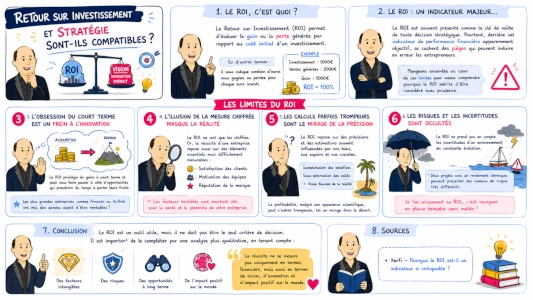
The Return on Investment (ROI) is a major indicator in management used to evaluate the economic gain or loss generated by an outlay relative to its initial cost.
For example, if you invest $1,000 in an advertising campaign that generates $2,000 in revenue, your ROI is 100% because you gained $1,000 on a $1,000 outlay.
The Return on Investment is frequently heralded as the supreme cornerstone of all strategic decisions. Yet, many managers overlook the hidden pitfalls of this backward-looking ratio.
Profitability accounts solely for immediate financial flows, failing to reflect the qualitative, transformational foundations of organizational resilience.
 Author: Thierry P. Gaillard -
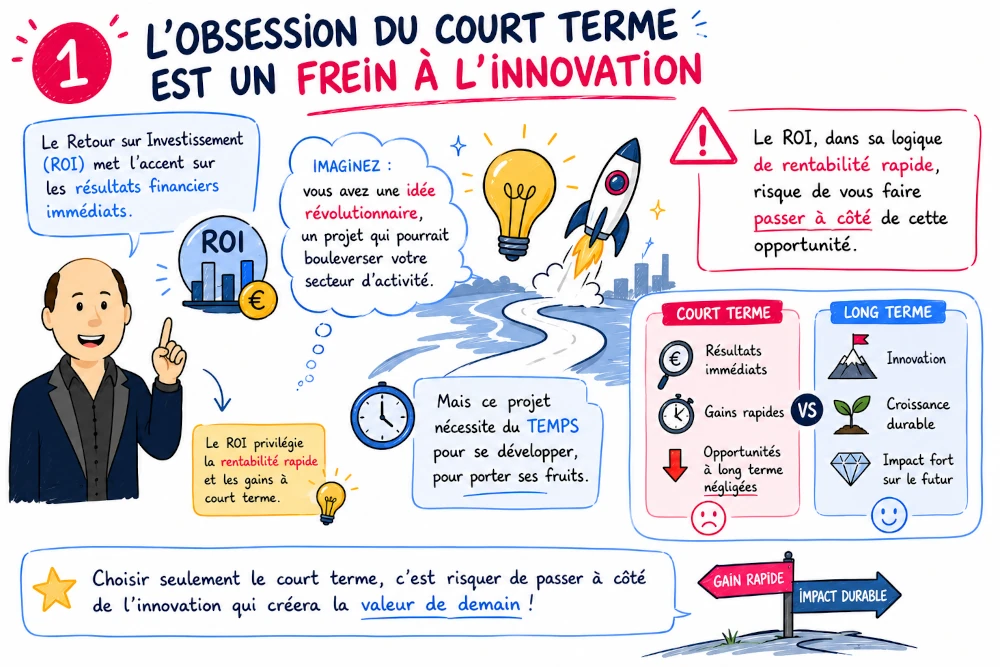
Short-term obsession acts as a brake on innovation
The relentless demand for immediate financial returns pushes leaders toward low-risk, incremental improvements at the expense of bold, transformational bets. Disruptive innovations rarely generate positive ROI in their early stages; evaluating them through strict short-term payback models virtually guarantees their premature cancellation.
Industry pioneers succeeded precisely because leadership prioritized customer infrastructure, network scale, and strategic positioning over quarterly ROI targets for years.

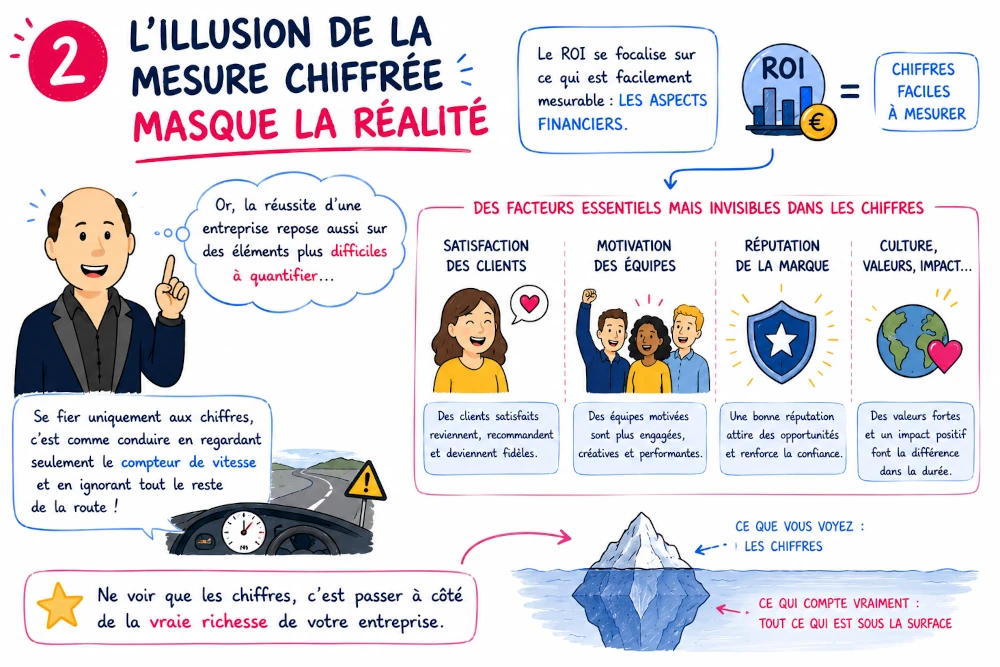
The illusion of quantified metrics masks qualitative reality
ROI rewards what is easily measurable (immediate costs and revenues) while ignoring what is vital yet difficult to quantify: brand equity, organizational culture, employee morale, and long-term customer trust.
When organizations cut R&D, training budgets, or customer support to boost short-term ROI, the numbers look favorable on paper while the enterprise's foundation quietly erodes.
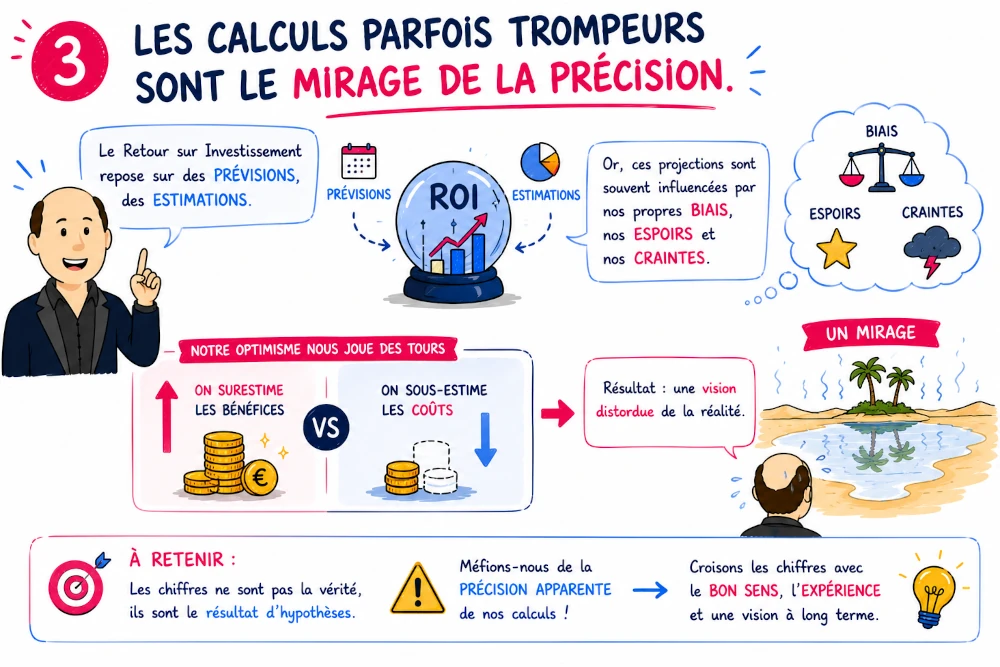
Misleading calculations create a false sense of precision
ROI formulas appear objective and scientific, but their outputs are only as reliable as the subjective assumptions fed into them: discount rates, projected adoption curves, and cost allocations. In practice, spreadsheet projections are easily manipulated to justify pet projects or kill promising initiatives.
Precision should never be mistaken for accuracy.
Downside risks and emerging uncertainties are sidelined
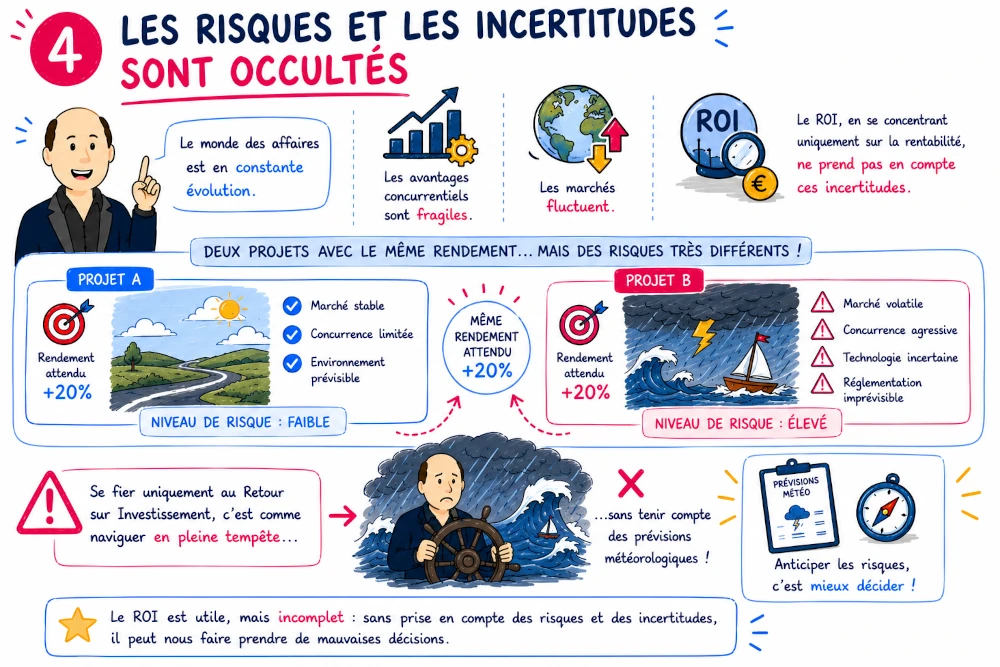
Le monde des affaires est en constante évolution. Les avantages concurrentiels sont fragiles, les marchés fluctuent. Le ROI, en se concentrant uniquement sur la rentabilité, ne prend pas en compte ces incertitudes. Deux projets avec un rendement identique peuvent en réalité présenter des niveaux de risque très différents. Se fier uniquement au Retour sur Investissement, c'est donc comme naviguer en pleine tempête sans tenir compte des prévisions météorologiques.
Conclusions and strategic recommendations
ROI remains a useful operational metric for evaluating well-defined, short-term capital expenditures. However, treating ROI as the supreme arbiter of corporate strategy is dangerous. To build enduring competitive advantages, executives must complement ROI with strategic scorecards: customer lifetime value, market agility, technological capabilities, and strategic optionality. Balance financial discipline with visionary ambition.
En tant qu'entrepreneurs, nous devons garder à l'esprit que la réussite ne se mesure pas uniquement en termes financiers, mais aussi en termes de vision, d'innovation et d'impact positif sur le monde.