
4 Key stages to successfully launch your online store
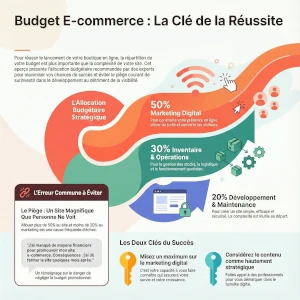
Launching an e-commerce store is no longer just about setting up a shopping cart—it requires a coordinated operational, technical, and commercial strategy to avoid running out of capital before reaching product-market fit.
From initial unit economic modeling and platform selection to high-converting UX design, payment gateway trust, and multi-channel customer acquisition, every link in the chain directly determines your profitability.
In this article and accompanying podcast, discover the 4 foundational stages to turn your e-commerce project into a sustainable, scalable commercial success.
 Author: Thierry P. Gaillard -
Stage 1: define clear objectives, margin models, and realistic budgets
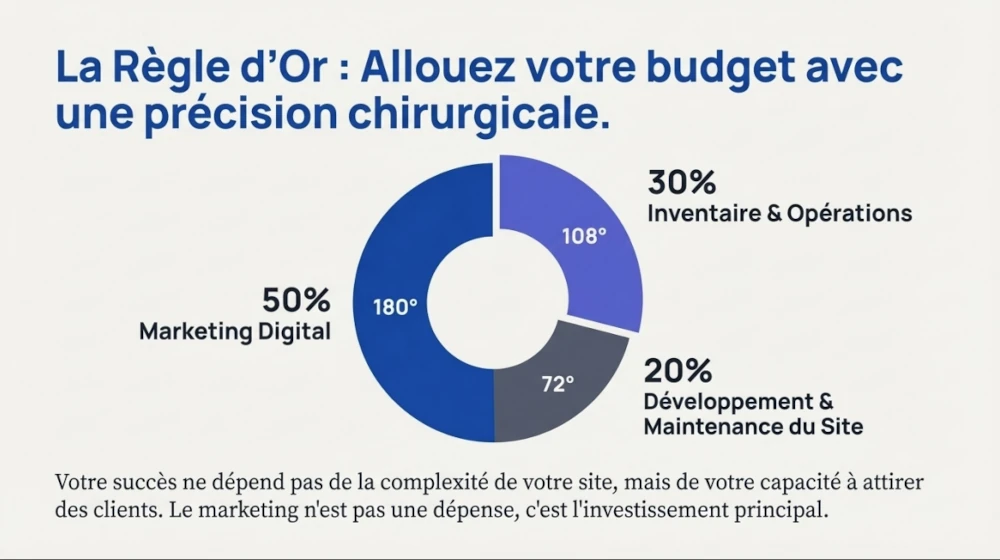
Launching an online store requires careful budget planning and clear objectives. You must allocate your budget across design, website maintenance, web marketing, and day-to-day operations.
An effective rule of thumb is to allocate:
- 20% for website development and maintenance,
- 50% for digital marketing,
- 30% for inventory (product or license management) and daily operations.
The aborted online travel agency
Warning! These percentages are not chosen at random; they correspond to specific operational needs confirmed across the launch of multiple online stores.
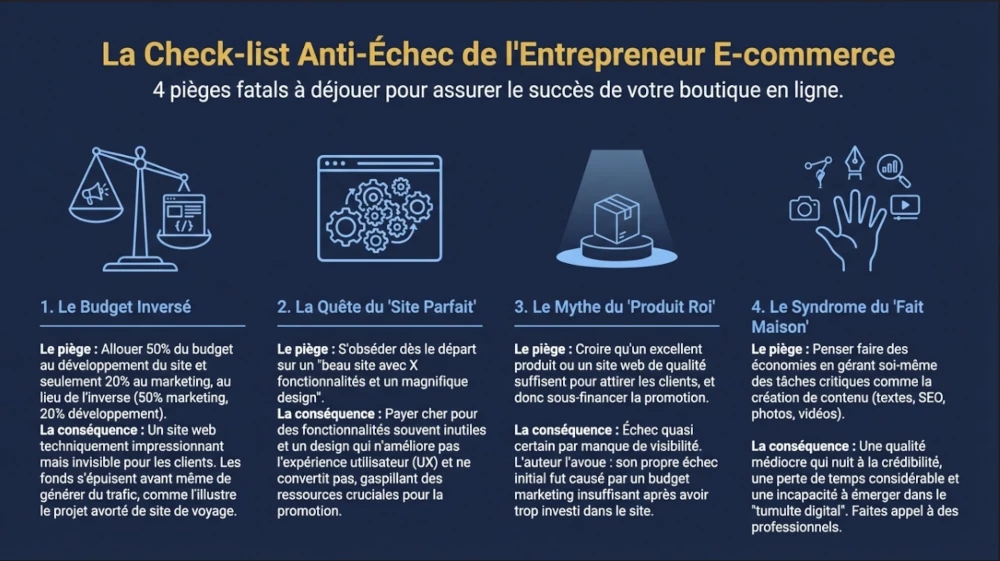
I have repeatedly encountered entrepreneurs who allocated 50% of their budget to development and only 20%—or even less—to web marketing.
For example, for a Canadian travel destination website, my contact insisted on building an overly ambitious site packed with features alongside a native mobile app right from Version 1. Furthermore, he placed disproportionate emphasis on visual design (logo, colors, fonts, etc.) at the expense of web marketing. Ultimately, investors refused to back him and he had to abandon his project before even launching.
A beautiful website with X features
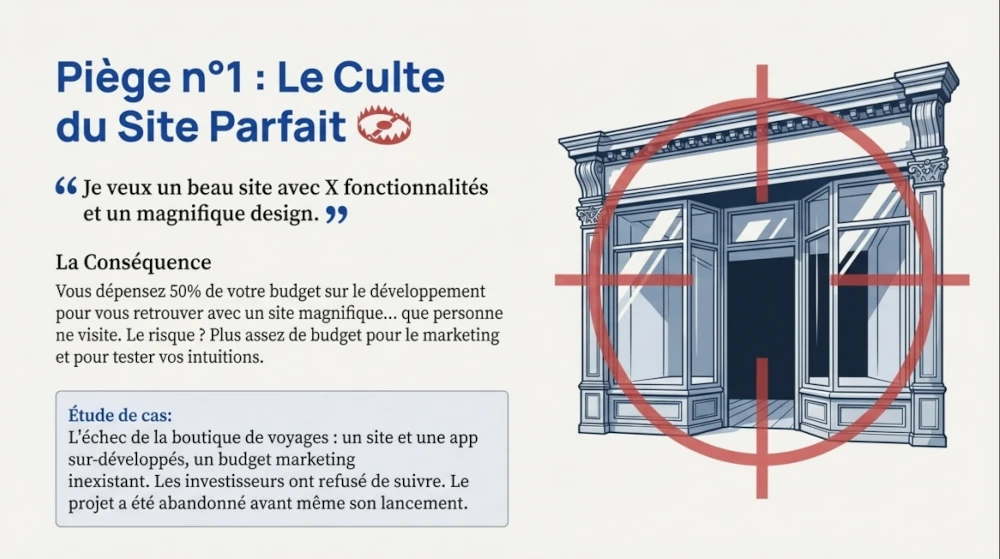
I often hear the following phrase: "I want a beautiful site with X features and a stunning design".
That is a mistake, because you will pay dearly for features that may never be useful, or for a heavily graphical design whose UX is ineffective and fails to convert.
The major risk is running out of cash to promote your e-commerce store just as competition intensifies and requires substantial marketing investment. The danger is also being unable to test your assumptions in the market—and therefore being wrong while believing you are right.
Set realistic objectives
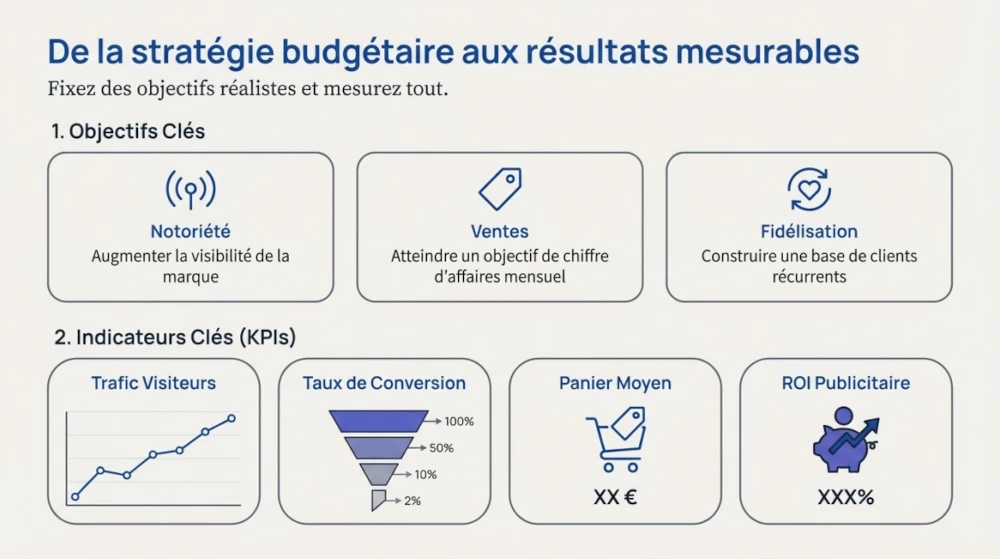
Once your budget is clearly defined and allocated, set realistic objectives aligned with your total envelope around three core actions:
- increasing brand awareness,
- reaching a target number of monthly sales,
- building loyalty among a target customer base.
Measure your progress using Key Performance Indicators (KPIs) such as website visitor traffic, conversion rate, average order value (AOV), and return on ad spend (ROAS / ROI). Adapt your strategy based on these metrics to achieve sustained growth.
Now, the first operational step you must take is building your website and ensuring its ongoing maintenance.

Stage 2: develop, test, and maintain your e-commerce platform
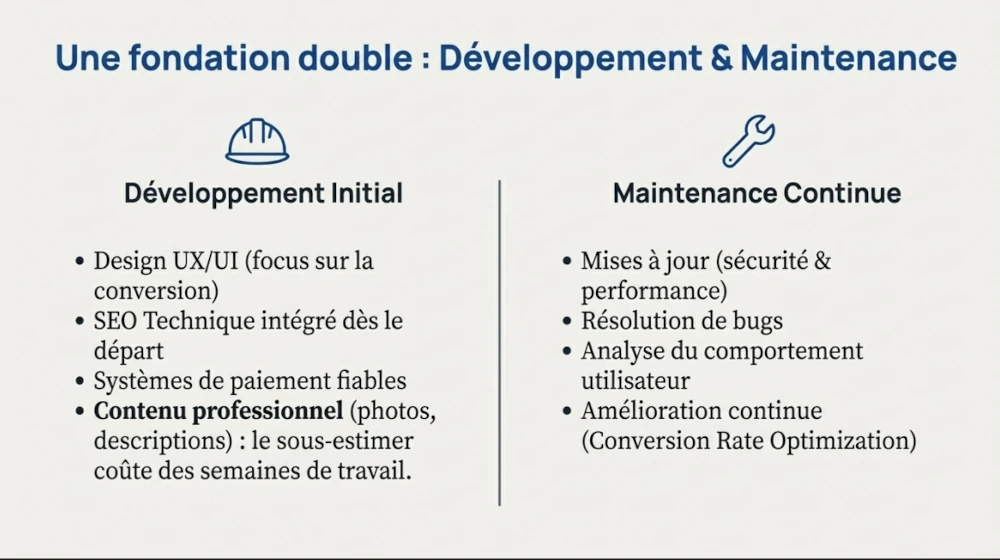
Website development and maintenance refer to two crucial phases in launching an e-commerce website.
Website development
This phase involves the initial creation of your online store. It includes website design (visual identity and user experience), technical development (coding, integrating content management systems such as Shopify or WooCommerce), setting up payment gateways, and search engine optimization (SEO). Note in passing that I integrate organic SEO right from the website development phase—not as an afterthought, as far too many entrepreneurs unfortunately do. Development also includes creating custom content, such as product descriptions, images, and videos. Regarding this last point, hire a professional: my experience shows that nine times out of ten, when a project owner tries to cut corners here, they lose many weeks by underestimating the importance and complexity of this task.
Website maintenance
Once the site is live, it requires regular maintenance. This includes updating software and security plugins, improving existing features, fixing bugs, updating content, and performing regular backups. Maintenance is crucial to ensure a smooth user experience, keep the online store secure, and strengthen SEO. It must also include traffic data analysis to understand user behavior and implement continuous improvements. Website maintenance is a vital pillar when launching your online store because it drives continuous optimization—essential for boosting visibility and, above all, conversion rates.
The budget for e-commerce website development and maintenance is therefore essential. It guarantees your online store's functionality, security, and appeal to customers while adapting to technological shifts and market trends.
Let us now examine the largest expense category: digital marketing, which will enable you to bring awareness and traffic to your online store.
Stage 3: deploy an ambitious multi-channel digital marketing strategy
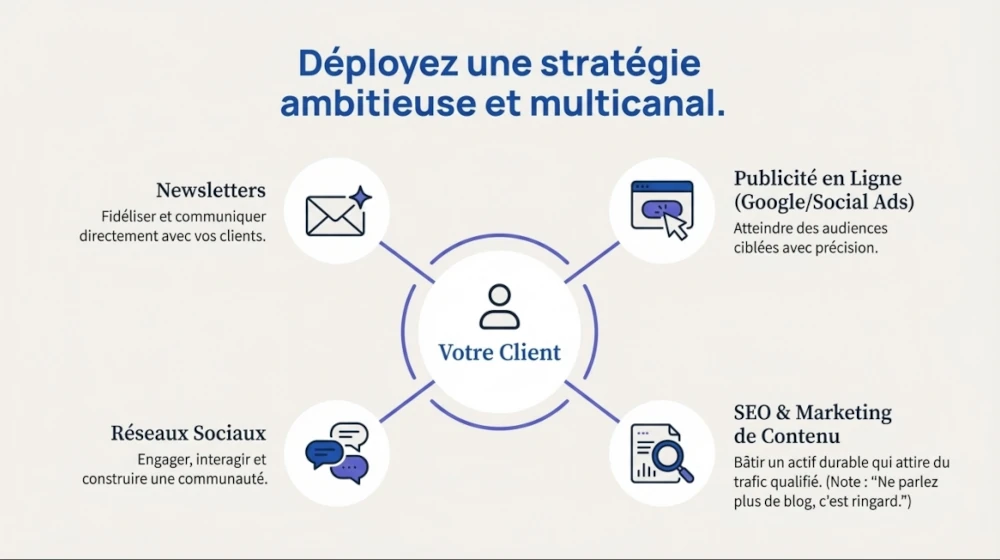
Digital marketing encompasses all the techniques and strategies used to promote your brand, product, or service online. Here are the key components to deploy.
Online advertising
Use advertising platforms such as Google Ads, Bing Ads, or Facebook Ads to run targeted ads. Your ads must be tailored to reach your specific audiences based on their interests, behaviors, or demographics. Note that AI marketing increasingly manages promotional campaigns autonomously.
Search Engine Optimization (SEO)
Optimize your website to improve its ranking in organic search results. This involves keyword optimization, producing high-quality content, improving page load speed, and earning backlinks. Warning! This channel is increasingly complex due to fierce competition. Contrary to popular belief"SEO is free traffic", it requires a substantial budget managed by a qualified professional.
Content marketing

Create and share relevant content. This can include articlesStop calling it a blog—that term is outdated., guides, e-books, and more. While indispensable, text alone is no longer enough. Produce multimedia content such as videos, infographics, podcasts, or interactive tools to attract and engage your buyer personas. Content must deliver genuine value to your prospective customers, strengthening brand awareness and loyalty. It requires growing budgets because even though tools like ChatGPT reduce unit production costs, your content must stand out as remarkable. Hire true professionals (graphic designers, UX designers, copywriters, etc.) to build and project your brand positively.
Social media marketing
Maintain an active presence on social platforms such as Facebook, Instagram, LinkedIn, X, or TikTok to engage with your audience, share your standout content, and promote your products and services. The more resources you invest in producing high-quality content, the more effectively you will communicate on social media. The goal is to be seen, heard, and remembered by your target audience. Standing out from the crowd also requires dedicated budget.
Newsletters
Sending personalized updates and promotions to your customers via newsletters remains a highly effective way to stay top of mind. Email works remarkably well provided you communicate clearly and transparently with your audience, ask what interests them (segmentation), and bring them genuine solutions. Prioritize informative content over aggressive sales pitches.
Data analytics and tracking
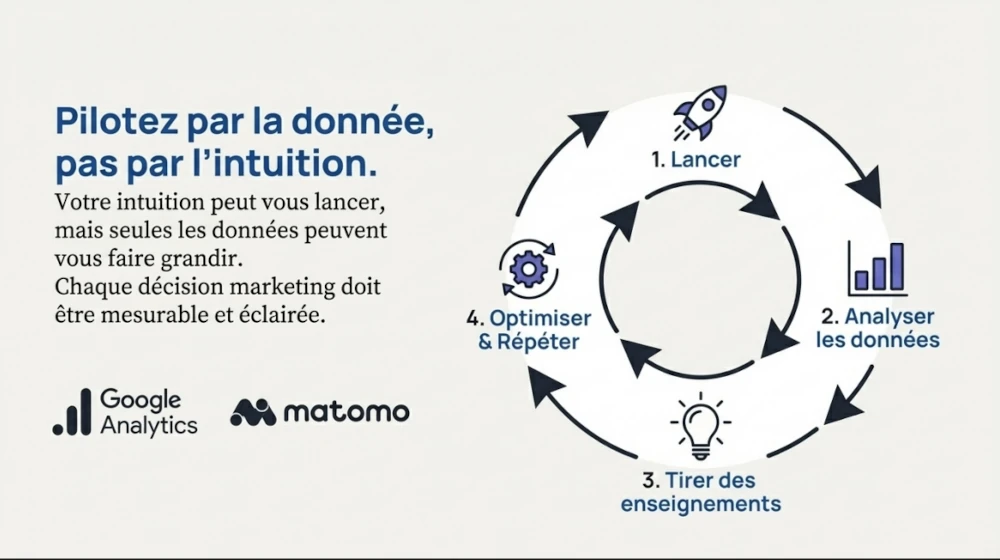
Use tools like Google Analytics or Matomo to track campaign performance, understand user behavior, and make informed decisions based on data analysis. This work spans the entire lifecycle of your online store and requires recruiting talent capable of extracting reliable, actionable insights from your data.
Digital marketing is essential to build your online presence, drive traffic to your e-commerce website, convert visitors into buyers, and retain customers. Allocating a substantial budget to digital marketing maximizes the reach and effectiveness of your promotional efforts.
In my view, this budget item is far too often neglected by entrepreneurs, who are then surprised when their great website or extraordinary app is barely used by customers. I strongly recommend capping the budget spent on building your website or app so you can preserve maximum capital for promotion. The success of your online store depends heavily on digital marketing.
Do not waste money building an overly original or complex website. Keep it simple, cost-effective, and efficient. Choose the right e-commerce platform, or risk inevitable failure.
Early in one of my own ventures, I spent too much money on a website I wanted to make visually stunning and packed with features. As a result, I lacked the financial resources to promote my e-commerce store. The consequence: I had to shut the site down a few months later.

Over thirteen years as a digital marketing manager and web project director, I have seen firsthand the root cause of failures and successes: a budget wasted on unnecessary development and a glaring lack of funds for promotion and advertising.
Consider yourself warned...
Let us now look at the third and final expense category to plan for when launching your online store.
Stage 4: master inventory management and daily operations
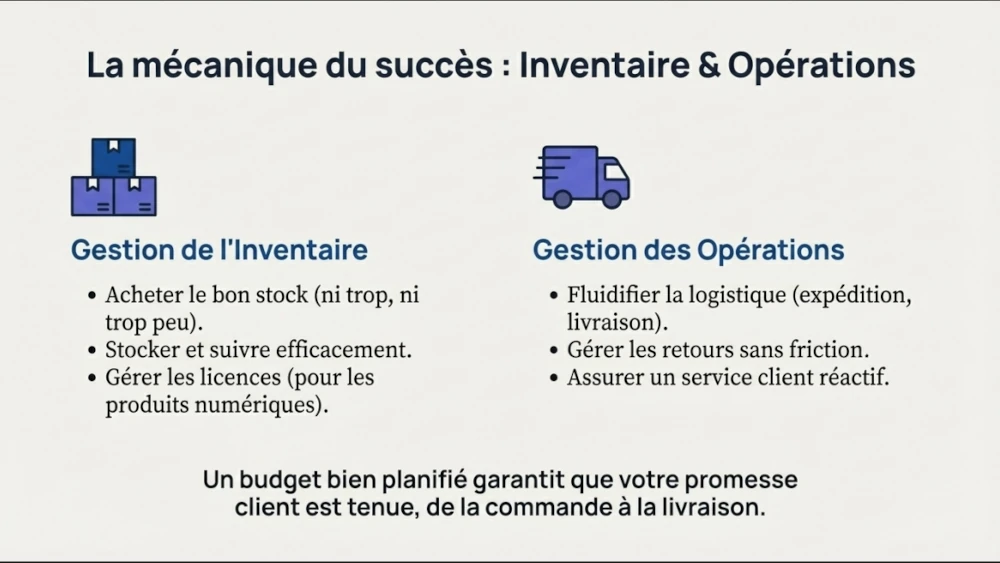
When speaking of inventory and operations, I am referring to two essential pillars of running an online store.
Inventory management
This covers the products you sell. Managing inventory involves purchasing stock (if you sell physical goods), warehousing those products, and tracking their availability. For digital services or products—intangible by nature—this involves server maintenance or software license management.
The budget allocation for inventory must cover these costs and ensure you hold enough stock to meet demand without over-investing in slow-moving inventory that ties up working capital.
Operations management
This term encompasses all daily activities required to keep your online store running. It includes logistics (such as order fulfillment, shipping, and delivery), returns and exchanges management, customer service, and payment processing. Operations also include order management and accounting.
Balancing investment between inventory and operations is crucial yet complex. A well-planned budget ensures both areas are sufficiently funded so your business runs smoothly and efficiently.
Strategic conclusions: ensuring long-term profitability
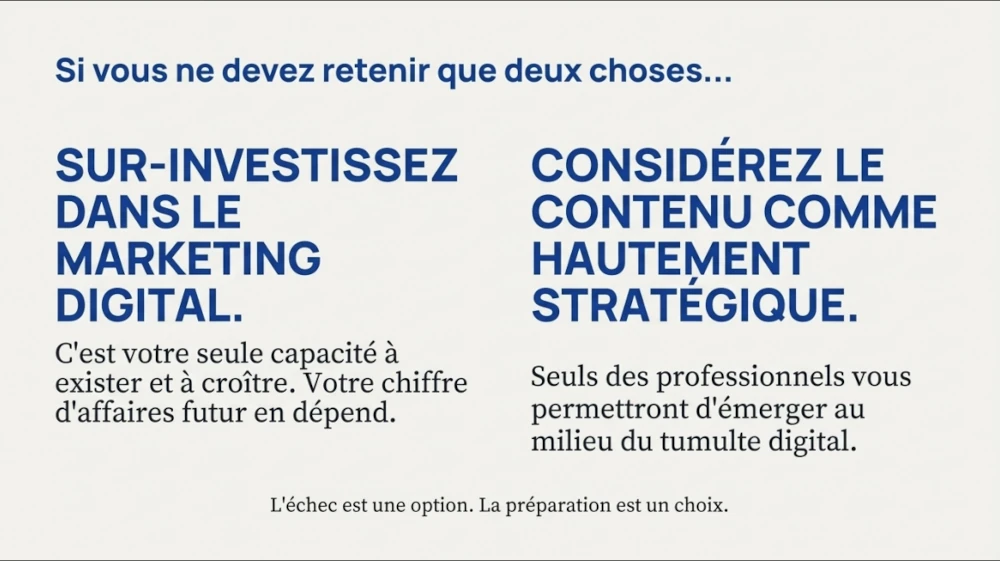
Successfully launching your online store is ultimately a matter of execution. If you execute all the steps outlined in this article, your e-commerce store has a very high probability of succeeding. However, if any one of these pillars is neglected or misjudged, failure may await at the end of the journey.
I would like to close this article with two points that I consider paramount:
- Invest heavily in digital marketing—meaning your ability to make your store known to the widest qualified audience long enough for revenue to fund reinvestment.
- Treat content as highly strategic: hire skilled professionals who will help you stand out amidst information overload and digital noise.
FAQ
Setting clear objectives and budgets, developing and maintaining the website, deploying an ambitious digital marketing strategy, and effectively managing inventory and daily operations.
An effective allocation is 20% for website development and maintenance, 50% for digital marketing, and 30% for inventory and daily operations.
Over-investing in development drains the funds available for digital marketing, which is essential to attract customers. For example, an online travel store project failed before launch because too much capital was planned for custom features and design rather than marketing.
The risk is wasting money on unnecessary features or a graphic design that fails to convert, starving the business of the financial resources needed to promote and market the store.
Increasing brand awareness, achieving a target volume of monthly sales, and building loyalty within a defined target audience.
Online advertising (SEA/social ads), search engine optimization (SEO), content marketing, social media marketing, email newsletters, and data analytics and tracking.
High-quality content is essential to attract and engage customers, improve organic search rankings (SEO), and establish lasting brand credibility.
It ensures you have enough products on hand to meet customer demand without tying up excessive capital in slow-moving stock, which is vital for operational and financial efficiency.
It encompasses logistics (order fulfillment, shipping, and delivery), returns and exchanges, customer service, payment processing, order tracking, and accounting.
Disciplined budget allocation—prioritizing digital marketing (50%) and strategic content creation—is the decisive factor in achieving long-term e-commerce success.

About the author:
Thierry P. Gaillard - End-to-end digital project management
After working at American Express for 15 years—including six years as an IT project manager and eight years as director of a 100-person profit center—Thierry P. Gaillard became a web entrepreneur, digital marketing manager, and e-commerce specialist.
His areas of expertise include web performance, branding, commercial negotiation, and management.