
Use the decoy effect to boost digital marketing revenue by 42.8%

As an entrepreneur or marketing director, setting the optimal price for your products or services is one of your greatest challenges: you must safeguard margins while attracting buyers.
Furthermore, you must remain competitive against rivals and market substitutes.
In this guide, discover how to structure your pricing tiers and increase revenue by 42.8% by deploying the decoy effect to sell more premium offerings.
Finally, we explore ethical boundaries to prevent manipulative practices and ensure sustainable customer trust.
 Author: Thierry P. Gaillard - -
Definition of the decoy effect (asymmetric dominance principle)
The decoy effect—also known as the "Attraction Effect" or "Asymmetric Dominance Effect (ADE)"—is a psychological phenomenon observed in marketing and behavioral economics. This factor has been demonstrated experimentally on numerous occasions.
It occurs when introducing a third option (the decoy) into a binary choiceA choice involving only two possible options (e.g., yes/no). alters how the other two options are perceived and thereby influences the individual's decision.
The decoy is deliberately designed to be clearly inferior to one of the options (the target), making that target option look significantly more attractive and increasing its probability of being chosen.

Detailed psychological mechanics: how decoys alter perceived value
The decoy effect was first theorized in 1982 by Joel Huber, John W. Payne, and Christopher Puto in a landmark scientific paper published in The Journal of Consumer Research.
The decoy effect relies on the principle of choice relativity, asymmetric dominance, and the way we evaluate the value of things. This means that as individuals, we tend to evaluate the options presented to us not in absolute terms, but by comparing them against one another.
In practical terms, when a brand offers two possible options for a product or service, adding a third alternative can significantly increase the probability of customers choosing the option that dominates it.
The decoy is an option that, while less appealing overall, shares common attributes with the other two choices. The decoy is clearly inferior to one of the options (the target), yet comparable in value to the other (the competitor). By comparison, this makes the target option look far more attractive.
The attraction effect has been replicated multiple times across consumer research studies (Huber & Puto, 1983; Simonson, 1989; Park & Kim, 2005; Malkoc et al., 2013), experimental economics (Herne, 1999; Sonsino, 2010; Kroll & Vogt, 2012), and cognitive psychology (Trueblood et al., 2013).
Originally studied within marketing research, it has even sparked breakthroughs across other scientific disciplines (Huber et al., 2014).
Mastering the decoy effect: Dan Ariely's landmark 'The Economist' experiment
In his bestselling book Predictably Irrational: The Hidden Forces That Shape Our Decisions, Dan Ariely, Professor of Psychology and Behavioral Economics at Duke University, cites a real-world subscription offer from The Economist to illustrate the decoy effect.
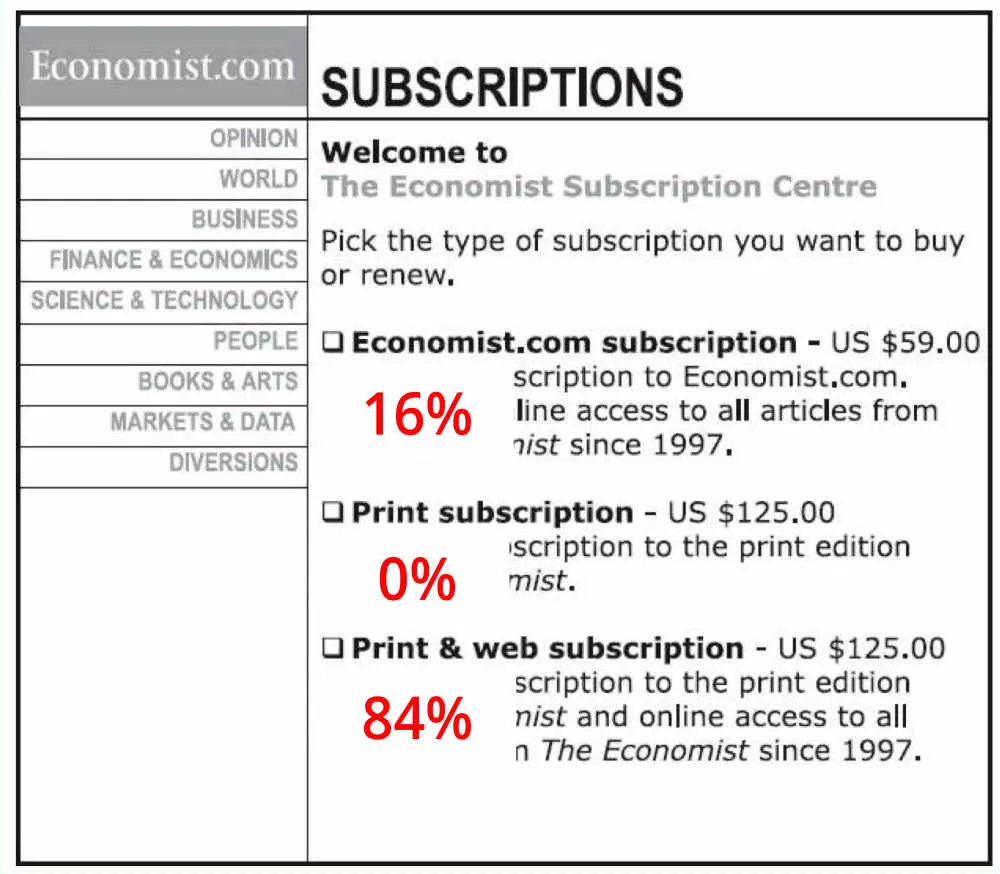
Print-only subscription = print + digital subscription
Dan Ariely wondered why The Economist offered a "Print-only" subscription at the exact same price as its "Print + Digital" bundle.
He conducted an experiment with his MIT students, asking them to choose one of the three subscription options. Here are the results he obtained:
- 16% chose the Digital-only subscription ($59).
- 0% chose the Print-only subscription ($125).
- 84% chose the Print + Digital subscription ($125).
The results were unequivocal! The decoy offer—the Print-only subscription—steered the overwhelming majority of students toward the target offer: "Print + Digital."
Two subscriptions instead of three
To test his hypothesis, Dan Ariely presented the same offer to a second group of students, this time removing the "Print-only" option that nobody in the first group had selected.
Here are the results he obtained:
- 68% chose the Digital-only subscription ($59).
- 32% chose the Print + Digital subscription ($125).
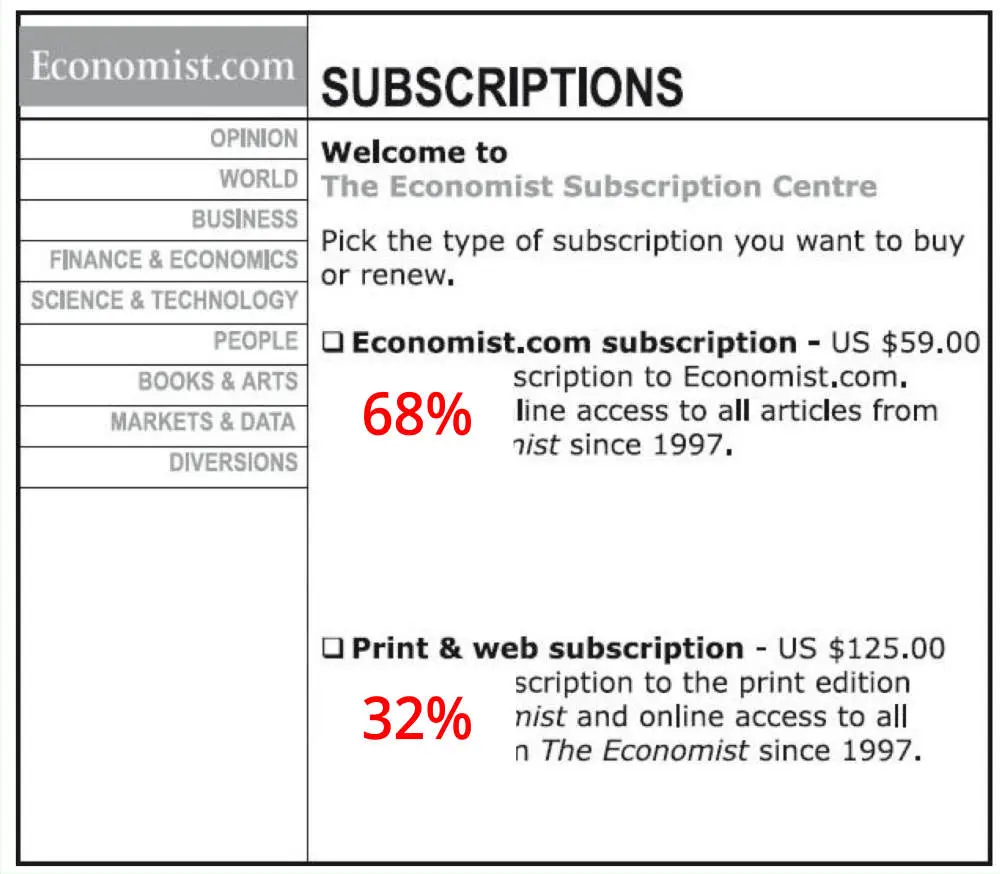
Removing the "Print-only" decoy caused a dramatic drop in selections of the "Print + Digital" subscription.
Ultimately, the presence of the decoy increased total revenue by 42.8%.
Case study: how Netflix and modern streaming services structure tiers
At the time of writing this article, Netflix offered three different subscription tiers on its pricing page:
- Standard with ads: €5.99 per month.
- Standard: €13.49 per month.
- Premium: €19.99 per month.
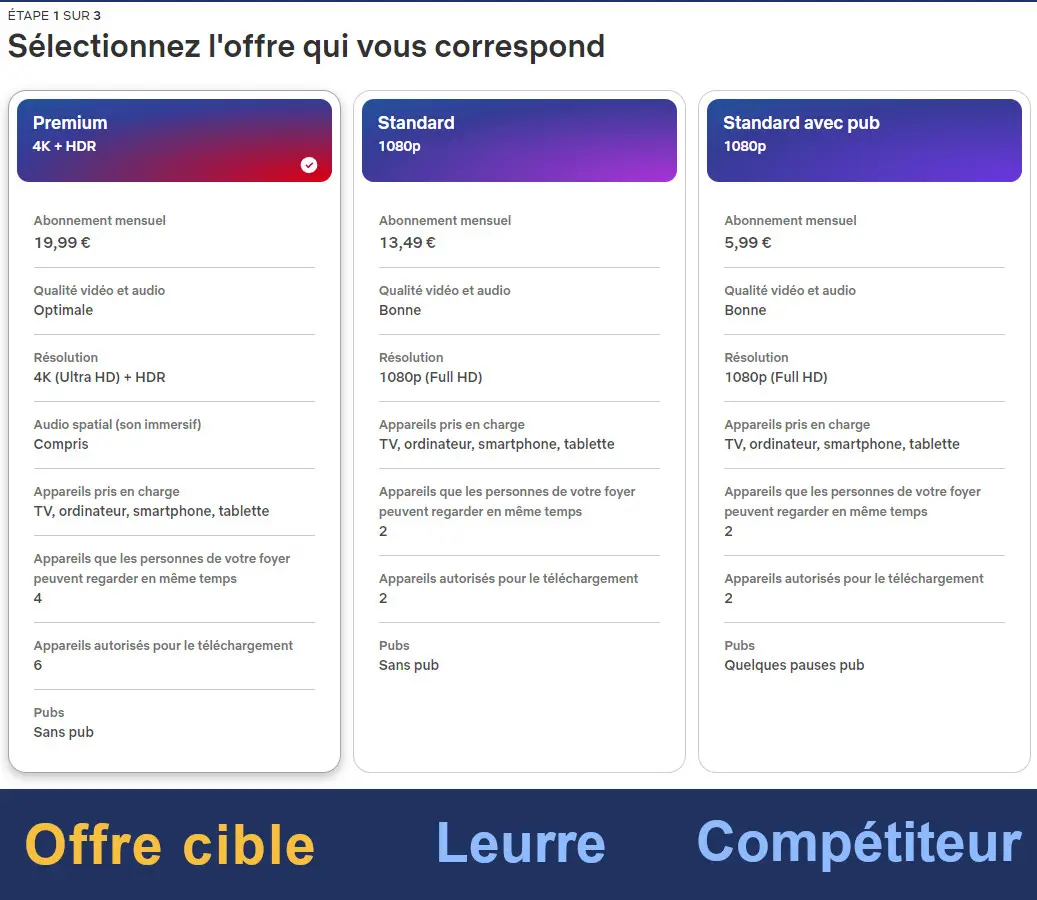
We can clearly see that the Premium plan at €19.99 per month is the target offer, highlighted with a more prominent purple-and-red banner than the other two. Its position on the left is also the first one Western readers scan, establishing the initial anchoring bias.
The Standard plan acts as a decoy because, for a price only slightly lower than the Premium plan, it delivers significantly lower quality:
- No 4K (Ultra HD) + HDR resolution, which makes a dramatic visual difference.
- No top-tier video and audio quality.
- No spatial audio (immersive sound).
- Only two household members can stream simultaneously, compared to four on the Premium plan.
- Only two devices allowed for offline downloads, compared to six on the Premium plan.
Viewers who have invested in a 4K television will naturally want to make the most of it by subscribing to the Premium plan—only slightly more expensive than the Standard plan—to enjoy a near-cinema experience at home.
The Standard plan also serves as a decoy because it offers the exact same viewing resolution and simultaneous stream limits as the Standard with ads plan, with the sole exception of offline downloads and ad-free playback, which alone rarely justify more than doubling the monthly price.
The Standard with ads plan represents the competitor option—designed to compete directly on price against rivals like Disney+ at €8.99 per month or Amazon Prime Video at €6.99 per month.
Through these three pricing tiers, Netflix strategically positions itself to sell "Standard with ads" plans to budget-conscious customers and "Premium" plans to viewers seeking a high-end experience. The positioning of the three offers is textbook!
Ethical guidelines & implementation best practices for marketers
The decoy effect is a powerful tool in marketing and behavioral economics. It leverages our natural tendency to evaluate options relatively rather than in absolute terms. However, using the decoy effect must remain ethical and transparent.
Your business should avoid unfairly manipulating consumer choices and ensure that all options are presented clearly and honestly.
Ultimately, the decoy effect can guide consumers toward choices that bring them greater satisfaction while contributing to the commercial success of your business.
References & further reading
- Jstor.org - Adding Asymmetrically Dominated Alternatives: Violations of Regularity and the Similarity Hypothesis - Published by Oxford University Press in June 1982.
- Dan Ariely - Pricing The Economist.
- Dan Ariely - Are we in control of our own decisions?
- Sciencedirect.com - A monetary measure of the strength and robustness of the attraction effect.

About the author:
Thierry P. Gaillard - End-to-end digital project management
After working at American Express for 15 years—including six years as an IT project manager and eight years as a profit center director leading around a hundred people—Thierry P. Gaillard became a web entrepreneur, digital marketing manager, and e-commerce specialist.
His specialties include web performance, branding, business negotiation, and management.