
Book review: nudge – improving decisions about health, wealth, and happiness
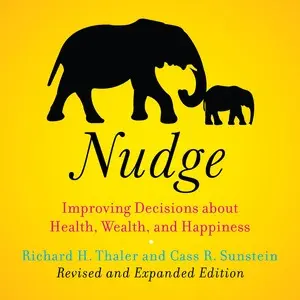
Awarded the Nobel Prize in Economic Sciences in 2017, Richard H. Thaler co-authored with Harvard law professor Cass R. Sunstein a revolutionary book that transformed modern governance and marketing: 'Nudge'.
By establishing the discipline of choice architecture and libertarian paternalism, the authors prove that subtle, zero-cost modifications to the environment can guide individuals toward better decisions without ever restricting their freedom of choice.
 Author: Thierry P. Gaillard -
Nudge: how choice architecture drives better decisions in digital marketing
Vuibert Editions - 2010 - 228 pages - €25
Richard H. Thaler, one of the book's authors, was awarded the 2017 Nobel Prize in Economic Sciences in recognition of his experimental work on nudges. This concept reflects deep practical wisdom because it accepts human beings for what they truly are: imperfect individuals who occasionally need guidance. Not to be confused with Econs—those hypothetical, hyper-rational beings who supposedly always act with flawless perfection.
The nudge philosophy sits squarely between laissez-faire thinkers—who assume free individuals systematically make optimal decisions backed by complete knowledge of the problem—and hardline interventionists, who believe everything must be regulated because most individuals are unwilling victims of the system.
It combines the notion of freedom with paternalism—specifically, the desire to positively influence people's choices by helping them make decisions aligned with their own best interests rather than against their will. It is our cognitive biases, now extensively documented by neuroscience, that influence our actions—sometimes negatively. Here are several key examples:
- Loss aversion: we strongly prefer keeping what we already have rather than taking risks.
- Status quo bias: we naturally dislike making active decisions or changing our current state.
- Availability heuristic: we judge the likelihood and severity of a risk based on recent, memorable events rather than older ones because they exert a stronger emotional impact on our behavior.
- Dominance of the automatic system: we frequently give in to immediate impulses rather than engaging our reflective, rational system to act more thoughtfully.
- Social mimicry (herd behavior): we like doing what most other people approve of doing, partly because we know others are watching us.
- Spotlight effect: we tend to overestimate how closely other people pay attention to us. Consequently, we feel pressured to conform to what we believe others think of us.
- Mere-measurement effect (suggestion): simply asking people when and how they intend to do something significantly increases the probability that they will actually follow through.
However, these biases overwhelmingly foster inertia. And inertia leads either to inaction or to poor decision-making. As libertarian paternalists, the authors encourage choice architects to help us make wiser, easier, and faster choices while fully preserving our absolute freedom to choose otherwise.
Choice architecture encompasses several core mechanisms:
- Default options: particularly effective when people face complex, infrequent decisions—such as buying a home, choosing a university, or calculating future retirement savings. The default option is designed to serve as the best choice for those who do not actively choose—which means a very large proportion of users. Crucially, it requires that users retain the ability to opt out or revert at any moment, effortlessly, without disrupting their automatic cognitive system;
- Expecting error: because humans are naturally prone to mistakes, well-designed choice architecture anticipates and prevents them. Different nozzle sizes at gas stations depending on the fuel type selected are a classic everyday illustration;
- Giving feedback: it is essential that users can immediately see when they are doing well or making a mistake in real time—such as the instant preview screen and shutter sound on a digital camera;
- Understanding mappings (providing benchmarks): a good choice system helps people translate technical options into relatable real-world outcomes so they can make better decisions. For instance, 3D architectural rendering software helps buyers visualize the final result far better than flat blueprints;
- Structuring complex choices: the more complex a choice becomes, the higher the risk of error. A skilled choice architect prioritizes a clear, simplified filtering structure over an exhausting, unorganized catalog to help customers avoid mistakes;
- Incentives: how options and incentives are framed directly shapes our behavior. The authors cite the example of a school cafeteria where simply rearranging how fruits and vegetables were displayed on the counter triggered a major shift in consumption (+25%).
The book also offers valuable strategic avenues for businesses looking to elevate their marketing. Companies should nudge users toward making the right choice by rigorously ensuring they offer the right product or service to the right customer. To achieve this, organizations must ask themselves four fundamental questions before designing their offer:
- Who uses it?
- Who chooses it?
- Who pays for it?
- Who profits from it?
Nudges are universal. They apply across countless areas of everyday life: mortgages and financial credit, health insurance, retirement savings, organ donation, climate change mitigation, and digital interfaces. The book also addresses critics who denounce nudges as an elaborate form of manipulation. According to the authors, nothing could be further from the truth: nudges merely help people make better choices without restricting their freedom—at any time, users remain completely free to opt out or choose differently with a single click.
In the business world, studying behavioral nudges should be a systematic prerequisite before launching any new digital service or product offering, because nudges respect individual free will and empower users without coercion or forced choices.
It is also an outstanding way to differentiate your brand from competitors by delivering genuine, measurable added value to your customers.
I wholeheartedly recommend a careful reading of this foundational book to put its principles into practice.


About the author:
Thierry P. Gaillard - End-to-end digital project management
After working at American Express for 15 years—including six years as an IT Project Manager and eight years as Director of a 100-person profit center—Thierry P. Gaillard became a web entrepreneur, digital marketing manager, and e-commerce specialist.
His areas of expertise include web performance, branding, commercial negotiation, and management.