Landscape of travel industry key players
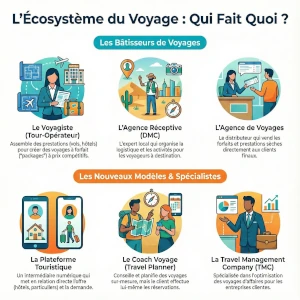
Across the expansive and dynamic travel sector, an interconnected array of professionals shape every step of the traveler experience worldwide. From early inspiration and booking to on-the-ground execution, incoming agencies, tour operators, and digital travel platforms form a complex, interdependent ecosystem.
This comprehensive guide examines the primary business models, operating mechanisms, competitive frictions, and emerging opportunities redefining the tourism landscape.
 Author: Thierry P. Gaillard - -
1. Destination management companies (DMC / incoming agencies)
Known across the English-speaking world as Destination Management Companies (DMCs), incoming agencies operate exclusively on the receiving side of tourism flows. This activity is termed "incoming" because their primary mission is receiving, coordinating, and managing travelers once they reach a specific geographic destination.
DMCs are local producers and assemblers. Rooted on the ground, they negotiate directly with local hotels, transport providers, licensed guides, restaurateurs, and activity operators. By securing negotiated volume rates, preferential access, and seamless logistics, they design authentic excursions and secure flawless operational execution. They cater to two distinct segments:
- Originating travel agencies and outbound tour operators: DMCs handle requests for proposals (RFPs), greet clients upon arrival, supervise ground transport, and resolve emergencies on the ground.
- Independent in-destination travelers: Individual tourists looking to book high-value day tours, authentic local workshops, and curated small-group excursions during their stay.
2. Tour operators (wholesale vacation packagers)
Tour operators are the wholesale manufacturers of the tourism economy. Their business model rests upon two foundational pillars:
- Assembling distinct travel components (such as charter flights, airport transfers, hotel accommodations, and guided itineraries) into an all-inclusive single product sold at an aggregated price point, known as a "Package" or vacation package. Tour operators contract with airlines, hotel chains, bus operators, and incoming DMCs across the globe.
- Securing massive wholesale discounts by committing to large inventory volumes (hotel room allotments, guaranteed aircraft seats, private cruises) up to 12 or 18 months ahead of the season.
By purchasing massive inventories well in advance, tour operators unlock price concessions inaccessible to individual consumers. This enables them to offer packages substantially cheaper than self-assembled components, while capturing a healthy gross margin. This dynamic creates a mutually beneficial cycle:
- The supplier secures guaranteed baseline occupancy months before departure.
- The traveler benefits from packaged pricing and consumer protection regulations.
- The tour operator produces an optimized product with compelling value-for-money.
However, this model carries considerable inventory risk. If market demand shifts or geopolitical disruptions occur, unsold committed seats and hotel allotments remain payable. Large operators frequently charter full aircraft or enter long-term leases on resort properties (such as all-inclusive holiday villages and club concepts). Historically distributed solely through retail travel agencies, tour operators increasingly sell directly to the public online via dynamic packaging systems.
3. Cruise operators: from mass tourism to luxury yachting
Cruise lines represent a hybrid powerhouse within modern tourism: bridging maritime transport and all-inclusive hospitality. Rather than merely selling transportation from point A to point B, they design self-contained "floating destination" experiences. Through vertical integration, the ship itself becomes the destination, while port calls frequently act as secondary visual backdrops. The global market is divided into two contrasting strategic paradigms.
1. The mass-market volume industry
Operated by global conglomerates deploying mega-ships carrying 4,000 to 7,000 passengers, these floating resorts drive profitability through standardization and economies of scale. Once aboard, captive guests encounter an extensive ecosystem of ancillary revenue streams (casinos, specialty restaurants, premium wellness spas, branded retail arcades). Leading mass operators include:
Royal Caribbean International
The archetype of architectural gigantism. Known for its Icon and Oasis class ships, Royal Caribbean constructs floating entertainment complexes complete with surf simulators, multi-deck waterslides, and ice skating rinks aimed squarely at multi-generational family vacations.
Carnival Cruise Line
Positioned as the "Fun Ships" brand, Carnival targets budget-conscious travelers and families with aggressive price points and high-energy on-board entertainment, emphasizing short Caribbean getaways.
MSC Cruises
A privately held Swiss-Italian giant, MSC Cruises represents the European approach to large-scale cruising, boasting one of the world's most modern fleets with elegant design aesthetics and multi-lingual passenger experiences.
Costa Cruises
A European subsidiary of Carnival Corporation, Costa Cruises remains a traditional household name in the Mediterranean, offering mass-market standardized leisure.
2. The tailor-made & expedition segment
In stark contrast, boutique yachting and polar expedition operators cater to affluent travelers seeking quiet sophistication and rare itineraries. Navigating smaller vessels and expedition catamarans, they access pristine ports and remote polar regions inaccessible to large ocean liners. Value is created through itinerary exclusivity and personalized service:
Ponant
The international benchmark for French luxury polar exploration. Operating cutting-edge icebreakers such as Le Commandant Charcot, Ponant reaches remote Arctic and Antarctic waters paired with gastronomic dining and naturalist lecture series.
The Ritz-Carlton Yacht Collection
A prominent example of a five-star hospitality brand expanding to the sea, offering customized super-yacht residential suites, private terraces, and an intimate club atmosphere.
Star Clippers
A specialized operator of traditional tall sailing ships (clipper vessels), delivering romantic, wind-driven seafaring far removed from conventional mega-liner crowds.
Seabourn and Silversea
Ultra-luxury all-suite lines (Seabourn under Carnival; Silversea under Royal Caribbean) providing dedicated butler service and navigating upriver waterways directly into urban centers such as the Thames in London.
4. Private lifestyle & travel concierges
Operating both within five-star luxury hotels and as independent lifestyle management agencies, private concierges provide hyper-personalized assistance for high-net-worth clients during travel and daily life.
Their primary asset is an intimate network of local relationships and cultural expertise, allowing them to secure sold-out restaurant tables, private after-hours museum tours, and bespoke private aviation charters that cannot be booked through conventional channels.
Available 24/7 with strict non-disclosure standards, they act as indispensable partners for travelers seeking seamless off-the-beaten-path experiences.
5. Travel agencies: traditional retail networks vs. OTAs
The travel agency functions as the distribution interface connecting worldwide supply with local consumer demand. Unlike incoming agencies that receive inbound tourists, retail agencies specialize in outbound ("outgoing") travel. Today, this sector is split between two distinct paradigms: physical brick-and-mortar storefronts selling human empathy and trust, and Online Travel Agencies (OTAs) operating automated platforms with razor-thin unit margins on vast search volumes.
Decades ago, agencies relied on passive intermédiation: point-to-point ticketing (airline or rail tickets) and packaged catalog tours distributed on a commission basis. When Internet connectivity allowed airlines and hotel chains to sell directly to consumers ("disintermediation"), traditional storefronts were forced to reinvent their value proposition.
Today's successful agencies practice high-value re-intermediation: adopting dynamic packaging tools and contracting directly with local DMCs to design custom itineraries. Rather than passive clerks, agents now operate as "Travel Designers," justifying advisory service fees through deep expertise and risk management.
1. Physical storefront networks
Maintaining high-street presence, these networks rely on personal relationships to serve complex multi-destination itineraries or corporate accounts:
Havas Voyages
A flagship French retail distribution network operating a phygital model that combines retail boutiques with corporate travel management tools.
Selectour
A leading voluntary cooperative network bringing together independent travel agencies under a shared purchasing group to negotiate collective commercial agreements with airlines and tour operators.
2. Online travel agencies (OTAs)
OTAs are technology and data platforms first, and travel distributors second. Profitability hinges on algorithmic yield optimization, organic search capture, and programmatic advertising:
Booking.com (Booking Holdings)
The global titan of hotel distribution. Rather than owning rooms, Booking.com provides an exhaustive marketplace connecting global demand with instant availability, supported by frictionless conversion funnels.
Expedia Group
Positioned as the comprehensive travel supermarket, Expedia aggregates flights, accommodations, car rentals, and in-destination activities across a portfolio including Hotels.com and Vrbo, maximizing profitability through cross-selling.
6. Travel coaches & independent travel planners
The profession of Travel Planner or travel coach is a recent development enabled by remote digital tools and changing consumer attitudes. Their business model is distinct from regulated travel agents:
- Independent consumers: Travel planners charge a flat consultation or research fee to craft a completely bespoke day-by-day itinerary with verified links. The consumer books the components directly, eliminating commission markups but requiring travelers to bear direct cancellation responsibility.
- Agencies and operators: Acting as specialized destination experts and freelance business developers for agency networks needing niche regional intelligence.
7. Digital tourism platforms & two-sided marketplaces
Digital tourism marketplaces epitomize the platform economy. Operating as two-sided algorithmic networks connecting fragmented local supply with global consumer demand, platforms possess negligible tangible assets: Airbnb does not own real estate, and Uber owns no vehicle fleet.
Their dominance is anchored in five core structural assets:
- Long-tail catalog breadth: Aggregating millions of niche lodging and experiential choices.
- Transactional commission model: Collecting transactional percentages unburdened by service production overhead.
- Operational disintermediation: Hosts manage listings and pricing directly, shielding the platform from conventional tour operator liability.
- Reputation infrastructure: Verified peer review mechanisms replacing traditional star classifications.
- Technological scalability: Automated transaction processing at near-zero marginal cost.
GetYourGuide
Based in Berlin, GetYourGuide organized the previously fragmented market for local museum admissions, guided walks, and outdoor adventures, introducing real-time mobile ticketing and structured quality benchmarks.
BlaBlaCar
A global leader in long-distance carpooling, BlaBlaCar monetizes spare passenger seats in private vehicles, creating a dense regional transport network governed by mutual driver-passenger trust frameworks.
8. Travel management companies (TMCs) & corporate travel
A term popularized in the 2000s by American Express Business Travel, Travel Management Companies (TMCs) specialize exclusively in business travel management for multinational corporations and institutions. Operating through regional corporate travel centers rather than street-level shops, TMCs provide critical B2B capabilities:
- Deploying Self-Booking Tools (SBTs) allowing corporate travelers to reserve policy-compliant flights, hotels, and rail within established company spend caps.
- Providing advanced BI & spend analytics enabling procurement executives to audit corporate policy compliance and travel budgets.
- Leveraging aggregated corporate spend to negotiate substantial rate concessions with airlines and global hotel chains.
- Ensuring Duty of Care and traveler security through round-the-clock emergency crisis response and real-time employee geolocating during geopolitical or natural disasters.
Industry leaders in B2B travel:
American Express Global Business Travel (Amex GBT)
The global leader managing tens of billions in annual transaction volume. Amex GBT delivers unrivaled corporate negotiating leverage and enterprise-grade 24/7 security monitoring.
BCD Travel
A major privately held Dutch TMC, BCD Travel is renowned for data consolidation across disparate corporate ERPs and strategic management consulting through its Advito advisory division.
Navan (formerly TripActions)
A Silicon Valley disruptor, Navan pioneered the integration of travel booking and automated corporate expense management with intuitive consumer-grade UI.