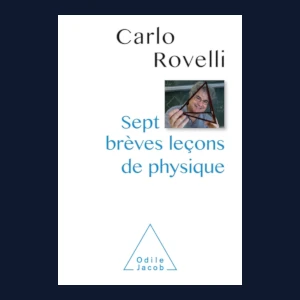
Seven brief lessons on physics by Carlo Rovelli
It was Emma, my twelve-year-old daughter, who suggested purchasing "Seven Brief Lessons on Physics" by Carlo Rovelli because she is fascinated by the discipline. I chose this volume because it was brief and I did not want to discourage her curiosity. In the end, she loved it—and so did I!
 Author: Thierry P. Gaillard -
Seven brief lessons on physics
Author: Carlo Rovelli - Éditions Odile Jacob - 2015 - 96 pages - €9.90
This work explains major physical phenomena in a clear, accessible manner without getting bogged down in intricate equations. Moreover, it demonstrates an authentic poetic elegance. For those whose curiosity is sparked, delving into further reading will be a natural next step.
The first lesson by Carlo Rovelli, research director at CNRS and professor at Aix-Marseille University, explores Einstein's theory of general relativity—"the most beautiful of theories"—which revolutionized our vision of space, gravitation, and time itself, revealing that time as intuitively perceived by humans does not exist.
The second lesson delves into quanta. Quanta are discrete "packets of energy." For instance, light is not an unbroken wave, but a continuous stream of photons—small packets of radiant energy, or quanta.
The third lesson traces the milestones of human cosmology, from ancient ages when humanity knew only the Earth and sky, up through the 1930s when astronomers realized our solar system was part of a galaxy, the Milky Way. Along the way, Anaximander deduced that the Earth was surrounded entirely by space, Aristotle first demonstrated the spherical nature of Earth, and Copernicus revealed that Earth orbited the Sun.
I especially enjoyed the fourth lesson, entitled "Grains of Space," because it proves that our instinctive impression of empty vacuum is false: space is vibrating with particles known as quarks, gluons, electrons, neutrinos, and more. The existence and movements of these poetic particles are governed by quantum physics. The entirety of nature emerges from these fundamental building blocks.
I also deeply connected with the seventh and final lesson, presented by the author himself, contemplating the nature of consciousness, free will, and our relationship with nature. What is humanity's place in a universe governed by quantum mechanics? These physical phenomena continually challenge human common sense and initial intuition, as authentic science so often does.
Ultimately, each brief lesson provides the reader with an invitation to pause, set the book aside, and let one's mind wander among the universe's most wondrous mysteries. A pure moment of poetic wonder...